

Basic compliance starts by turning real workplace tasks into controls, responsibilities and evidence.
Basic health and safety compliance should not feel like building an aircraft before your business is allowed to take off. Most employers who ask for "basic compliance" are not asking to avoid responsibility. They are asking for a clear starting point: What must we do first, who must do it and how do we keep it under control?
Start with the work your people actually do. Identify the hazards. Decide on the controls. Give the work to responsible people. Keep evidence. Check that it is happening. Improve what is not working.
That is the practical thinking behind the SafetyWallet platform: make compliance visible, manageable and part of normal work.
Take management ownership. List the work and people involved. Assess the risks in each task. Select and implement control measures. Put the right Policies, Procedures and Practices in place. Appoint responsible people. Inform and train employees. Schedule registers and inspections. Record incidents and close corrective actions. Monitor, observe and improve.
These steps create a practical starting cycle for basic health and safety compliance. They are not a universal legal checklist. The detailed requirements will depend on your industry, number of employees, tasks, equipment, substances, contractors, premises and applicable legislation.
Simple Does Not Mean Superficial
South Africa's Occupational Health and Safety Act places the responsibility on the employer to provide and maintain, as far as reasonably practicable, a working environment that is safe and without risk to employees' health. It also connects this duty to identifying hazards, taking precautionary measures, supplying the necessary means, and providing information, instruction, training and supervision.
"Basic" cannot mean downloading a few templates, putting them in a file and declaring the business compliant. It means starting with a simple structure that can grow with your workplace.
For a practical overview of the wider South African requirements, use SafetyWallet's guide to health and safety compliance in South Africa.
Step 1: Take Management Ownership
Start with one clear management decision: health and safety is a business responsibility.
The owner, CEO or senior manager does not need to perform every safety activity. However, management must make sure that the right people, time, authority and resources are available. A safety representative, consultant or Triple P Champion can coordinate and support the process, but the employer's accountability cannot simply be handed over.
- Name the accountable manager.
- Name the person who will coordinate day-to-day activities.
- Decide which branch, site or work area is included.
- Set a first review date.
Step 2: List the Work and the People Involved
Do not start with a generic document list. Start with what happens in your business.
Create a task register by walking through each work area and listing routine and non-routine tasks. Include receiving stock, operating machinery, using ladders, loading vehicles, cleaning, maintenance, working with electricity or chemicals, office work, driving and contractor activities.
For each task, ask:
- Who performs it?
- Who else could be affected?
- What equipment, substances or energy sources are involved?
- Where and when is the work performed?
- What changes when the task is rushed, interrupted or performed after hours?
Step 3: Assess the Risks in Each Task
Now take one task at a time. Break it into sensible steps, identify the hazards, consider who may be harmed and evaluate the risk using the organisation's approved method.
For example, "working in a warehouse" is too broad. Receiving a delivery, reversing a forklift, unloading pallets, stacking stock and picking from a rack are different tasks with different hazards.
Good task-based risk assessments connect the real task to real controls. They should be completed with input from people who understand the work and reviewed when equipment, substances, layouts, people, incidents or work methods change.
No task without hazards. No hazard without a control decision. If a task is missing from the task register, its hazards and controls may also be missing.

If a task is missing from the task register, its hazards and controls may also be missing.
Step 4: Select and Implement Control Measures
A risk assessment is not the finish line. It tells you what needs to be controlled.
Start by asking whether the hazard can be eliminated. If it cannot, consider substitution, isolation or engineering controls before relying mainly on rules, training and personal protective equipment.
For a forklift risk, painting a walkway may help, but a physical barrier, a controlled crossing point, speed management, visibility controls and competent supervision may provide stronger protection when they are suitable for the site.
For every selected control, record:
- What exactly must be done?
- Who is responsible?
- Who is accountable for making it possible?
- By when must it be completed?
- What evidence will show it is in place?
- How will it be checked again?
Buying an item is not the same as implementing a control. The control must be available, suitable, used and checked in practice.

Stronger controls change the work environment instead of relying only on warnings and PPE.
Step 5: Put the Right Policies, Procedures and Practices in Place
This is where SafetyWallet's Triple P System keeps the paperwork connected to the workplace.
- Policies state management's commitment, direction and authority.
- Procedures explain how recurring health and safety processes will be managed.
- Practices are what people actually do while working. Task-specific safe operating procedures help guide those practices.
Do not print every policy and procedure you can find. Select what is applicable, customise it to the business, approve it through the right authority and connect it to the relevant risks and controls. A signed policy is important, but it is not proof that the requirement is working. It must lead to resources, responsibilities, training, registers, inspections and visible practice.
Step 6: Appoint Responsible People
Compliance becomes manageable when every activity has a name next to it.
Identify the statutory and operational roles that apply to your workplace. Depending on the business and legal requirements, this may include health and safety representatives, committee members, first aiders, fire or emergency roles, incident investigators, supervisors and people responsible for specific machinery or inspections.
Avoid copying a universal appointment pack. The required appointments must follow the size, activities and risks of the actual workplace. Each appointed person should know:
- What they are responsible for.
- What authority they have.
- What training or competence they need.
- What activities they must complete.
- How often activities are due.
- What evidence must be kept.
- When and to whom a problem must be escalated.
An appointment letter without understanding, time or follow-through is only a piece of paper.
Step 7: Inform and Train Employees
Employees cannot follow controls they do not know, understand or have the ability to apply.
Keep the training practical. Start with induction, the hazards connected to the person's work, the task-specific SOP, emergency arrangements, how to report unsafe conditions and the limits of their authority. Use toolbox talks and refresher learning to reinforce the controls that matter most.
SafetyWallet's health and safety eLearning can support structured knowledge development, but learning completion is not the same as competence. Supervisors must still check whether the person can apply the required controls in the workplace.
Step 8: Schedule Registers and Inspections
This is where many "basic compliance" systems fail. The documents exist, but no one remembers what must happen next Tuesday, next month or before a certificate expires.
A useful register does more than store a name or date. It connects requirement to responsible person, frequency, due date, evidence, verification and action.
Schedule the inspections and recurring activities required by your risks and applicable requirements. These may include workplace, first-aid box, fire equipment, ladder, PPE, vehicle, machinery, housekeeping or other task-specific checks.
OHS Online helps bring tasks, controls, registers, responsible people, due dates, inspections, evidence and actions into one digital system. But software gives visibility; visibility is not the same as control. Someone still has to perform the inspection, correct the defect and verify the result.

A register becomes useful when responsibility, dates, evidence, findings and actions stay connected.
Step 9: Record Incidents and Close Corrective Actions
When something goes wrong — or nearly goes wrong — record it quickly, protect people, preserve the relevant evidence and investigate to the level appropriate to the event.
Do not stop at "the employee was careless". Ask what happened to the system:
- Was the hazard identified?
- Was the control suitable and available?
- Was the SOP practical?
- Was the person informed, trained and supervised?
- Was equipment maintained?
- Had a previous warning or inspection finding been left open?
Assign every corrective action to a responsible person with a due date, required evidence and verifier. Certain incidents have specific external reporting requirements, so obtain competent guidance where necessary.
Step 10: Monitor, Observe and Improve
Basic compliance is not a project that ends when the file is full. It is a simple repeating rhythm:
Use inspections, management reviews, incident trends, audit findings and Job Safety Observations to compare the required controls with actual work. Recognise safe actions. Correct unsafe conditions. Where behaviour needs development, use factual observation and proportionate coaching rather than labels or blame.
SafetyWallet's approach to behaviour based safety adds MES — the Mindset Evolution Schema — to help organisations explore the traits, beliefs and values influencing behaviour. It does not replace physical controls or turn observation into a performance score. It supports learning, recognition, coaching and ownership after the control environment has been checked.
When the work changes, return to Step 2. When a risk changes, return to Step 3. When evidence shows a control is weak, improve it. That is how a basic process becomes a living system.
Want to see where your current system stands? Start by listing one department's tasks and checking whether every risk has a control, an owner and a monitoring activity. Explore SafetyWallet's practical compliance support.
What We See Repeatedly in South African Workplaces
The problem is rarely that an employer has absolutely nothing. More often, the pieces are disconnected:
- Policies exist, but they do not drive daily action.
- People are appointed, but they are unsure what to do next.
- Risk assessments are completed, but controls are not linked to SOPs and registers.
- Inspections are scheduled, but evidence and corrective follow-through are weak.
- Consultants assist, but the employer does not build enough internal ownership.
- Management wants compliance, but cannot see what is overdue, who is responsible or whether a control is effective.
This is why a quick safety file can feel helpful at first and still fail later. Documents are necessary, but the real test is whether they control work.
Software Only vs Consultant Only vs the SafetyWallet Model
| Approach | What it solves | What it often misses | Best use | Long-term result |
|---|---|---|---|---|
| Software only | Stores information and improves visibility | Internal ownership, physical implementation and follow-through | Organised teams with competent internal capacity | Useful visibility if people act on the information |
| Consultant only | Adds specialist knowledge and implementation support | Daily internal ownership between visits | Defined specialist or capacity gaps | Strong support, but dependency can develop if roles are unclear |
| Safety file / document approach | Creates a central document set | Live risk control, due dates, evidence and workplace practice | Evidence storage as part of a wider system | Often becomes outdated when treated as the whole solution |
| SafetyWallet model | Connects software, risk, controls, training, support, behaviour and accountability | Still requires employer decisions, resources and action | Employers wanting ownership with structured support | A practical system that can be monitored and improved |
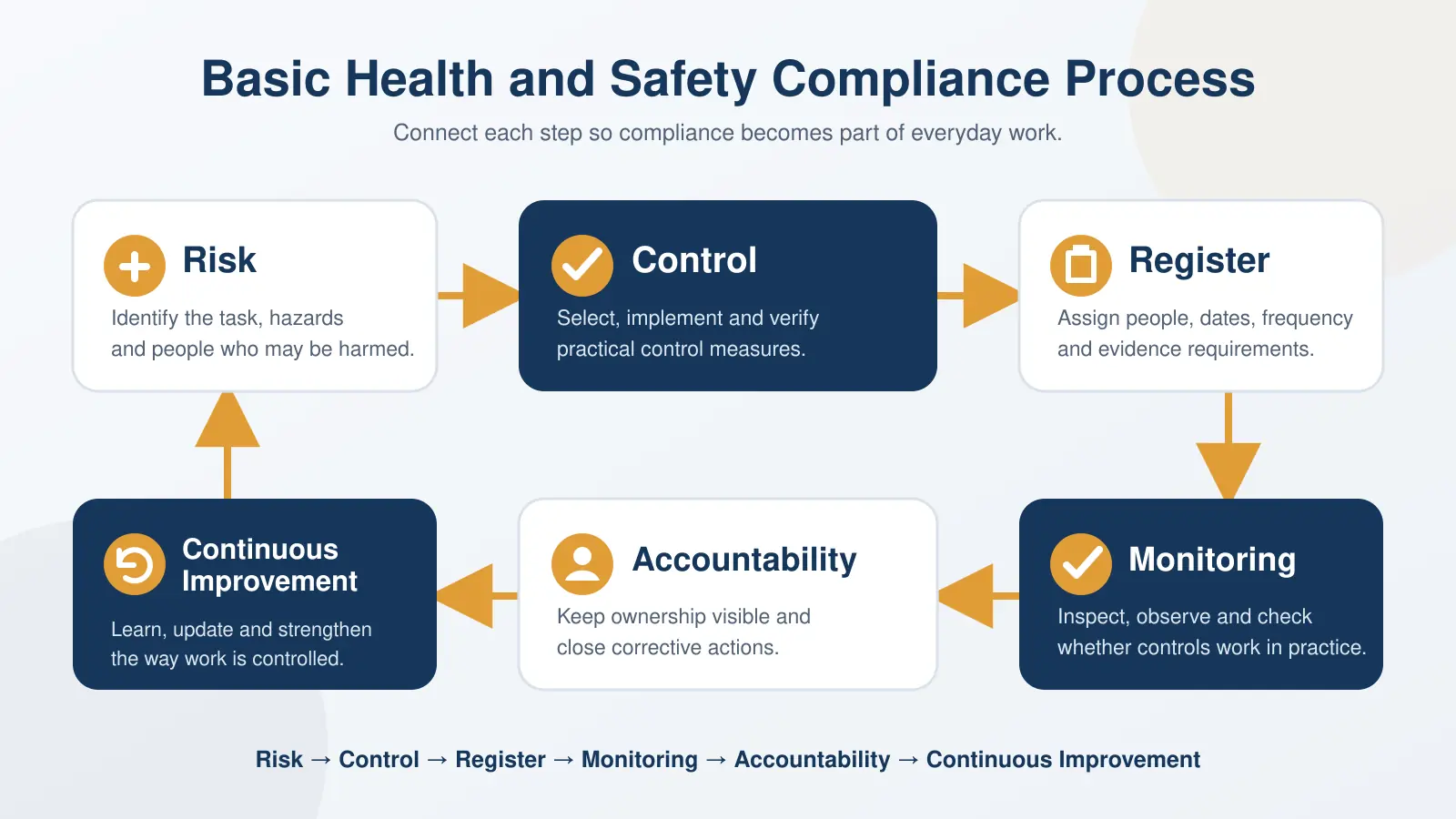
Risk → Control → Register → Monitoring → Accountability → Continuous Improvement.
The SafetyWallet Model: One Platform, Multiple Layers of Support
The layers work together to support a practical health and safety management system:
- OHS Online is the digital system. It connects tasks, controls, registers, responsible people, dates, evidence and actions.
- Triple P is the structure. Policies give direction, Procedures organise the process and Practices show whether the system is lived.
- Task-Based Risk Assessment is the foundation. It starts with actual work rather than generic templates.
- Job Safety Observation and control verification are the execution check. They compare required controls with actual practice.
- MES is the behaviour and culture layer. It supports evidence-grounded recognition, coaching and development.
- SafetyWallet and authorised Partner support are the capacity layer. Expert health and safety support can assist where the employer needs specialist guidance or implementation capacity.
- SafetyWallet Shop, also known as My Safety Shop, is the practical support channel. It connects qualifying products and services to workplace control needs.
- My Safety Hub is the education layer. It supports ongoing health and safety awareness and understanding.
These layers do not remove employer accountability or guarantee legal compliance. They make it easier to see what applies, allocate the work, retain evidence and improve the system.
Basic compliance can start simply without staying basic.
Talk to the SafetyWallet team about turning your tasks, risks and controls into a manageable implementation plan.
Talk to the SafetyWallet team →Conclusion: Start Simple, Then Keep It Moving
Basic health and safety compliance is not a smaller legal duty or a once-off document pack. It is a simple way to organise the first cycle of ownership, work, risk, control, responsibility, evidence and improvement.
The fastest useful starting point is not "Which documents can I download?" It is "What work do we do, what can harm people and how will we control it?" Once that is clear, the right policies, procedures, appointments, training, registers and inspections become easier to identify and manage.
The SafetyWallet workplace health and safety compliance platform helps employers build that rhythm without losing ownership of it.
We believe in making sure your loved ones return home healthy and safe after work. That purpose becomes practical when every risk leads to a control, every control leads to responsibility, and every responsibility is checked.
Ready to make compliance simpler and more visible? Book a SafetyWallet demo and see how the platform helps you turn tasks, risks and controls into a working compliance system.