
Behaviour-Based Safety is often misunderstood. Many organisations think it means watching workers, recording unsafe acts and reminding people to "be more careful". That may create activity, but it does not automatically create safety culture.
A strong Behaviour-Based Safety programme in South Africa must go deeper. It must help people understand the risk, apply the control, observe the behaviour, give meaningful feedback, reinforce the right habits and build ownership over time.
The real purpose of Behaviour-Based Safety is not to blame workers. It is to help the organisation see how daily choices, workplace conditions, supervision, procedures, pressure and leadership all influence safe or unsafe behaviour.
This is why observation alone is not enough.
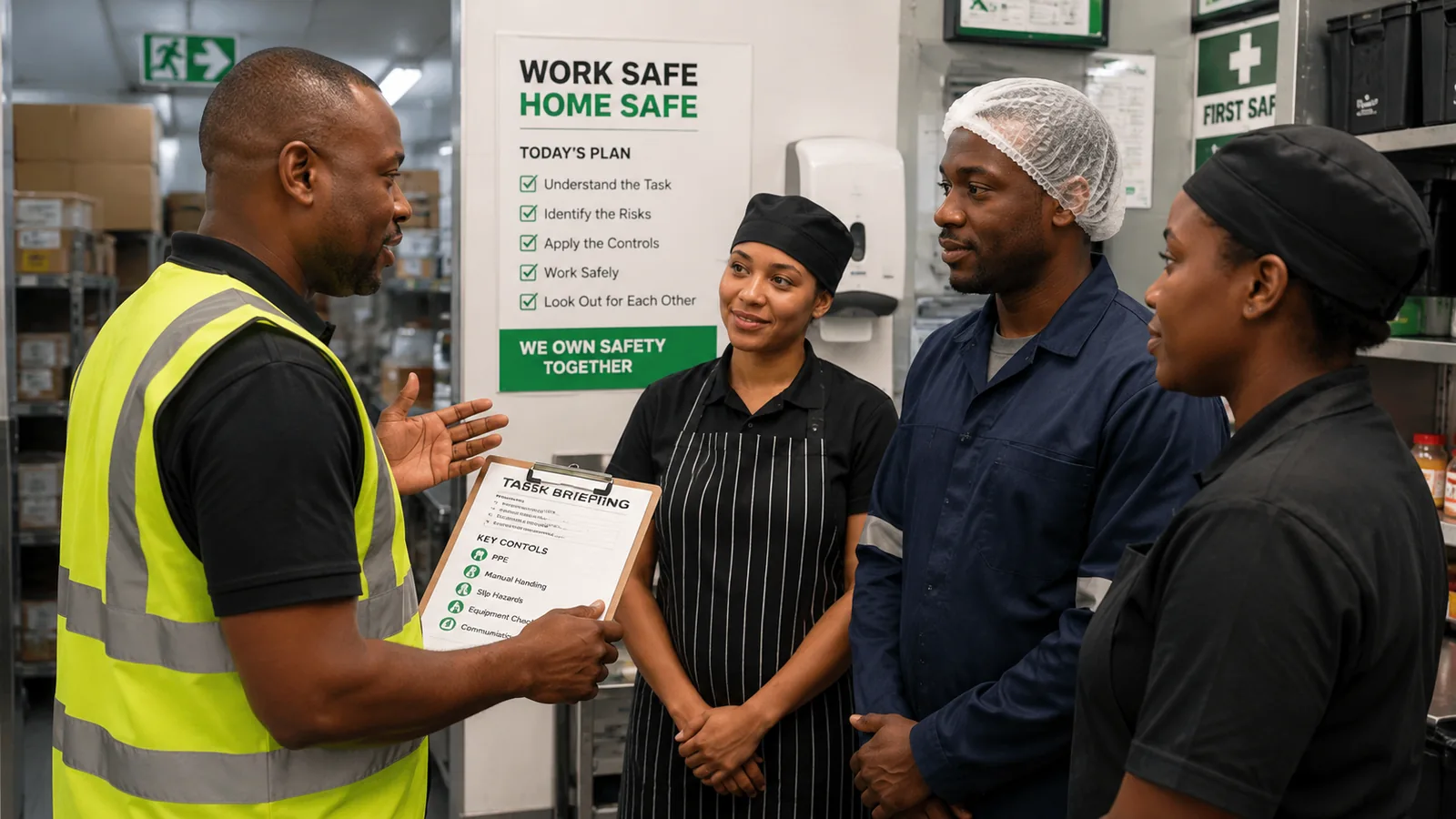
Behaviour-Based Safety starts when teams understand the task, the risk and the control.
If your organisation wants to move from observation cards to real behaviour ownership, explore the Behaviour-Based Safety programme in South Africa from SafetyWallet. SafetyWallet helps connect mindset, structure and daily execution through MES, Triple P and OHS Online.
What Behaviour-Based Safety Really Means
Behaviour-Based Safety is a structured approach to improving workplace safety by focusing on the actions, decisions and habits people demonstrate during work.
But behaviour does not happen in isolation. An employee may bypass a control because the task is badly designed. A supervisor may accept shortcuts because production pressure is high. A contractor may work unsafely because induction was rushed. A worker may fail to wear the correct PPE because the issue was never linked clearly to the hazard and task exposure.
A mature BBS programme must ask better questions: Why did the behaviour happen? Was the control practical? Was the employee trained? Was the safe method clear? Was the supervisor reinforcing the right standard? Was the behaviour linked to a task-based Health and Safety Risk Assessment? Was the organisation measuring follow-through or only counting observations?
When BBS is done properly, it becomes a bridge between risk control and culture.
Why Behaviour-Based Safety Programmes Fail
Many Behaviour-Based Safety programmes fail because they become a reporting exercise. The business launches observation cards, sets targets, asks supervisors to complete a certain number of observations and then expects incident rates to drop.
This creates several problems. People may complete observations because they have to, not because they believe in the process. The quality of observations may become weak. Employees may feel they are being watched rather than supported. Supervisors may focus on unsafe acts without understanding the reasons behind them. Management may expect quick results before trust has developed.
Observation without trust creates resistance. Observation with trust creates learning.
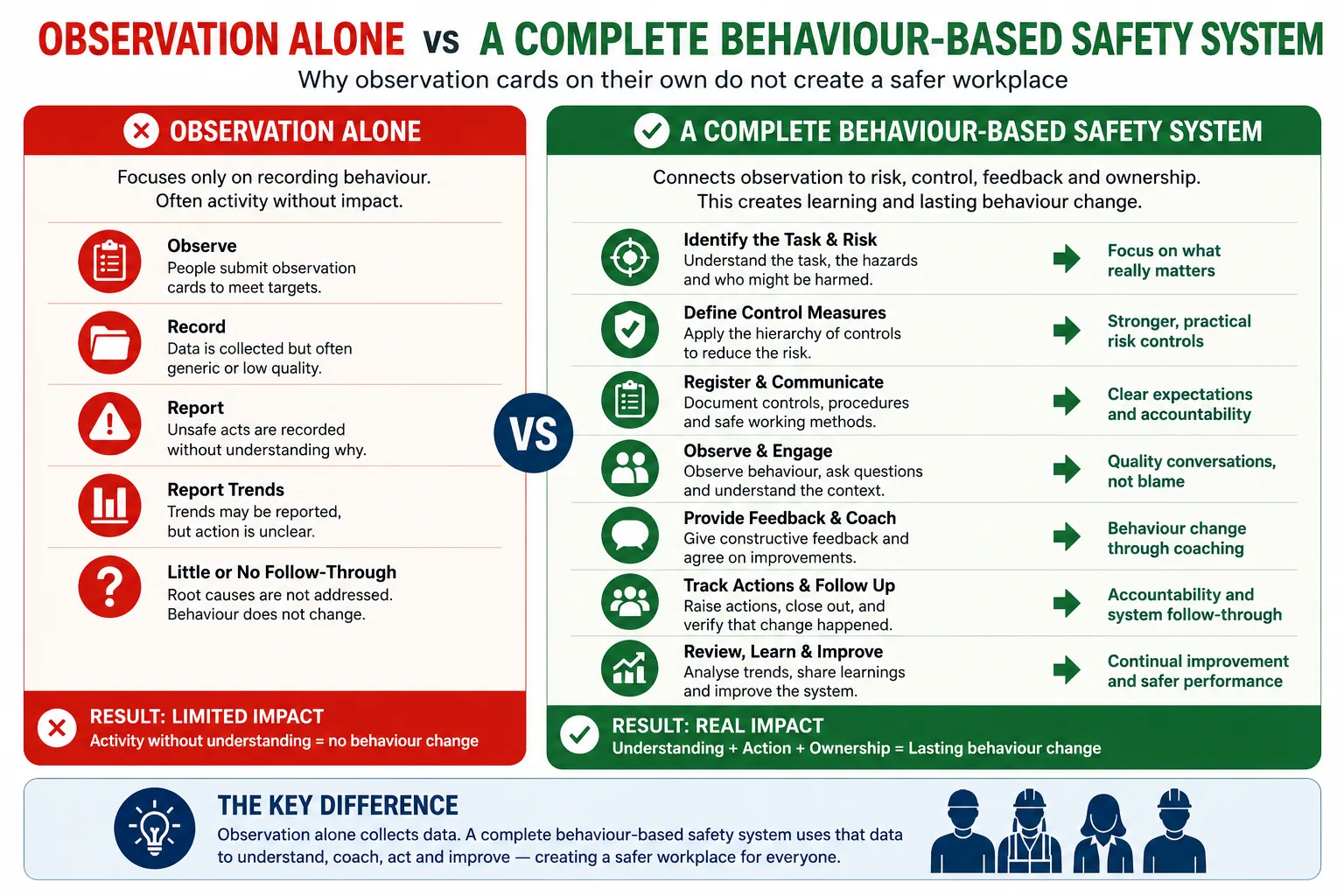
Observation creates value only when it leads to risk control, feedback, action and ownership.
The South African Context: Behaviour Must Support Legal and Operational Duties
In South Africa, Health and Safety is not only a moral responsibility. Employers have practical duties to provide and maintain a working environment that is safe and without risk to health, as far as reasonably practicable. That duty cannot be achieved by paperwork alone.
A file may contain policies, procedures, appointments, inspection forms and risk assessments. But the real question is whether people are applying the controls during daily work.
For example, a cleaner may know that chemicals must not be mixed, but does the person follow the correct dilution method when cleaning a deep fryer area? A receiving clerk may know that manual handling is a risk, but does the team use the correct method when receiving stock at the back door? A supervisor may know that working at height is dangerous, but does the team inspect the ladder before replacing signage?
Behaviour-Based Safety must connect these daily actions to risk controls, not only to general safety reminders. This is central to Health and Safety Compliance in South Africa.
Behaviour Must Start with Risk
A common mistake is to start a BBS programme by deciding what behaviours to observe before the organisation fully understands its task risks. That creates generic observation checklists.
A stronger approach starts with a task-based Health and Safety Risk Assessment. First identify the task. Then identify the hazards. Then define the control measures. Then translate those controls into expected behaviours. Then observe whether those behaviours are happening. Then use the findings to coach, improve and strengthen the system.
For example, if the task is cleaning a deep fryer, the expected behaviours may include isolating the fryer, allowing the oil to cool, using the correct PPE, preventing slips, handling cleaning chemicals safely and keeping unauthorised employees away from the area.
If the task is managing contractor induction, the expected behaviours may include verifying documentation, confirming task risk, communicating site rules and ensuring the contractor understands emergency procedures before work starts.
The SafetyWallet Behaviour-Based Safety Logic
A mature Behaviour-Based Safety programme should follow this flow: Risk leads to Control, which leads to Register, which leads to Observation, which reveals Trait, which builds Value, which forms Identity, which creates Ownership.
This is different from a traditional observation-only approach. Risk identifies what can harm people. Control defines what must be in place. Register makes the control visible and manageable. Observation checks whether the control is being followed. Trait helps understand the behaviour behind the action. Value gives the behaviour meaning. Identity helps the person see themselves as someone who owns safety. Ownership turns safety into a daily responsibility.
The SafetyWallet Health and Safety SaaS platform connects behaviour to mindset, structure and execution. MES helps address beliefs, values and risk perception. Triple P gives structure through policies, procedures and practices. OHS Online makes daily execution visible through risk assessments, inspections, training, actions and reporting.
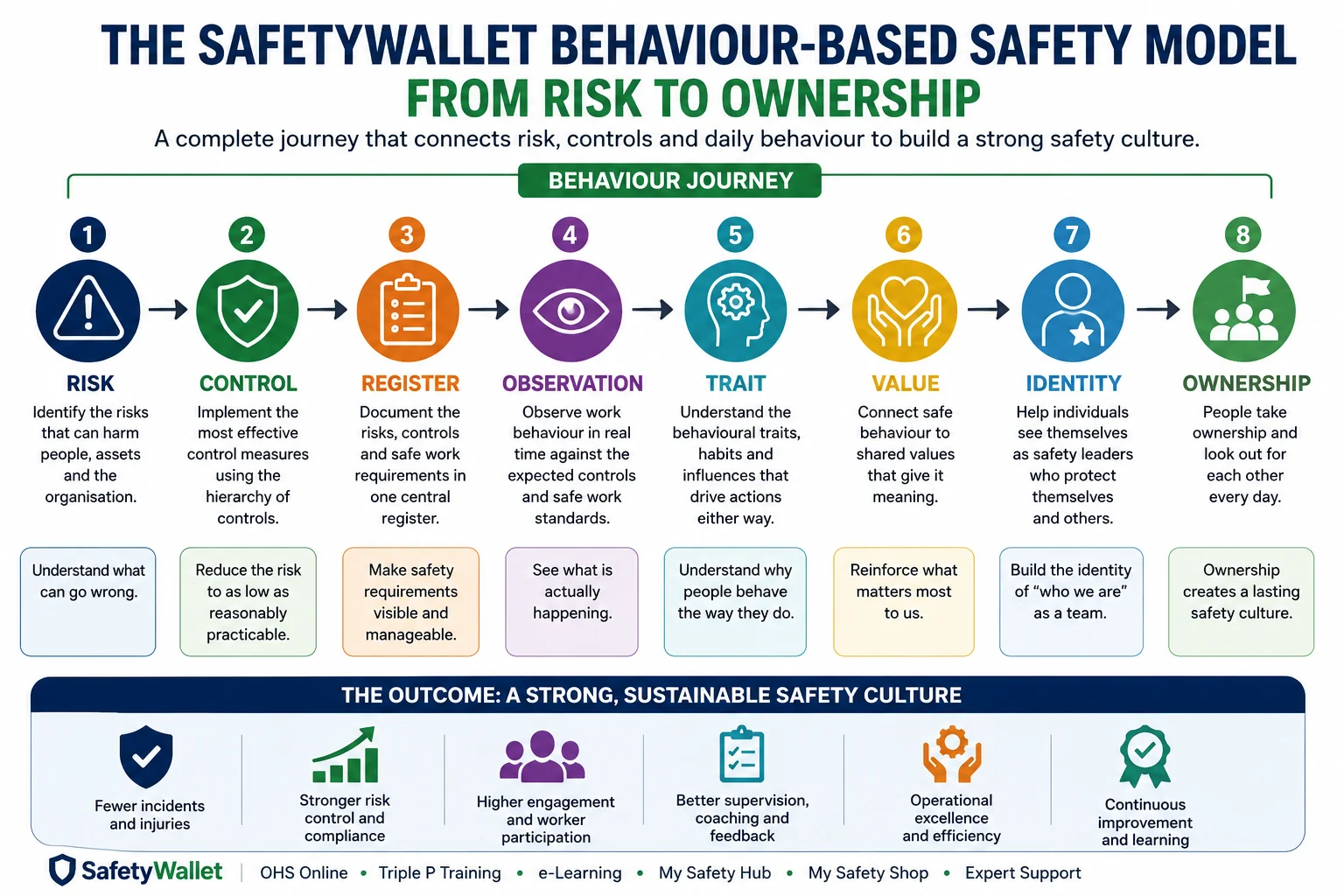
Sustainable safety culture connects risk control to behaviour, values and ownership.
Why Management Commitment Matters
Behaviour-Based Safety cannot be delegated to workers alone. It must be visibly supported by leadership.
Employees watch what management does more than what management says. If production always wins over safety, people learn that safety is conditional. If supervisors ignore shortcuts, unsafe behaviour becomes normal. If managers only talk about safety after an incident, employees learn that safety is reactive.
Strong leadership means managers participate in safety conversations, supervisors coach instead of only instructing, unsafe conditions are corrected, employees are thanked for raising concerns, corrective actions are closed properly and safe behaviour is recognised consistently.
Why Trust Is the Foundation of BBS
Workers must believe that the programme exists to protect people, not punish them. Without trust, employees may hide mistakes, avoid reporting, resist observation or give surface-level answers during safety conversations.
Trust grows when observations are handled respectfully, feedback is given immediately and constructively, supervisors ask questions instead of attacking, safe behaviour is recognised, unsafe behaviour is coached and system weaknesses are fixed.
The goal is not to catch people doing something wrong. The goal is to understand why behaviour happens and how the organisation can make safe behaviour easier, clearer and more consistent.
The Problem with Observation Quotas
Observation targets can be useful if they encourage participation, but they can become harmful when they turn into forced quotas. If employees are told to submit a fixed number of observation cards, they may start focusing on quantity instead of quality.
A better approach is to measure the quality and value of observations. Did the observation focus on a critical task? Was the behaviour linked to a control measure? Was feedback given respectfully? Was a system weakness identified? Was an action raised where needed? Was the action closed?
The goal is not more cards. The goal is better insight, stronger controls and safer behaviour.
Positive Feedback Is Not Soft — It Is Strategic
Many safety programmes focus mainly on what went wrong. That creates a negative emotional link with safety. Positive reinforcement changes that.
When a supervisor thanks an employee for stopping a job, reporting a hazard, using the right PPE, correcting a colleague respectfully or following a safe operating procedure under pressure, the organisation reinforces the identity it wants to build.
The message becomes: This is who we are. This is how we work. This is what we value. This is how we protect each other.
How BBS Supports a Health and Safety Management System
A Behaviour-Based Safety programme should not sit outside the Health and Safety Management System. It should strengthen it.
When observations are linked to controls, they become useful evidence. They show whether procedures are understood, whether training is effective, whether supervision is working and whether controls are practical.
A proper Health and Safety Management System connects risk assessments, control measures, safe operating procedures, training records, inspections, action requests, appointee responsibilities, incident investigations, management review and continuous improvement.
If unsafe behaviour is observed, the organisation must ask whether the control failed, the procedure was unclear, the training was weak, the supervision was inconsistent or the work environment created pressure to take shortcuts.
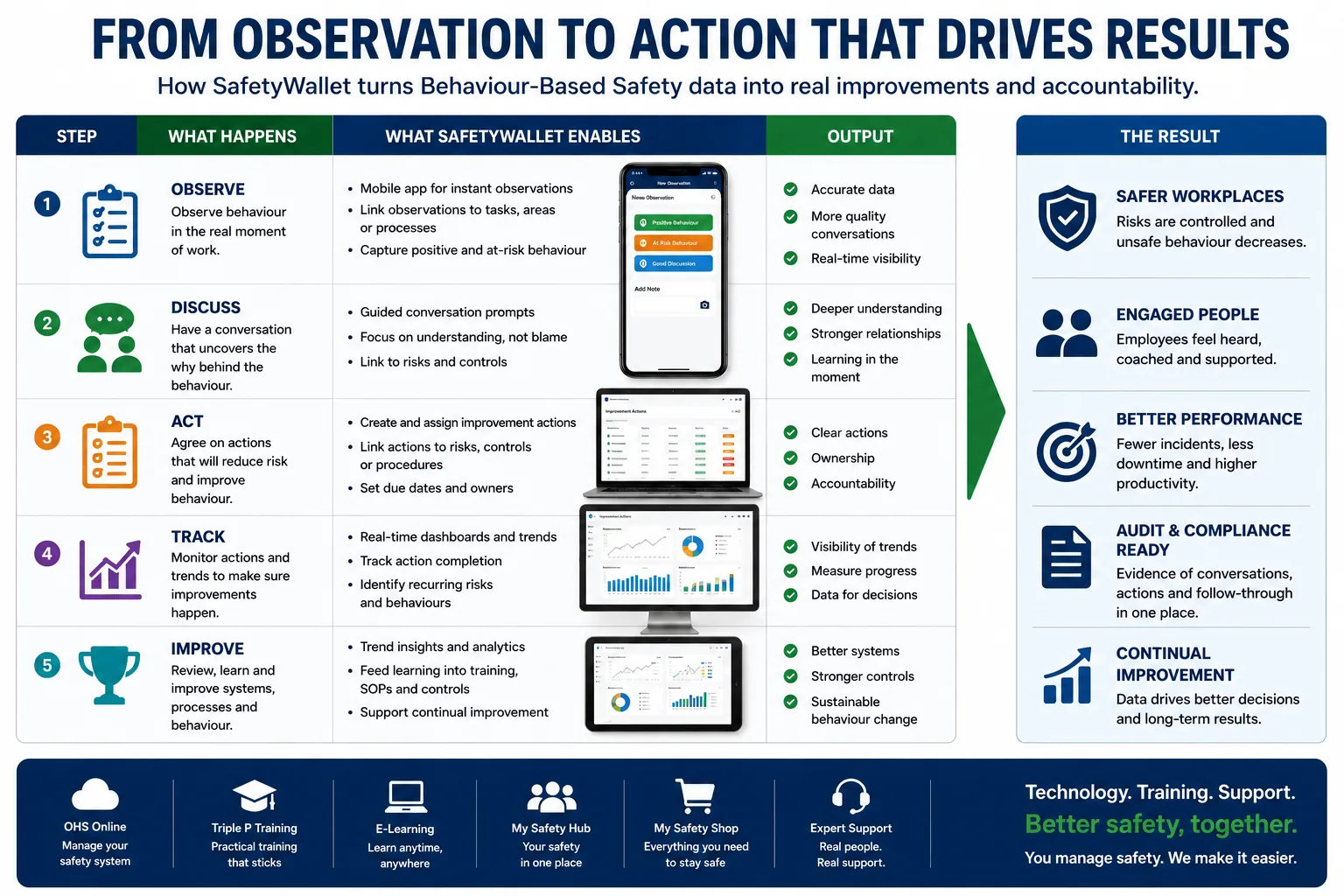
A living Health and Safety Management System turns observations into visible action.
How BBS Supports ISO 45001
ISO 45001 is built around leadership, worker participation, hazard identification, risk assessment, operational control, performance evaluation and continual improvement.
Behaviour-Based Safety supports these principles when it is implemented properly. Leadership becomes visible through participation and follow-through. Worker participation improves through observation and feedback. Operational control becomes stronger because behaviours are linked to task controls. Performance evaluation improves through trends and action tracking.
This is why ISO 45001 support in South Africa should not be treated as documentation only. A management system becomes stronger when the organisation can show that safe behaviour is being observed, coached, measured and improved at the point of work.
Behaviour-Based Safety Examples by Task
Cleaning a deep fryer
Unsafe behaviour may include rushing the job, not allowing equipment to cool, using incorrect PPE, mixing chemicals or leaving oil residue on the floor. A mature BBS observation checks whether the employee follows the safe sequence, understands the burn and slip risks, uses the correct PPE and knows when to stop if the control is missing.
Receiving stock at the back door
Unsafe behaviour may include poor manual handling, blocked walkways, unstable stacking, rushing during delivery pressure or allowing vehicles and pedestrians to mix. A good observation checks lifting method, load control, traffic separation, housekeeping and communication between the receiver and driver.
Inspecting fire extinguishers
Unsafe behaviour may include ticking the inspection without checking pressure, access, signage, service dates or damage. A strong BBS approach reinforces accuracy, attention to detail and the belief that inspection is a control activity, not an admin task.
Conducting a toolbox talk
Unsafe behaviour may include reading from a form without confirming understanding. A better behaviour is to link the toolbox talk to the actual task, ask questions, confirm controls and allow workers to raise concerns before work starts.
How SafetyWallet Supports Behaviour-Based Safety in South Africa
The SafetyWallet Health and Safety SaaS platform helps organisations manage their own Health and Safety responsibilities through structure, digital visibility, training and support. SafetyWallet does not remove the employer's responsibility. It helps the organisation make responsibility visible and manageable.
Through the Behaviour-Based Safety programme in South Africa, SafetyWallet connects:
- MES for mindset, values, beliefs and risk perception
- Triple P for policies, procedures and practices
- OHS Online for daily execution, inspections, risk assessments, action tracking and reporting
- My Safety Hub for learning and awareness
- My Safety Shop for practical support where additional controls or services are needed
- Structured support for organisations that need guidance to mature their system
This creates a more complete approach than observation cards alone. It helps organisations move from observation to ownership, paperwork to practice, unsafe acts to root causes, generic reminders to task-based controls, blame to coaching, and compliance activity to culture development.
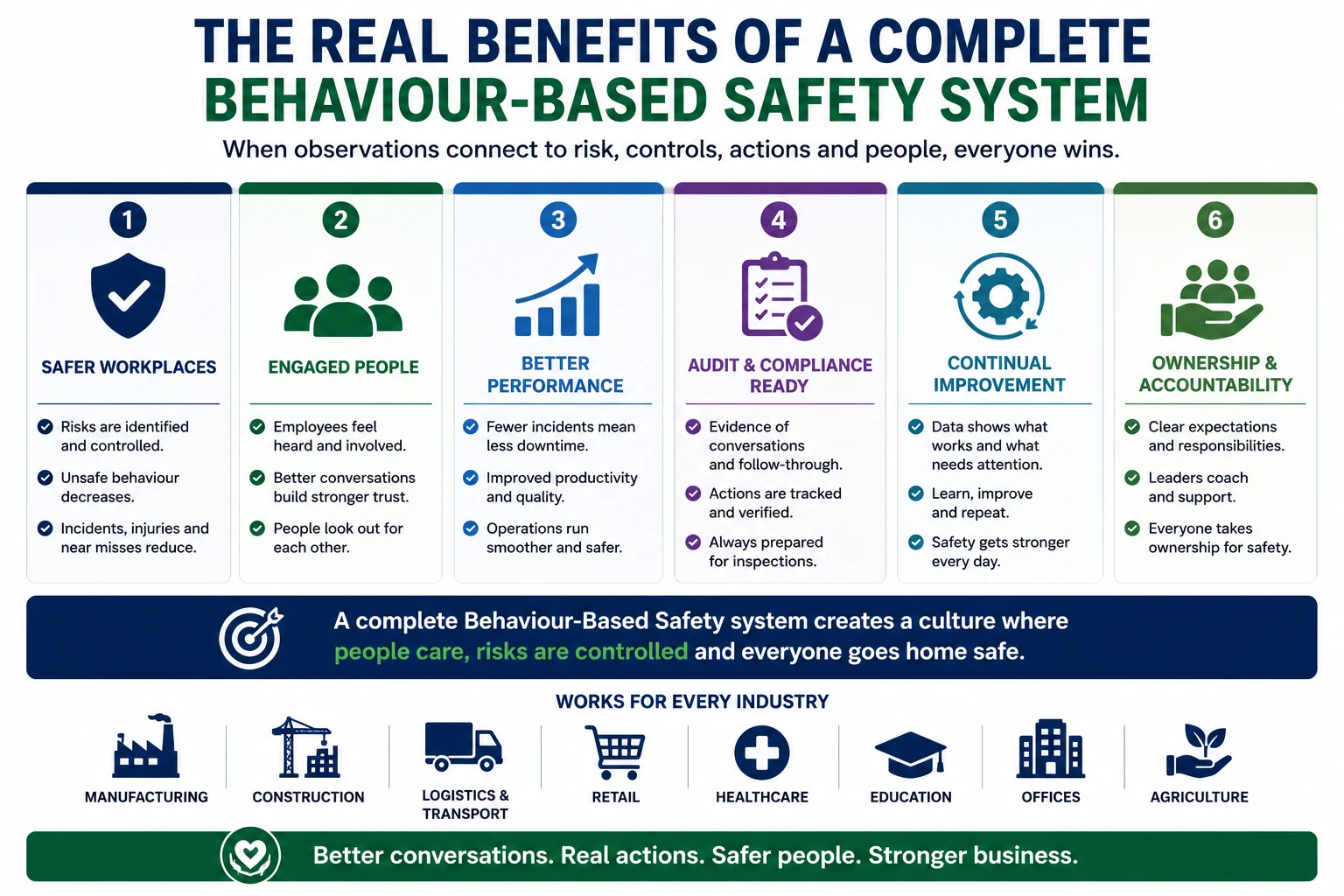
A complete Behaviour-Based Safety system creates safer workplaces, stronger ownership and better follow-through.
Package Positioning
Enterprise Secure supports stable organisations that are ready to manage their system internally with platform access and structured internal support.
Expert Guidance supports organisations that need more guided assistance to mature their Health and Safety system, strengthen role-player accountability and improve implementation.
Apex AI supports more complex environments that need advanced assistance, AI-enabled support and stronger visibility across tasks, controls, observations and actions.
These are not simple service agreements. They are compliance enablement options designed to support internal ownership.
Build a Behaviour-Based Safety system that does more than collect observation cards.
SafetyWallet helps your organisation connect risk, controls, observations, feedback, values and ownership through one practical platform.
Explore the Behaviour-Based Safety programme in South Africa →Conclusion
Behaviour-Based Safety in South Africa must be built on more than observation. Observation is important, but it is only one part of the system. To change safety culture, organisations need trust, leadership commitment, worker participation, clear task-based controls, positive feedback, action tracking and continuous improvement.
A strong BBS programme does not ask, "Who made a mistake?" It asks: What was the task? What was the risk? What control was expected? What behaviour was observed? Why did it happen? What must we reinforce? What must we improve? Who owns the follow-through?
That is how Behaviour-Based Safety becomes practical. That is how safety moves from a rule to a habit. That is how people begin to see themselves as owners of safety, not just employees being watched.
Visit the SafetyWallet homepage or the Behaviour-Based Safety solution page to see how SafetyWallet helps organisations build safer behaviour through mindset, structure, digital execution and ownership.