

Behaviour Based Safety starts with visible leadership, worker involvement and daily ownership of controls.
Many companies believe their safety culture problem can be solved with another poster, another toolbox talk, another observation card or another once-off training session. In reality, most Behaviour Based Safety failures happen after the programme has already been launched — when observations are not completed, managers do not review the trends, supervisors are unsure how to coach behaviour, and workers do not see the link between safety values and the task they are performing.
That is why Behaviour Based Safety in South Africa must be treated as more than an awareness campaign. It must become part of the way work is planned, controlled, observed, discussed, recorded and improved.
At SafetyWallet, the practical starting point is simple: safety behaviour must be connected to the real work people perform. That means the SafetyWallet platform must help the business connect risk, controls, registers, observations, traits, values, identity and ownership into one living workplace system.
This article uses an unnamed high-risk operational workplace as a practical case study. The business had strong safety values, visible leadership intent and a positive survey result, but the organisation still needed a better way to prove whether those values were becoming daily behaviour. This is a common South African workplace challenge: people may know what safety means, but the system still needs to show whether the control measures are followed when the task is performed.
Short Answer
Behaviour Based Safety is a practical method of improving workplace safety by observing real work behaviour, linking that behaviour to task-based risk controls, identifying the traits and values behind the behaviour, and using the evidence to coach, recognise, correct and improve. In South Africa, a strong behaviour based safety programme in South Africa should not replace legal compliance, risk assessments or management responsibility. It should strengthen them by making daily behaviour visible, measurable and accountable.
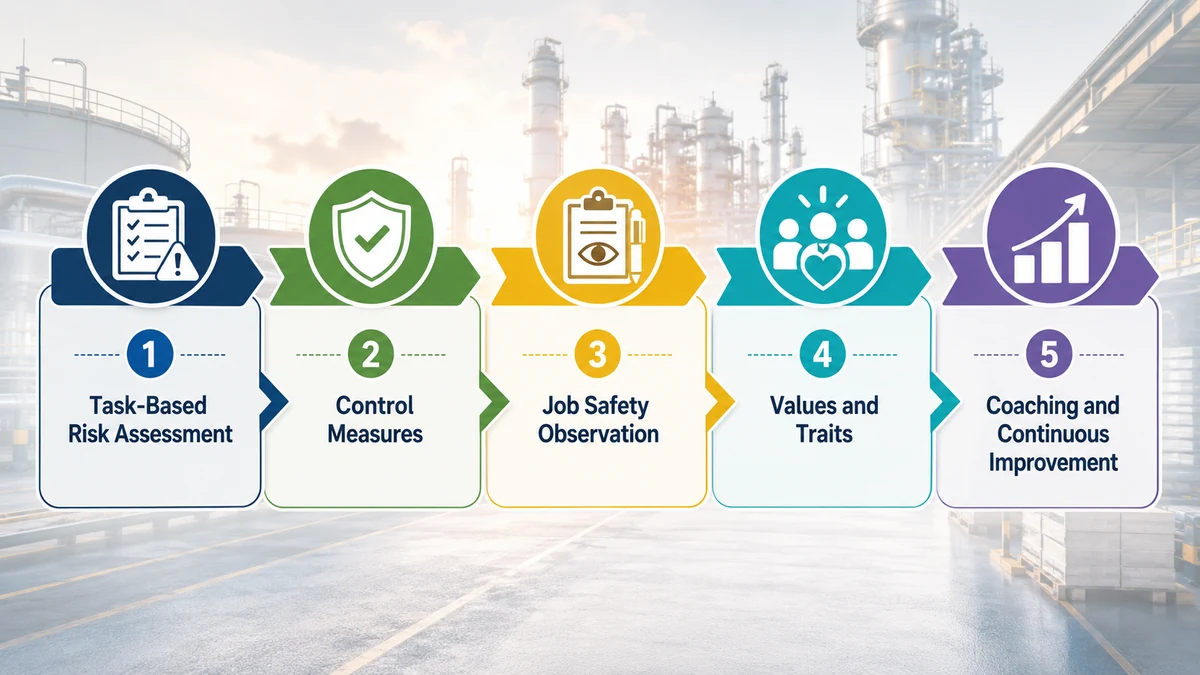
A strong BBS programme links task-based risk assessment, control measures, job observations, values and continuous improvement.
What Is Behaviour Based Safety?
Behaviour Based Safety, often shortened to BBS, is a structured approach to improving workplace safety by focusing on what people actually do during work. It looks at the behaviour that supports or weakens risk controls, then uses observation, feedback, coaching and recognition to improve safety performance.
A shallow BBS programme asks only, "Was the person safe or unsafe?" A stronger programme asks better questions:
- What task was being performed?
- What hazard and control measure applied to that task?
- Was the control measure visible and working?
- What behaviour supported or weakened the control?
- What trait or belief may be driving that behaviour?
- Which value was visible, missing or under pressure?
- What action, coaching or recognition must follow?
This is where SafetyWallet's BBS logic becomes different. The observation is not the end of the process. It is the evidence point that connects risk control to behaviour, and behaviour to ownership.
The SafetyWallet Behaviour Based Safety Logic
For practical workplace safety, SafetyWallet uses a progression that moves from technical control into human ownership:
This logic is important because unsafe behaviour is rarely only a worker problem. It may come from weak planning, unclear controls, poor supervision, production pressure, a missing register, poor follow-through, a limiting belief, a weak value connection or a culture where shortcuts have become normal.
A proper BBS programme must therefore look at the full chain. The business must know the risk, define the control, register the requirement, observe the work, understand the behaviour, coach the trait, reinforce the value, build identity and create ownership.
South African Context: Why BBS Cannot Be Separated from Legal Duties
In South Africa, Behaviour Based Safety should never be positioned as a replacement for occupational health and safety compliance. It must support compliance. Employers remain responsible for providing and maintaining a working environment that is safe and without risk to employees, as far as reasonably practicable. Employees also have duties to take reasonable care, follow lawful safety instructions and report unsafe or unhealthy situations.
This means a BBS programme should support health and safety compliance in South Africa by helping the employer prove that controls are not only documented, but also communicated, observed, followed, corrected and improved.
The Department of Employment and Labour does not inspect a company's safety culture poster. Inspectors look for practical evidence: appointments, training, inspections, risk assessments, incident records, committee minutes, corrective actions, registers and whether the workplace is being managed in line with legal duties. BBS supports this by adding behavioural evidence to the compliance picture.
The Case Study: When Values Look Strong but Behaviour Still Needs Proof
In a high-risk operational environment, leadership wanted to understand whether the organisation's safety values were genuinely visible in day-to-day work. A values and safety perception survey produced a strong result. On paper, the organisation looked positive. People indicated that they understood the values and supported the safety message.
But the management question was more difficult: "If our values score is strong, why do we still see inconsistent safety behaviour?"
That question is where Behaviour Based Safety becomes useful. A survey tells the business what people say, feel or believe at a certain moment. Job Safety Observations show what people do when they are performing a task under real conditions, with production pressure, changing work areas, contractor activity, time limits and supervision gaps.
The gap between survey results and observed behaviour should not be treated as failure. It should be treated as operational intelligence. It tells the business where values are understood but not yet embedded as habits.
Why a High Safety Survey Score Can Be Misleading
A high survey score may show awareness, but awareness is not the same as ownership. A person can know the right answer and still behave differently when the task becomes routine, rushed or uncomfortable.
In many workplaces, employees genuinely want to work safely. The problem is that work pressure, unclear supervision, weak follow-up or normalised shortcuts can slowly override the intended behaviour. The spoken value may be safety, but the rewarded behaviour may be speed, silence or convenience.
This is why Behaviour Based Safety must include both perception data and observation data. Perception tells the business what people believe. Observation tells the business what people do. Action tracking shows whether management is closing the gap.
If your business has safety values, risk assessments and training in place, but you are not sure whether those controls are visible in daily behaviour, start by reviewing your observation process. SafetyWallet can help you connect task-based controls, JSOs, MES and management accountability into one practical Behaviour Based Safety approach.
What We See Repeatedly in South African Workplaces
Across South African workplaces, the same practical gaps appear repeatedly.
- Many companies have documents, but the documents do not drive daily action.
- Health and Safety representatives are appointed, but not always confident about what they must do each week.
- Risk assessments are completed once, but not always connected to inspections, SOPs, registers and control measure verification.
- Inspections are scheduled, but evidence, corrective actions and follow-through are weak.
- Consultants can assist, but over-reliance on consultants can prevent internal ownership.
- Behaviour problems are visible, but the deeper belief, trait and value layer is not coached.
- Management wants compliance, but teams need visibility, accountability and a practical rhythm.
- Supervisors often see unsafe behaviour but do not have a simple method to record, coach and close the loop.
- Positive safety behaviour happens daily, but it is not captured or recognised, so it does not strengthen culture.
Software Gives Visibility, but Visibility Is Not the Same as Control
A dashboard can show overdue inspections, but someone still needs to inspect. A register can show missing evidence, but someone still needs to upload and verify it. A risk assessment can identify hazards, but controls must still be implemented. A policy can exist, but people must still understand and follow it. A consultant can assist, but the client must still build internal ownership.
This is why Behaviour Based Safety must be connected to a practical health and safety management system. If observations are captured but never reviewed, the organisation has activity without improvement. If findings are raised but not closed, the organisation has visibility without control. If values are communicated but not reinforced through daily supervision, the organisation has intention without culture.
Why Behaviour Based Safety Must Start with Task-Based Risk Assessment
A strong BBS programme does not start with generic behaviour categories. It starts with task-based risk assessments.
The reason is practical: people do not get injured in general safety themes. They get injured while performing tasks. They connect hoses, climb ladders, drive vehicles, receive deliveries, isolate equipment, clean spillages, handle chemicals, operate machinery, work with contractors, enter restricted areas or perform maintenance. Each task has hazards, exposure and control measures.
If the observation checklist is generic, the data will be weak. If the observation is linked to the task and its controls, the data becomes useful. Instead of asking "Was the worker safe?", the observation should ask:
- Was the required pre-use inspection completed before the equipment was operated?
- Was the exclusion zone in place before vehicle movement started?
- Was the correct permit or authorisation confirmed before maintenance began?
- Were the correct PPE and task-specific controls used during the work?
- Was the unsafe condition reported before the task continued?
- Did the supervisor verify that the control measure was in place?
These questions are stronger because they measure whether the control was alive in the task.
From Risk to Control to Register to Monitoring
The SafetyWallet operating logic connects the system and the culture layer:
Behaviour Based Safety adds the human layer to this process:
This second flow helps the business understand not only whether the control was followed, but what behaviour and value were visible when it was followed or not followed.
How Job Safety Observations Should Work in BBS
A Job Safety Observation should not be a policing tool. It should be a structured conversation supported by evidence. The observer watches a specific task, compares the behaviour to the required control measure, records what was seen, gives respectful feedback and triggers action where needed.
A good JSO should include:
- The task being observed
- The relevant control measure
- Whether the control was followed or not followed
- The positive behaviour or unsafe behaviour observed
- The immediate feedback given
- The value or trait linked to the behaviour
- The action required if the control was not followed
- The responsible person and close-out date
- Whether recognition is appropriate for positive behaviour
When JSOs are linked to control measures, they become a practical test of whether the health and safety system is working. When they are linked to traits and values, they become a practical tool for building safety culture.
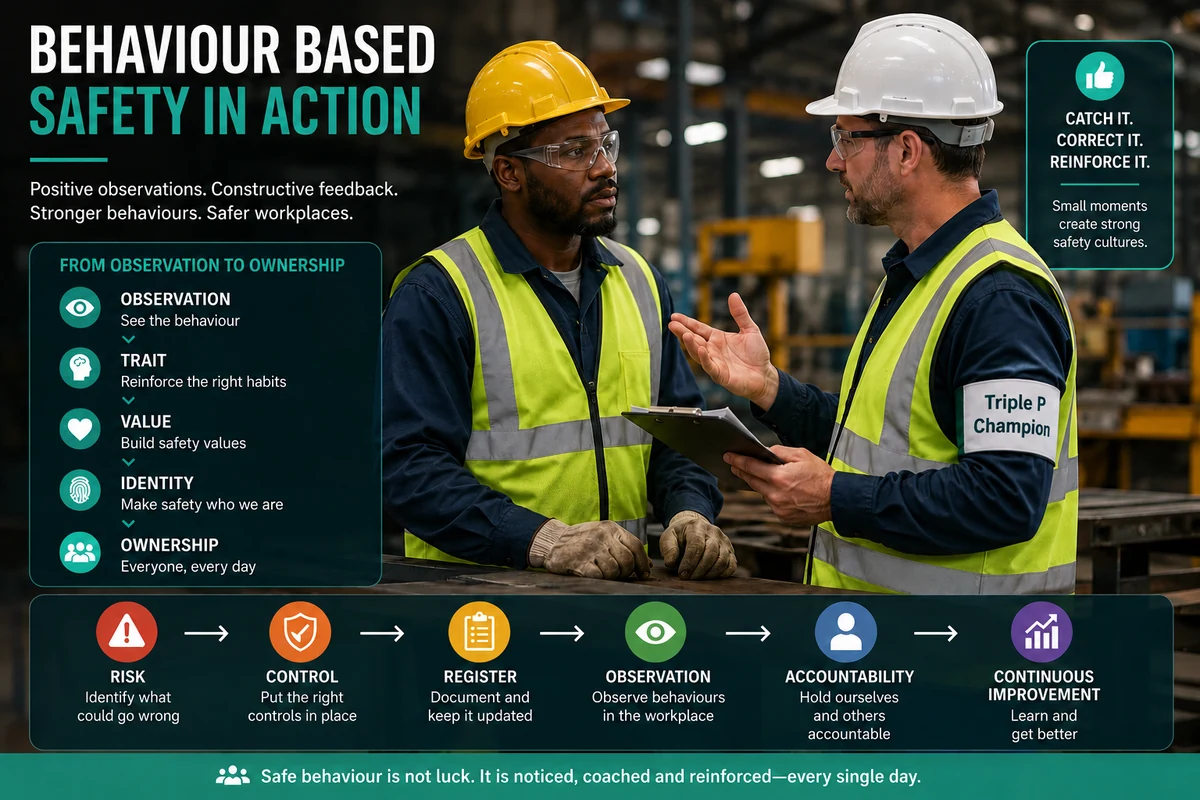
Behaviour Based Safety becomes practical when observations are used to coach, correct and reinforce safe behaviour.
How to Interpret a Yes or No Observation Answer
If the answer is Yes
A Yes answer means the required control was observed as being followed. This should not disappear into a spreadsheet. It should become positive behavioural evidence. The business should ask: what value was visible here? Was this accountability, care, commitment, discipline, excellence or ownership? A Yes answer is an opportunity to recognise safe behaviour and strengthen identity. People repeat behaviour that is noticed, valued and reinforced.
If the answer is No
A No answer means the control was not followed or was not visible at the time of observation. This should create a finding, but it should not automatically create blame. The business should first understand why the behaviour occurred. The reason may be a training gap, weak supervision, poor planning, unrealistic work pressure, lack of equipment, unclear SOP, a weak belief in the control, or a culture where shortcuts have become normal. The finding should then trigger coaching, retraining, control improvement, SOP review, management action or formal consequence where appropriate.
Behaviour Based Safety Must Not Become a Blame System
If employees believe BBS exists to catch them out, the programme will fail. People will hide behaviour, observers will soften findings, and the data will become unreliable.
A mature BBS programme must be firm on standards but fair in method. It must make unsafe behaviour visible without humiliating people. It must recognise positive behaviour, not only record negative findings. It must allow workers to explain why a control was difficult to follow. It must give management the courage to fix system weaknesses instead of blaming workers for every failure.
This is especially important in South African workplaces where trust, communication, supervision and role clarity can vary significantly across sites, departments and contractors.
The Role of MES in Behaviour Based Safety
SafetyWallet's behaviour based safety approach is strengthened by MES, the Mindset Emulation Schema. MES helps the business move beyond visible behaviour into the deeper drivers of behaviour: traits, beliefs, values, identity and ownership.
The MES roots-to-fruits model applied to Behaviour Based Safety works as follows:
- Roots: personal traits that influence safety behaviour
- Trunk: beliefs, including limiting beliefs and positive beliefs about safety
- Branches: values that guide decision-making under pressure
- Fruit: character and behaviour visible in daily work
- Sunlight: leadership, management support and the health and safety management system
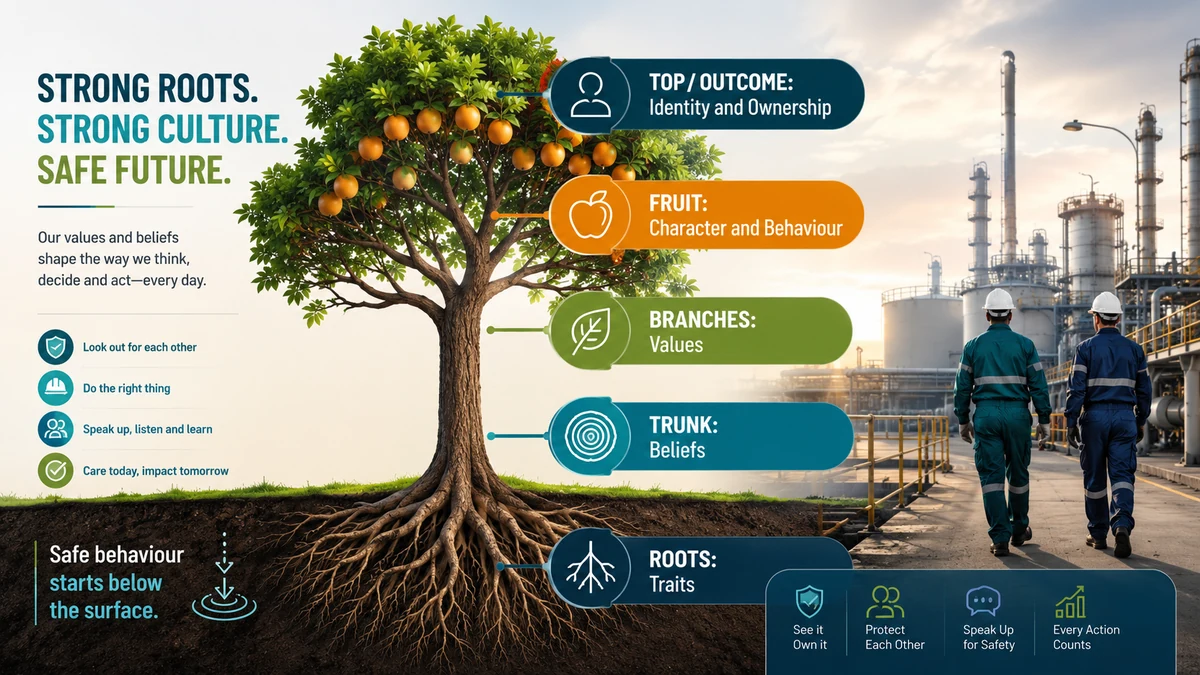
Safe behaviour starts below the surface: traits shape beliefs, beliefs support values, and values become behaviour and ownership.
This matters because a person may know the rule but still not believe the control is important. A supervisor may value safety but still reward production pressure. A team may understand the risk but still normalise a shortcut. MES helps the business coach the deeper layer so that behaviour becomes more than compliance; it becomes identity.
Values Become Real When They Are Visible in Tasks
Values do not become culture because they are printed on a wall. Values become culture when they are visible during the task.
- Accountability is visible when a worker stops and checks the control before starting.
- Excellence is visible when the SOP is followed properly even when the task feels routine.
- Commitment is visible when the supervisor completes observations even during busy periods.
- Care is visible when a worker reports an unsafe condition before someone gets hurt.
- Ownership is visible when management reviews trends and closes actions instead of waiting for the safety officer to chase everyone.
This is why BBS should link each observation to a value or trait. The business can then see which values are being lived and which values need coaching.
Management Commitment Is the Deciding Factor
In the unnamed case study, the biggest risk was not that the organisation lacked values. The biggest risk was that observations would not be consistently completed, reviewed and acted on. This is the point where many BBS programmes lose momentum.
Behaviour Based Safety cannot sit with the safety department alone. It must be operational. The safety team can design the framework, support training and interpret trends, but line managers and supervisors must own daily execution.
This is where a practical health and safety management system becomes important. The management system must give leaders visibility of observations, registers, inspections, actions, training and repeat findings so that accountability does not depend on memory or informal follow-up.
Management commitment is visible when leaders ask for BBS data, recognise safe behaviour, attend reviews, remove barriers, close actions and hold supervisors accountable for participation.
The SafetyWallet Model: One Platform, Multiple Layers of Support
SafetyWallet is not only OHS software. Workplace Health and Safety does not improve because a company buys software. It improves when software, structure, support, accountability and behaviour work together in one living system.
1. OHS Online: the digital system
OHS Online helps organisations manage risk assessments, registers, inspections, incidents, appointments, training records, dashboards and compliance evidence. For BBS, this creates visibility of observations, findings, actions and trends.
2. Triple P: the structure
The Triple P System connects Policies, Procedures and Practices. BBS lives in the Practice layer because it checks whether the policy and procedure are visible in real work.
3. TBRA: the risk foundation
Task-Based Risk Assessment identifies the actual tasks, hazards, risks and control measures. It gives BBS a fair and practical observation basis.
4. JSO and Control Measure Verification: the execution check
Job Safety Observations and control measure verification check whether the controls are being followed during the task. This turns BBS from opinion into evidence.
5. MES: the behaviour and culture layer
MES helps the business understand the traits, beliefs, values and identity behind behaviour. It supports coaching and recognition, not just correction.
6. Expert and Partner Support: the capacity layer
Expert health and safety support helps clients design, implement and improve their system. The purpose is not to remove employer responsibility, but to strengthen internal ownership.
7. SafetyWallet Shop and My Safety Shop: the practical support layer
The shops support clients with practical health and safety products and services required to close gaps, support controls and strengthen workplace readiness.
8. My Safety Hub: the education layer
My Safety Hub supports eLearning health and safety training, awareness and ongoing education. This helps reinforce the "why" behind safe behaviour.
Software Only vs Consultant Only vs The SafetyWallet Model
| Approach | What it solves | What it often misses | Best use | Long-term result |
|---|---|---|---|---|
| Software only | Visibility of registers, tasks, inspections, actions and dashboards | Internal behaviour, coaching, management rhythm and practical implementation | Useful when a business already has strong internal ownership | Visibility improves, but control may remain weak if people do not act |
| Consultant only | External knowledge, site support, audits, documentation and advice | Can create dependency if the client does not build internal ownership | Useful when expertise or capacity is needed | The consultant may carry the system instead of the client |
| Safety file / document approach | Documents, policies, appointments, procedures and legal evidence | Daily control, behaviour, follow-through and live dashboards | Useful as a foundation, but not enough as a management system | Compliance appears organised, but daily practice may remain disconnected |
| SafetyWallet model | Connects software, training, support, risk, control measures, behaviour, values and accountability | Requires client participation and management commitment | Best for businesses that want visible ownership and practical control | A living health and safety management system supported by data, structure and behaviour change |
How BBS Supports ISO 45001 and Continual Improvement
Behaviour Based Safety can support ISO 45001 support in South Africa because it provides practical evidence of worker participation, operational control, monitoring, corrective action and continual improvement.
BBS does not replace ISO 45001. It supports an ISO 45001-aligned health and safety management system by helping the organisation prove that controls are understood, observed and improved in real work. When observation trends show repeat control failures, the business can update the risk assessment, improve the SOP, retrain the team, review supervision or strengthen leadership accountability. That is continual improvement in action.
A Practical Implementation Rhythm for Behaviour Based Safety
- Identify the key high-risk tasks that must be observed
- Link each task to the relevant control measures from the task-based risk assessment
- Create JSO questions that test whether those controls are followed
- Map each control to a trait or value that supports safe behaviour
- Train supervisors and observers to give respectful feedback
- Capture both positive and negative observations
- Review trends weekly or monthly at management level
- Use findings for coaching, retraining, SOP review, control improvement and recognition
- Discuss repeated trends in health and safety committee meetings
- Keep improving the system: Risk → Control → Register → Monitoring → Accountability → Continuous Improvement
Task-Based Examples: How BBS Works in Real Operations
Example 1: Vehicle and pedestrian interaction
A risk assessment identifies a control requiring an exclusion zone during vehicle movement. A JSO checks whether the zone is actually in place before movement starts. A Yes answer may reflect accountability and discipline. A No answer may reveal poor supervision, unclear signage, time pressure or a weak belief in the control.
Example 2: Equipment pre-use inspection
The control requires the operator to inspect equipment before use. The observation checks whether the inspection happened before operation. Repeated No findings may show that the inspection process is too slow, supervisors do not verify it, or the team has normalised starting work without checking.
Example 3: Contractor task control
A contractor performs a task under permit control. The observation checks whether induction, task authorisation, PPE and site controls are confirmed before work begins. This helps the business manage external behaviour that can affect employees and operations.
Example 4: Reporting unsafe conditions
A worker sees a damaged guard, spill or blocked access route. BBS should not only ask whether the worker walked past it. It should ask whether the reporting culture supports speaking up and whether management responds when unsafe conditions are reported.
What Management Should Measure
- Observation completion rate by department and supervisor
- Positive behaviour observations by value or trait
- Repeat findings by task and control measure
- Actions closed on time versus overdue
- High-risk tasks observed versus not observed
- Training needs identified from observation trends
- SOPs or controls needing review
- Departments with weak observation participation
- Recognition given for safe behaviour
- Improvement trends over 30, 60 and 90 days
Common Mistakes to Avoid
- Starting with generic observation cards instead of task-specific controls
- Using BBS to blame workers instead of improving the system
- Ignoring positive behaviour and only recording failures
- Not training supervisors to observe and coach respectfully
- Collecting observations but not reviewing trends
- Leaving action close-out to the safety officer alone
- Treating BBS as a campaign instead of a management rhythm
- Failing to link behaviour to values, traits and recognition
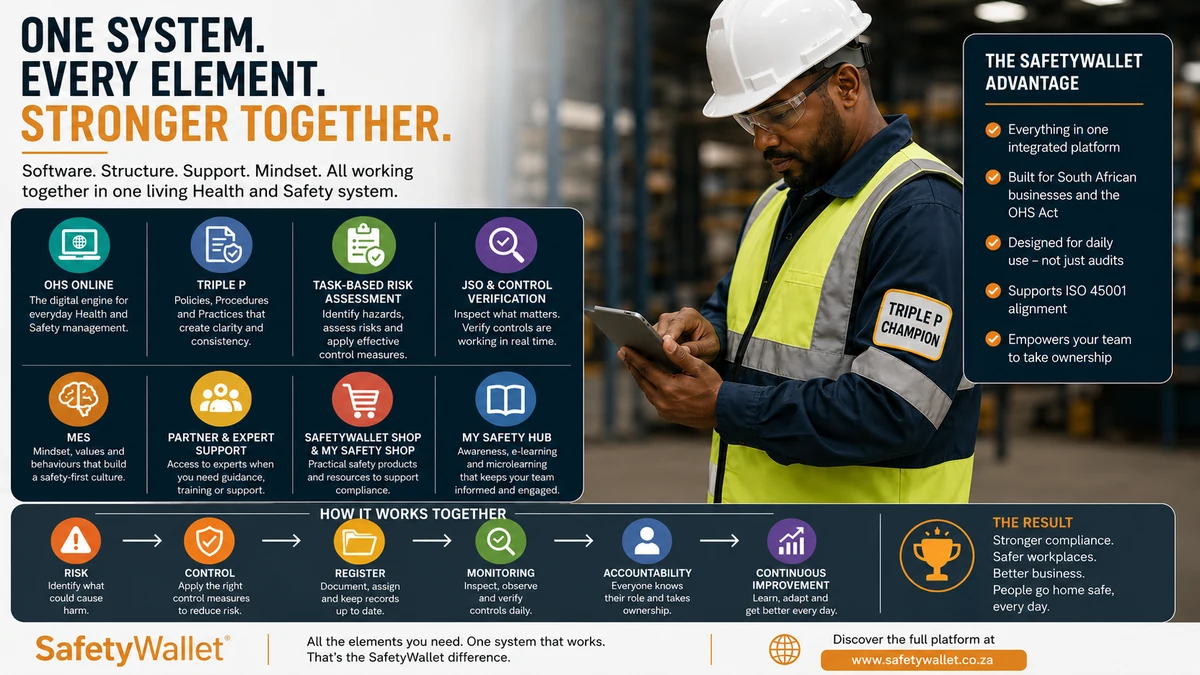
SafetyWallet brings software, structure, support and mindset together in one practical Health and Safety management system.
SafetyWallet Solution
SafetyWallet helps South African businesses build a practical behaviour based safety programme in South Africa by connecting risk assessments, control measures, observations, values, traits, training, dashboards and support.
The platform helps the business move from "we have a safety value" to "we can see whether the value is visible during the task." It helps managers ask better questions, supervisors record better evidence, appointees understand their role, and workers see that safe behaviour is recognised and coached.
SafetyWallet also supports the broader ecosystem of health and safety compliance in South Africa, risk assessment, management systems, ISO 45001 support in South Africa and expert health and safety support. This makes BBS part of a complete health and safety management approach, not a separate campaign.
The employer remains responsible for health and safety. SafetyWallet empowers, guides and supports the employer with structure, visibility, training and practical tools so that internal ownership becomes stronger.
Turn safety values into visible workplace behaviour.
Explore SafetyWallet's behaviour based safety programme in South Africa to see how OHS Online, Triple P, MES, job observations and expert support help build safer workplace behaviour.
Explore the Behaviour Based Safety programme →Conclusion: BBS Is Where Safety Values Become Visible
Behaviour Based Safety is not about catching people out. It is about helping the business understand whether its risk controls, values and leadership intentions are becoming visible during real work.
A survey can show perception. A risk assessment can show planned controls. A policy can show intent. But a Job Safety Observation shows whether the control is alive in the task.
When BBS is connected to task-based risk assessment, registers, control measure verification, MES, values, recognition, management review and corrective action, it becomes a powerful system for building safety culture. It helps the business move from awareness to action, from action to evidence, from evidence to improvement, and from improvement to ownership.
This is why the SafetyWallet platform is designed to support more than software. It helps South African businesses bring together OHS Online, Triple P, TBRA, JSO, MES, training, support and practical accountability so that every worker has a better chance of returning home healthy and safe after work.
Ready to turn safety values into visible workplace behaviour? Talk to the SafetyWallet team about building a practical Behaviour Based Safety programme supported by OHS Online, Triple P, MES and structured Health and Safety support.