
A contractor arrives to repair your roof. A supplier delivers a machine part. A cleaning team starts while employees are still using the area. Each relationship needs management before, during and after the work.
The important questions begin before someone signs the visitor register. What will happen on site? Who could be affected? Which controls must be in place? Who checks them? What information must each party provide?
Good contractor and supplier management connects those answers. For the client, it supports safer operations and clearer oversight. For the provider, it creates understandable requirements, better preparation and a fair opportunity to demonstrate capability. The SafetyWallet platform helps both sides organise that relationship through OHS Online, structured methods and support.
Short answer

Agree the work, the interfaces and the controls before activities begin.
What does the South African OHS Act require?
The Occupational Health and Safety Act 85 of 1993 provides the foundation. Relevant duties depend on the parties, activities and applicable regulations.
| Provision | Core duty or issue |
|---|---|
| Section 8 | Employers must provide and maintain a safe working environment, so far as reasonably practicable, including appropriate systems, precautions, instruction and supervision. |
| Section 9 | Undertakings must be conducted, so far as reasonably practicable, without exposing affected non-employees to health or safety hazards. |
| Section 10 | Duties concern articles and substances supplied for work, their safe use and relevant safety information. |
| Section 37 | Addresses employee and mandatary acts or omissions, including the written-arrangement exception in subsection (2). |
A section 37(2) agreement is not a blanket transfer of every duty. Section 41 preserves statutory requirements subject to specified exceptions. Read the provisions together and obtain competent advice for the actual arrangement. Source: OHS Act, sections 8–10, 37 and 41.
Turn responsibilities into arrangements people can use
For practical health and safety compliance in South Africa, identify what each organisation controls. The client may control access, process information and shutdown timing. The contractor controls its employees, equipment and work method. They must resolve how these interact.
Use agreements, task assessments and site arrangements to record those decisions. Construction, electrical work, hazardous substances and other activities may need additional, specific controls. This overview is not a substitute for checking the rules applicable to the job.
Start by identifying the relationship and its risks
"Supplier" does not describe one level of risk. A stationery delivery, a chemical supply and the installation of production equipment create different questions. A business supplying goods may also perform on-site work.
| Situation | Practical questions for both parties |
|---|---|
| Courier or routine delivery | Where can the driver enter, park and unload safely? Who receives the delivery? |
| Painter or plumber | How will the work area be separated from employees and visitors? What changes need approval? |
| Equipment supplier and installer | Does the equipment meet the agreed specification? Who checks installation and handover? |
| Chemical supplier | Is the exact product identified, with suitable safety information and agreed storage arrangements? |
Requirements should follow the goods, work and risk. Asking every provider for the same large file can distract attention from the evidence that matters.

Supplier assurance includes checking the actual goods against the agreed requirements.
What we see repeatedly in South African workplaces
The management gaps worth testing are familiar: quotations requested before the scope is clear; documents received without checking their relevance; induction signed without testing understanding; and inspections completed without effective follow-up.
Procurement, Operations and Health and Safety need to work together. Procurement sets commercial requirements; operational managers coordinate the work; OHS provides competent advice; the Triple P Champion helps connect responsibilities and evidence. Each role needs authority and time to act.
Review one current contractor relationship: can you identify the work, the critical controls and the person checking them? Discuss your contractor-management needs with SafetyWallet.
Manage the relationship from planning to review
Use the same core logic for contractor work and your own employees' work:
1. Define the work and select a suitable provider
Describe the outcome, location, timing, known hazards, affected people and handover requirements before comparing quotes. Use task-based risk assessments to identify applicable tasks, hazards and controls, customised to actual conditions.
Evaluate capability against the defined scope. Check that evidence belongs to the right organisation, person, equipment or product and remains relevant and current. A low price should not compensate for an absent critical control.
Clear requirements help the client compare like with like. They also help the contractor price the necessary people, equipment and precautions properly.
2. Establish the relationship and verify readiness
Agree responsibilities, information requirements, access and communication. Check readiness for the actual people, place, work and date. A generally suitable company may still have an uninducted worker or equipment awaiting inspection.
Induction should explain site hazards, reporting, emergencies and work boundaries. Ask people to demonstrate understanding. Keep organisation approval, site readiness and task authorisation as separate decisions.
3. Control and monitor the work
Align the task assessment, method, SOP, site conditions and applicable permit-to-work arrangements. Use permits where the relevant requirements and approved site rules call for them. Resolve conflicting activities, changes and missing precautions before proceeding.
Assign supervision and inspections according to risk. Record findings, make unsafe situations safe, allocate corrective actions and check whether the correction works. An action marked "closed" needs evidence appropriate to the problem.
4. Close out and learn together
Confirm safe handover, outstanding defects and required records. Review both parties' performance, including late client instructions, unrealistic schedules or missing site information. Use the findings to improve the next appointment and the organisation's own programme.
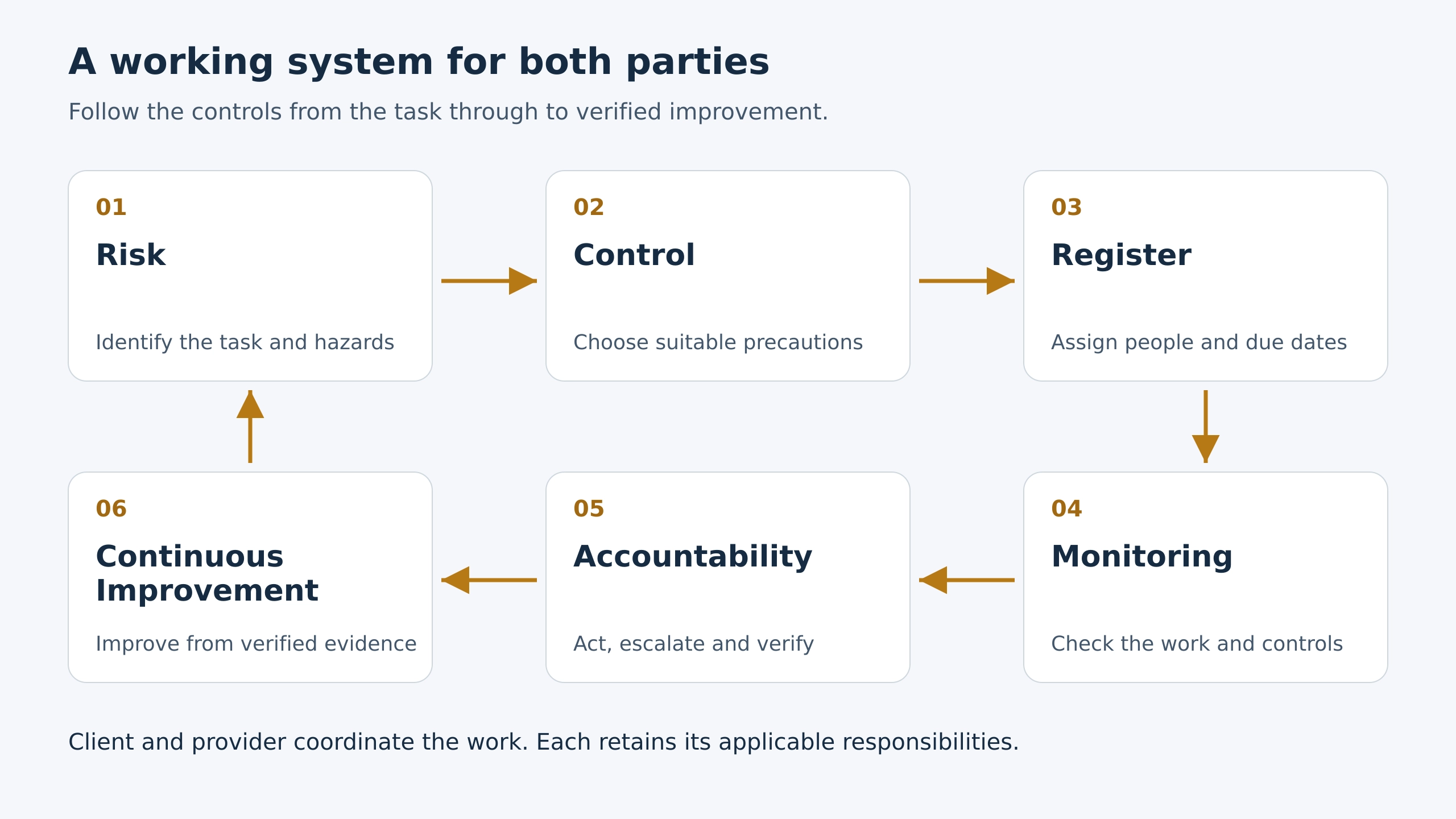
Connect each important control to a responsible person, evidence and ongoing review.
A Friday shutdown shows why both sides matter
Consider a fictional warehouse planning electrical maintenance and cleaning before Monday. Procurement requests "service and clean the area", but the scope does not identify overlapping activities. The electrical contractor expects an isolation; the client expects the contractor to arrange it. The cleaner brings a different product from the one reviewed.
The useful response begins with coordination. Clarify the work and isolation responsibility, review the changed product, sequence the activities and confirm who authorises the restart. If a critical prerequisite is unresolved, the affected work is not ready.
The client gains a clearer programme and fewer surprises. The contractors gain accurate information and an agreed method for resolving obstacles. A connected record helps everyone see the decision, its owner and the evidence supporting it.

Induction should prepare people for the actual site and work they will encounter.
The SafetyWallet model: one platform, multiple layers of support
The SafetyWallet model combines a SaaS subscription, OHS Online, structured Health and Safety methods, learning and support. Its principle is Ownership with Support: organisations manage their responsibilities with a connected system and practical guidance.
OHS Online is the digital engine. The Triple P System—Policies, Procedures and Practices connects management intent to daily implementation. Task-Based Risk Assessment identifies the controls that shape procedures, registers, training and inspections.
Job Safety Observations test actual practice. MES, the Mindset Evolution Schema, supports respectful recognition, coaching and development after immediate risks are controlled. Its connection to behaviour based safety follows:
Start with observable facts and discuss influences without diagnosing people or assuming motives. Recognise a contractor who reports a changed condition; resolve the condition as well as reinforcing the safe decision.
Health and Safety eLearning and My Safety Hub support learning. Expert health and safety support and approved Partners add capacity within agreed scope. The SafetyWallet Shop, also known as My Safety Shop, provides relevant products and services.
Together, these support a practical health and safety management system. Organisations developing their management approach can also explore ISO 45001 support in South Africa; certification remains a separate assessment outcome.
How OHS Online helps clients, contractors and suppliers
Find providers and become discoverable
The SafetyWallet Contractor and Supplier Directory allows logged-in subscribers to search participating organisations by relevant products, services and keywords. With consent, contractors and suppliers choose how their offerings are categorised and found.
For clients, this supports discovery and direct invitations into a managed relationship. For providers, it creates visibility among subscribers looking for their services. It is a business-discovery opportunity; enquiries, contracts and appointments are not guaranteed. Listing does not certify competence or replace the client's evaluation.
Keep authorised information connected
A participating SafetyWallet contractor or supplier can maintain its own Health and Safety programme and share relevant, authorised information with connected clients. When applicable shared information is updated, the client's view updates automatically. An overdue shared managed requirement is flagged for review and follow-up.
This can reduce repeated requests and outdated copies. Access remains relationship-specific: one client should not receive unrelated client records or unnecessary personal information.
Existing providers can also be invited without a directory listing or existing subscription. External organisations use the upload portal to maintain requested documents manually; that route is not automatically linked to a complete OHS Online programme.
Use visibility to support decisions
Software gives visibility, but visibility is not the same as control. Someone still needs to inspect, verify information, resolve an overdue item and decide whether work may proceed. A flag supports that decision; it does not automatically suspend a contractor.
OHS Connect supports self-management with internal support. Expert Guidance adds professional guidance within its agreed allocation. Both retain employer ownership. A contractor or supplier that subscribes also gains a system for its own people and operations, beyond its clients' document requests.

Relevant, authorised information helps both organisations prepare and make decisions.
What each party gains
| Client or subscriber | Contractor or supplier |
|---|---|
| Easier discovery of participating providers | Visibility for selected products and services |
| Clearer requirements and readiness decisions | Earlier notice of what the client needs |
| Current authorised information and overdue visibility | Less repetitive sharing of the same maintained information |
| Better coordination and action tracking | A clear route for raising site obstacles or changes |
| Evidence for ongoing relationship reviews | Fairer assessment, recognition and improvement opportunities |
Book a SafetyWallet demo to explore contractor discovery, connected information sharing and ongoing management for your organisation.
Book a SafetyWallet demo →Subscriber rewards for active contractor and supplier management
Qualifying SafetyWallet subscribers earn an additional reward discount based on the total number of qualifying contractors and suppliers they actively manage through the OHS Online Contractor and Supplier Module.
| Actively managed contractors and suppliers | Reward discount |
|---|---|
| 0–4 | No contractor/supplier management reward |
| 5–9 | 2.5% |
| 10–14 | 5% |
| 15–19 | 7.5% |
| 20–24 | 10% |
| 25 or more | 12.5% |
How the reward is calculated
Only the percentage for your applicable tier applies. The tiers are non-cumulative, meaning percentages from lower tiers are not added together. As your qualifying total reaches a higher tier, that tier’s percentage replaces the previous percentage.
For example, actively managing 10 qualifying contractors and suppliers earns a 5% reward discount, not 2.5% plus 5%.
The maximum Contractor and Supplier Management Reward Discount is 12.5% for 25 or more actively managed contractors and suppliers, subject to meeting the programme’s qualifying criteria.
Where the reward applies
The reward applies to products and services available for purchase through OHS Online within the SafetyWallet ecosystem, including approved Partner services offered there. It does not automatically apply to an external contractor’s invoice or your SafetyWallet subscription fee. The reward cannot be exchanged for cash.
The separate Compliance Discount has its own qualifying requirements. Any combined application is governed by the applicable reward programme rules.
What counts as active management?
Active management means maintaining genuine contractor and supplier relationships through ongoing management of relevant requirements, information review, monitoring and follow-up under the programme rules. A directory listing, invitation or stored document alone does not qualify.
The reward belongs to the qualifying subscriber managing those relationships. A contractor or supplier that is also a qualifying SafetyWallet subscriber can earn its own reward by actively managing its own contractors and suppliers. Being managed by a client does not entitle it to that client’s discount.
Software only vs consultant only vs the SafetyWallet model
| Approach | What it solves | What it can miss | Best use | Long-term result |
|---|---|---|---|---|
| Software only | Organises information | Workplace action | Supporting capable owners | Depends on consistent use |
| Consultant only | Provides expertise | Daily follow-through | Defined specialist input | Depends on implementation |
| Safety file/document approach | Stores instructions and evidence | Changing conditions | Supporting work decisions | Needs continuing review |
| SafetyWallet model | Connects software, training, support, risk, controls, behaviour and accountability | Still needs employer action | Building internal ownership | Supports sustained improvement |
Make the next appointment a better-managed relationship
Start with one current provider. Define the work, agree who controls each important interface, check readiness and assign follow-up. Extend this discipline across all applicable contractor and supplier relationships.
For a Department of Employment and Labour inspection, a practical preparation question is whether your team can explain its arrangements and retrieve the evidence behind them. Accurate records should reflect what happened in the workplace.
SafetyWallet helps bring those activities together so clients and providers can prepare, communicate and improve with support.
Our purpose remains: "We believe in making sure your loved ones return home healthy and safe after work."
Talk to the SafetyWallet team about connecting your contractor and supplier relationships to your Health and Safety programme.
By SafetyWallet. Based on its Contractor and Supplier Health and Safety Management learning material and practical Ownership with Support approach. This article provides general educational guidance; specific legal arrangements require advice appropriate to their facts.