
Many employers only start looking for their Health and Safety file after the Department of Employment and Labour has already sent a notice of inspection. That is where the pressure starts. The notice does not only ask for documents. It asks for evidence that the employer understands its duties, keeps records, involves Health and Safety Representatives, manages risk, and can show practical control in the workplace.
A Department of Employment and Labour inspection normally tests three things at the same time: your paperwork, your workplace conditions and your people's understanding of Health and Safety. The notice may say documents audit and walk-through inspection, but the real question behind it is simple: can the employer prove that Health and Safety is being managed in practice?
The inspection notice confirms that the inspector may examine records required under the Occupational Health and Safety Act and COIDA, that these records must be ready on arrival, that Health and Safety Representatives and employee representatives must be part of the inspection, and that the inspector may choose employees to interview. It also states that if the employer uses an agent, the employer remains responsible for obtaining the relevant documentation before the inspection.
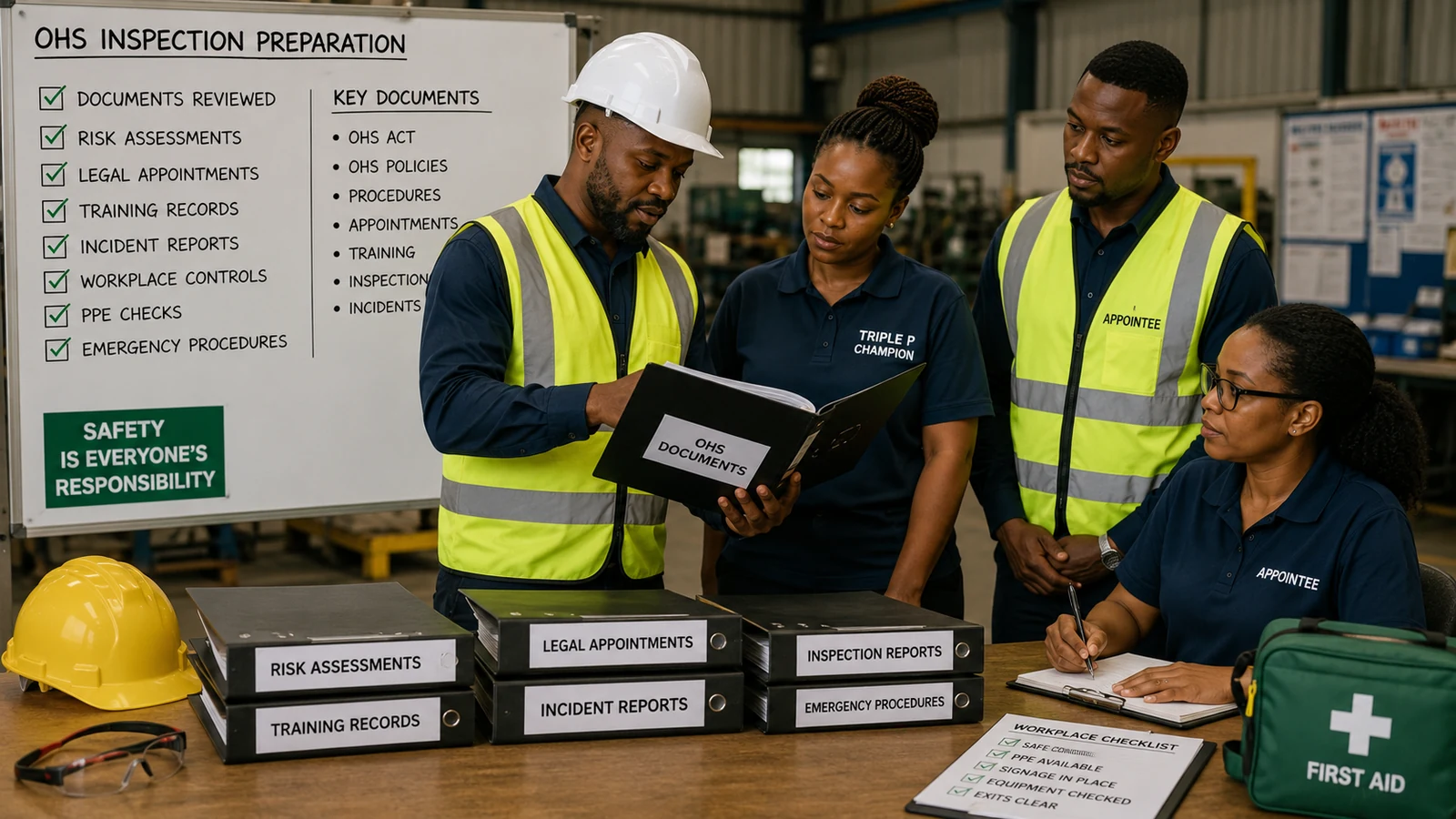
Inspection readiness starts before the inspector arrives, with documents, people and workplace controls prepared.
Short Answer
To prepare for a Department of Employment and Labour Health and Safety inspection, an employer should gather all required OHS Act and COIDA records, check that appointments and competencies are current, verify risk assessments and registers, prepare Health and Safety Representatives, complete a workplace walk-through, close obvious gaps, and make sure employees understand the risks and controls linked to their work.
SafetyWallet helps employers prepare by using OHS Online, Triple P, task-based risk assessments, registers, inspections, evidence tracking, training support and partner assistance to turn inspection preparation into a managed Health and Safety system.
Need help checking whether your inspection documents are ready? SafetyWallet can help you organise your OHS records, registers and evidence before the inspection. Explore health and safety compliance in South Africa with SafetyWallet.
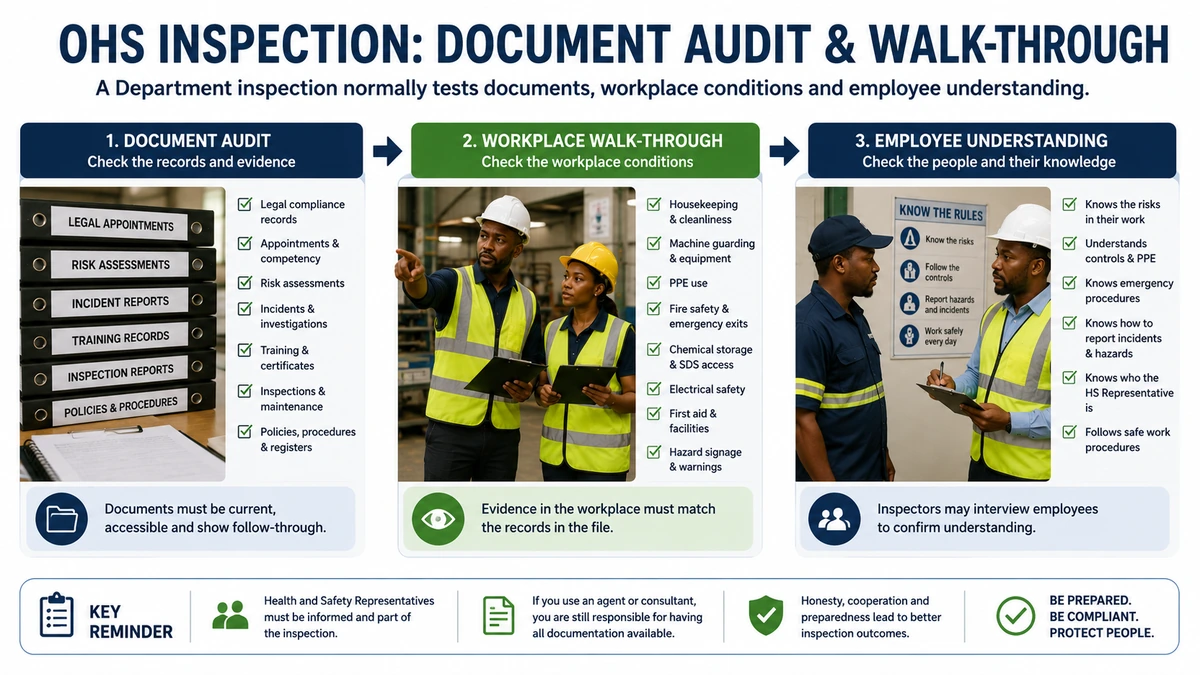
A Department inspection normally tests documents, workplace conditions and employee understanding.
Why a Department of Employment and Labour Inspection Is Not Only a Paperwork Exercise
The Department workplace Health and Safety guidance explains that employers must, as far as reasonably practicable, maintain a working environment that is safe and without risk to workers' health. It also explains that Health and Safety works through communication and cooperation between employer and workers, including representatives who inspect, report and participate in committees.
This is important because many employers prepare for an inspection by printing documents. That is only one part of readiness. An inspector may also check:
- Whether documents are available and current
- Whether appointments are supported by competency
- Whether incidents were recorded and investigated
- Whether Health and Safety Representatives are active
- Whether risk assessments are linked to actual workplace tasks
- Whether controls are visible during the walk-through
- Whether employees know what to do
- Whether equipment inspections are in place where applicable
The Department guidance confirms that inspectors may request documents, inspect and copy records, question people, inspect workplace conditions and, where necessary, issue prohibition, contravention or direction notices.
That is why SafetyWallet's view is practical: do not prepare only for the file. Prepare for the system.
The Inspection Notice Tells the Employer What to Prepare
The notice contains five practical instructions before the annexure list even begins.
First, the inspection is conducted in terms of the Occupational Health and Safety Act and COIDA. This means the employer must prepare both Health and Safety compliance records and Compensation Fund / COIDA records.
Second, the inspection includes a document audit and a workplace walk-through. This means the employer should not only gather files. The employer should physically walk the site before the inspector arrives.
Third, the Health and Safety Representatives and employee representatives must be informed and must be part of the inspection. This is not a management-only exercise.
Fourth, the inspector may choose employees to be interviewed. Employees should not be coached to give false answers. They should understand the real risks, rules, PPE, emergency procedures and reporting process linked to their tasks.
Fifth, if the employer uses a consultant, partner or agent, the employer remains responsible for making sure the documentation is available before the inspection. A consultant can support. A partner can assist. SafetyWallet can guide, structure and help manage evidence. But the employer remains responsible for Health and Safety at its workplace.
The Department has publicly stated that responsibility for compliance with statutory workplace requirements rests with the employer.
What We See Repeatedly in South African Workplaces
In many South African workplaces, the problem is not that there are no documents. The problem is that documents do not always prove daily control.
- A Health and Safety file exists, but inspections are overdue
- Appointments are signed, but appointees are unsure what their duties mean
- Risk assessments were done once, but are not connected to SOPs, inspections or control measures
- First aiders and fire fighters were trained, but certificates have expired
- Incidents are discussed informally, but not recorded and investigated properly
- Safety Data Sheets exist, but employees using chemicals do not know where to find them
- Lifting equipment or pressure equipment is used, but statutory inspections are not easy to produce
- Health and Safety committee minutes exist, but actions are not followed through
- Employees know the task, but cannot explain the hazard, risk and control clearly
- Consultants helped to set up the file, but internal ownership never developed
This is why the SafetyWallet approach follows a living control logic:
The inspection notice asks for documents, but the employer should use the inspection as an opportunity to test whether this chain is actually working.
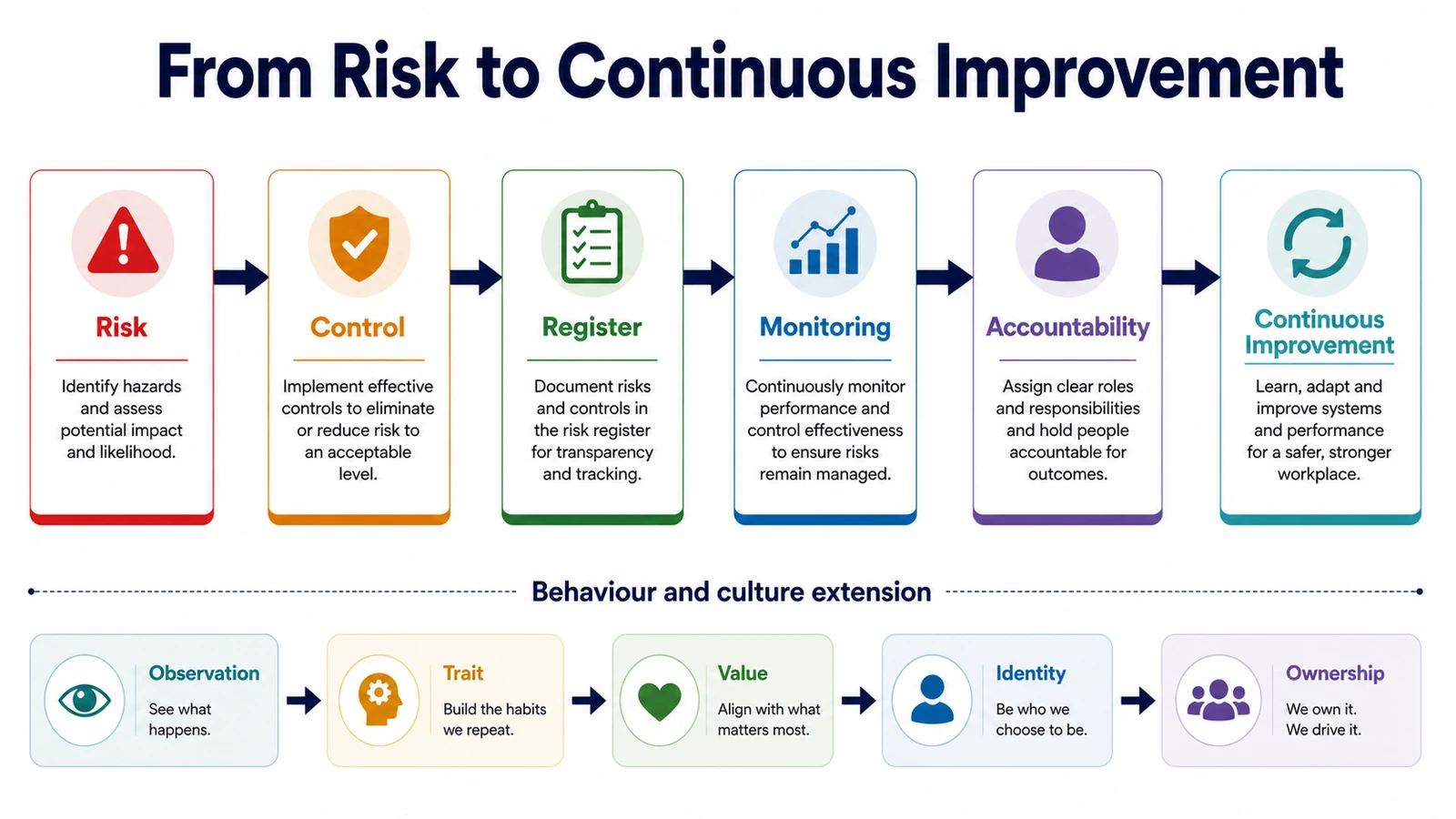
The strongest inspection preparation follows the flow from risk to control, register, monitoring and accountability.
The 25 Inspection Points Explained and How Employers Should Prepare
The annexure in the inspection notice lists minimum documents, records, reports and forms required to be kept on the premises where applicable. Below is a practical explanation of each point.
| No. | Inspector asks for | How the employer should prepare | How SafetyWallet and partners can assist |
|---|---|---|---|
| 1 | COIDA registration number | Confirm that the employer is registered with the Compensation Fund and that the registration number is available. | SafetyWallet can help keep COIDA details visible in the compliance record and support COIDA document tracking. Partners may assist with COIDA administration where required. |
| 2 | CIPC certificate | Keep the latest company registration certificate available. Check that the trading name, registered name and company details match other records. | OHS Online can store the CIPC certificate as part of the company profile and compliance evidence. |
| 3 | Return of Earnings submitted to the Compensation Commissioner for the past financial year | Keep proof of the latest Return of Earnings submission. Make sure it aligns with payroll and Compensation Fund records. | SafetyWallet can help track ROE evidence and remind the employer of missing annual documentation. |
| 4 | Latest proof of payment for COIDA | Keep proof that the Compensation Fund assessment has been paid. | SafetyWallet can store proof of payment and help management see whether annual COIDA evidence is complete. |
| 5 | Number of incident or occupational disease claims submitted last year | Prepare a summary of COIDA claims submitted, including claim numbers where available. Reconcile this with the incident register. | OHS Online can support incident recording, investigation evidence and claims tracking. |
| 6 | Copy of the Occupational Health and Safety Act and Regulations | Ensure a copy of the OHS Act and applicable regulations is accessible to workers and management. | SafetyWallet can support access to relevant Health and Safety legal and policy documents through the Health and Safety management system. |
| 7 | OHS appointments and proof of competency | Check all appointment letters: 16(2), GMR 2 competent person, First Aiders, Fire Fighters, H&S Representatives and other applicable appointments. Confirm competency certificates are current. | Triple P and OHS Online can help structure appointments, upload proof of competency, identify missing certificates and support appointee role clarity. |
| 8 | Health and Safety Representative inspection reports | Make sure H&S Rep inspections are completed, signed, dated and actioned. Evidence should show findings and corrective actions. | OHS Online can schedule inspections, capture findings, attach evidence and track corrective actions. |
| 9 | Health and Safety Committee minutes — minimum last 4 consecutive minutes | Prepare at least four consecutive committee minutes. Check attendance, agenda, incidents, inspections, actions and follow-up items. | OHS Online and SafetyWallet support can help structure committee evidence and action tracking. |
| 10 | Incident register for recording and investigation of incidents or occupational diseases | Ensure the incident register is up to date and that incidents were investigated, not merely listed. | OHS Online can support incident recording, investigation steps, corrective actions and evidence. |
| 11 | Lifts, escalators, passenger conveyors and goods hoist registration certificates and record book | Where applicable, keep registration certificates and record books available. Check latest inspection entries. | Partners can assist in identifying applicable equipment and arranging competent inspection support where needed. |
| 12 | Lifting machines and lifting tackle record books | Keep records for forklifts, cranes, slings, chains, hooks and other lifting equipment where applicable. | OHS Online can store inspection records and help track due dates. Partners can assist with statutory inspection coordination. |
| 13 | Certificates and inspection reports for pressure equipment | Prepare certificates and latest inspection reports for compressors, pressure vessels, boilers or other pressure equipment where applicable. | SafetyWallet partners can help identify pressure equipment records and coordinate with approved inspection service providers where required. |
| 14 | Steam generator registration certificate | Where applicable, keep the registration certificate and inspection records ready. | Partners can assist with specialist statutory equipment support where applicable. |
| 15 | Certificate of Compliance for electrical installation | Keep a valid electrical COC available and check whether changes to the electrical installation require updated certification. | OHS Online can store the COC and support expiry or review tracking. |
| 16 | Certificate of conformity for gas installations | Where gas installations exist, keep certificates available and check that cylinders, storage and signage are controlled. | Partners can assist with gas installation compliance evidence and workplace checks. |
| 17 | Medical surveillance programme | Where employees are exposed to health risks that require medical surveillance, prepare the programme and explain who is included and why. | SafetyWallet risk assessment process can help identify tasks and exposures that may trigger medical surveillance needs. |
| 18 | Medical surveillance and biological monitoring records | Keep confidential records controlled and accessible only in the correct manner. Prepare proof that the programme is being implemented. | SafetyWallet can help track whether medical surveillance actions exist, while employers must manage confidentiality and medical record control responsibly. |
| 19 | Risk assessment records, including health risk assessment | Ensure risk assessments are current, task-based and linked to hazards, risks and control measures. | SafetyWallet task-based risk assessment approach helps connect tasks, hazards, risks, controls, SOPs and inspections. |
| 20 | Occupational hygiene monitoring reports | Where exposure to noise, dust, fumes, chemicals or other health hazards exists, prepare occupational hygiene monitoring reports. | Partners can help identify monitoring needs and coordinate occupational hygiene service providers where needed. |
| 21 | Safety Data Sheets for Hazardous Chemical Agents | Keep SDSs for chemicals used on site. Make sure employees know the hazards, PPE, storage and emergency actions. | OHS Online can store SDSs, while inspections and training can test whether controls are understood. |
| 22 | Valid certificates of training for forklift and/or crane operators, with name list | Prepare operator certificates and a list of operators. Check expiry dates and equipment authorisation. | OHS Online can store training certificates and help track expiry dates. Partners can support training gap identification. |
| 23 | Employee list with names, gender and ID/passport numbers | Prepare a current employee list. Make sure contractors, labour broker workers or temporary workers are clearly understood where applicable. | SafetyWallet can help structure workforce-related compliance evidence in the management system. |
| 24 | Copies of exemptions issued by the Department of Employment and Labour | If exemptions were issued, keep copies available. If none exist, state that clearly. | OHS Online can store exemption documents and expiry conditions where applicable. |
| 25 | Complete and return employer particulars template by email | Complete the basic particulars form accurately and send it before the inspection if requested. Keep proof of submission. | SafetyWallet or a partner can help the employer review the form for completeness, but the employer must approve and submit accurate information. |
The Practical Preparation Plan Before the Inspection
Step 1: Confirm the inspection details and verify the inspector
Check the date, time, location, inspection type and contact details. If there is any doubt, verify the inspector using the contact route provided in the notice. Do not ignore the notice and do not wait until the day before the inspection.
Step 2: Build an inspection evidence pack
Create one pack for the inspector with a logical index. The pack should include COIDA documents, CIPC certificate, OHS Act access, appointment letters, competencies, H&S Rep inspections, committee minutes, incident records, risk assessments, equipment inspection records, certificates, SDSs, medical surveillance evidence where applicable and employee lists. This pack can be digital, physical or both, but it must be ready on arrival.
Step 3: Do your own document audit before the inspector arrives
Check every document against four questions: Is it available? Is it current? Is it signed or approved where required? Does it show follow-through? A signed appointment letter with no proof of competency is weak evidence. A risk assessment with no control verification is weak evidence. A committee minute with repeated actions and no closure is weak evidence.
Step 4: Conduct a workplace walk-through
Because the notice includes a walk-through inspection, the employer should physically inspect the workplace before the inspector arrives. Look at housekeeping, machine guarding, emergency exits, fire equipment, chemical storage, PPE use, signage, lifting equipment, pressure equipment, electrical risks, first aid boxes, incident reporting points and visible unsafe conditions. The aim is not to hide problems. The aim is to identify and correct obvious gaps before the inspection.
Step 5: Prepare Health and Safety Representatives and appointees
Health and Safety Representatives may accompany inspectors and participate in discussions during workplace inspections. They should understand their area, recent inspections, unresolved findings, incidents, committee actions and how to report concerns. Appointees should understand the duty they accepted. A 16(2) appointee, First Aider, Fire Fighter, H&S Representative, competent person or operator should not only have a signed letter or certificate. They should know what the appointment means in practice.
Step 6: Prepare employees for honest interviews
The inspector may interview employees. The employer should not script or coach false answers. Instead, employees should be reminded of the actual Health and Safety arrangements: the main risks in their task, what PPE must be used, what control measures apply, how to report unsafe conditions, who their Health and Safety Representative is, what to do in an emergency, where Safety Data Sheets are located, and what must happen after an incident or near miss.
Where SafetyWallet and Partners Fit In
SafetyWallet is not there to take over the employer's legal responsibility. SafetyWallet helps the employer build the system, structure, visibility and accountability needed to manage that responsibility practically.
The SafetyWallet platform supports employers through OHS Online, Triple P, risk assessments, registers, appointee records, inspections, corrective actions, evidence tracking, training support, My Safety Hub and partner assistance.
OHS Online: the digital evidence and accountability layer
OHS Online helps employers keep Health and Safety records organised, supporting inspection readiness because documents, registers, appointments, inspections, incidents, training and corrective actions can be managed in one digital environment. Software gives visibility, but visibility is not the same as control. A dashboard can show overdue inspections, but someone still needs to inspect. A register can show missing evidence, but someone still needs to upload and verify it. That is why OHS Online must be used as part of a living system.
Triple P: the structure behind the documents
The Triple P System helps organise Health and Safety into Policies, Procedures and Practices. This matters during an inspection because an inspector is not only looking for a file. The inspector may ask whether policies are understood, whether procedures are followed and whether practices are visible in the workplace.
Task-Based Risk Assessment: the foundation of control
A strong inspection preparation process must include health and safety risk assessments. Risk assessments should not be generic. They should be linked to actual tasks, hazards, risks, controls and safe operating procedures. For example, a forklift operation risk assessment should connect to operator training, pre-use checks, pedestrian separation, speed control, visibility, maintenance, incident reporting and supervision. That is how risk becomes control.
Registers and monitoring: the evidence trail
Registers are where compliance becomes visible. Appointments, equipment, inspections, training, incidents, SDSs, medical surveillance and statutory inspections should not sit in disconnected files. They should feed a management rhythm.
MES and behaviour: preparing people, not only files
Some inspection findings are document problems. Many are behaviour and ownership problems. Employees may have PPE but not wear it. A chemical store may have SDSs but workers may not know what they mean. This is where behaviour based safety and the SafetyWallet MES approach support safety culture by linking workplace actions to traits, values, identity and ownership.
Partner and expert support: capacity when the employer needs help
Some employers need practical help before an inspection. SafetyWallet and its partner network can assist with document reviews, gap identification, walk-through preparation, appointee coaching, statutory equipment record review and corrective action planning. Where expert health and safety support is required, partners can help the employer identify what is needed and coordinate the right specialist. The employer remains responsible, but the employer does not have to prepare blindly.
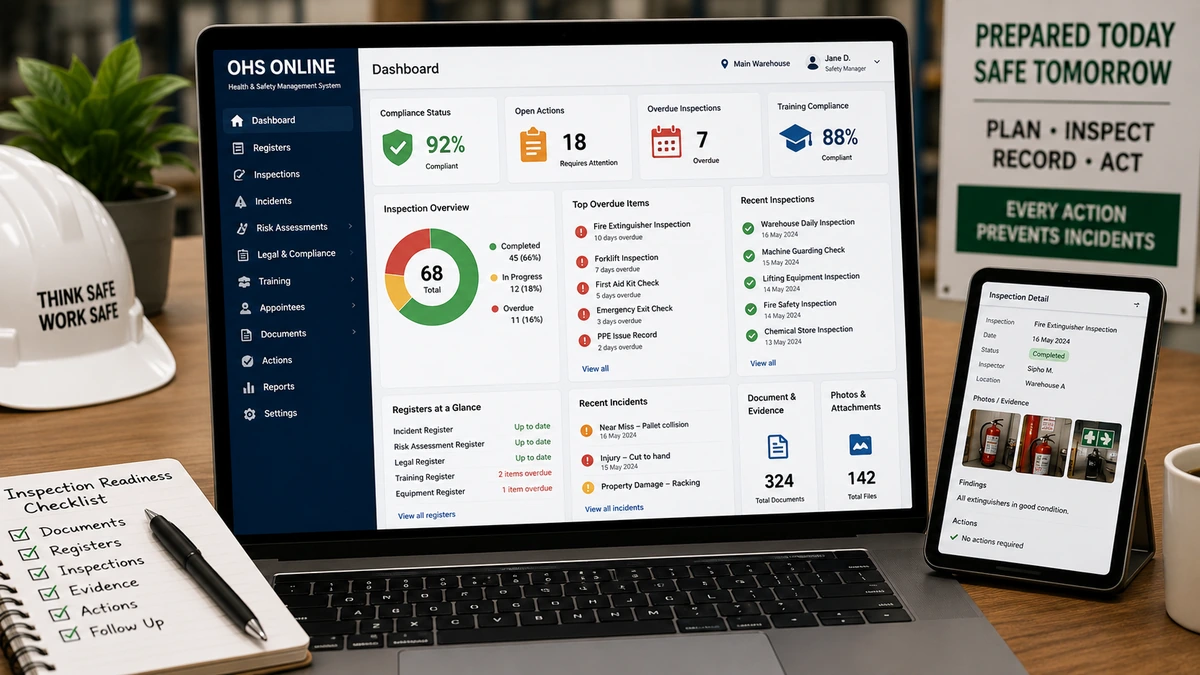
Inspection readiness improves when evidence, registers and actions are managed in one system.
Prepare with more confidence.
Use SafetyWallet, OHS Online and expert partner support to check your documents, risk assessments, appointees, inspections and corrective actions before the inspector arrives.
Explore health and safety compliance in South Africa →A Practical Inspection Readiness Checklist
Before the inspection day, management should be able to answer these questions:
- Is our COIDA registration and proof of payment available?
- Are our appointment letters current and signed?
- Do all appointed persons have proof of competency?
- Are H&S Rep inspections up to date?
- Do we have the last four Health and Safety committee minutes?
- Are incidents recorded, investigated and closed out?
- Are risk assessments current and task-based?
- Are chemical SDSs available and understood?
- Are equipment inspections up to date where applicable?
- Are training certificates valid?
- Are medical surveillance records in place where required?
- Are employees ready to explain the risks and controls of their work?
- Has management walked the workplace before the inspector arrives?
- Is there a person responsible for presenting each part of the evidence?
- Are open gaps recorded with action plans?
If the answer to any of these is "we are not sure," that item should become an urgent action before the inspection.
What Should Happen on the Day of Inspection?
On the day of inspection, the employer should receive the inspector professionally, verify details where necessary, have management and Health and Safety Representatives available, provide the document pack, answer questions honestly and accompany the inspector during the walk-through.
Do not argue defensively. Do not hide documents. Do not prevent employees from speaking to the inspector. Do not present documents you know are inaccurate.
If findings are raised, record them carefully. Ask for clarity where needed. Assign responsible persons and dates for corrective actions. After the inspection, update your registers and health and safety management system so that findings do not disappear after the inspector leaves.
How This Supports ISO 45001 and a Stronger Health and Safety Management System
Even if the employer is not certified to ISO 45001, the inspection preparation process supports the same practical discipline: leadership, worker participation, risk assessment, operational control, competency, documented information, performance evaluation and continual improvement.
SafetyWallet can support an ISO 45001-aligned health and safety management system by helping employers connect documents, risk assessments, controls, inspections, evidence and improvement actions.
For employers that want to move beyond reactive inspection preparation, the better long-term approach is a health and safety management system that is used weekly, not only when a notice arrives.
Conclusion
A Department of Employment and Labour inspection notice should not be treated as a once-off scramble for files. It should be treated as a test of the employer's Health and Safety system.
The annexure tells you what records may be required. The walk-through tests whether the workplace reflects those records. Employee interviews test whether people understand the system. The employer's response to findings tests whether accountability exists.
SafetyWallet helps employers prepare by turning inspection requirements into a practical management system: documents, registers, appointees, risk assessments, inspections, control measures, training, behaviour and corrective actions working together.
The employer remains responsible for Health and Safety. SafetyWallet and its partners help the employer build the visibility, structure, support and rhythm needed to manage that responsibility with more confidence.
We believe in making sure your loved ones return home healthy and safe after work. That purpose becomes real when compliance is not only stored in a file, but managed through daily control and ownership.
Book a SafetyWallet demo and see how OHS Online, Triple P, risk assessments and partner support help South African employers manage health and safety compliance in South Africa.