

A compliance audit should move from score and findings into practical controls, evidence and accountability.
Many South African companies only become serious about Health and Safety compliance when someone asks for proof: a client, a tender department, an insurer, a Department of Employment and Labour inspector, or a board member who wants to know whether the company is exposed.
That is why a Health and Safety Compliance Audit matters. But the audit itself is not the finish line. An audit measures the current state of compliance. The real value starts after the audit, when every finding becomes an action, every action is linked to a control measure, and every control measure is monitored until it becomes part of daily work.
This is where the SafetyWallet platform takes a different position. SafetyWallet does not treat compliance as a once-a-year file exercise. It helps employers turn audit findings into a living health and safety management system rhythm, supported by OHS Online, Triple P, task-based risk assessment, MES, practical support and internal accountability.
Need a clearer view of your compliance gaps? SafetyWallet can help you turn audit findings into practical action. Explore health and safety compliance in South Africa with SafetyWallet.
Short Answer
A Health and Safety Compliance Audit in South Africa is a structured assessment of a workplace's Health and Safety programme against the OHS Act, applicable regulations, standards, by-laws and internal safety requirements. It helps identify compliance gaps, risk exposure, missing evidence, weak controls and corrective actions. The strongest audit process does not end with a report. It follows this logic:
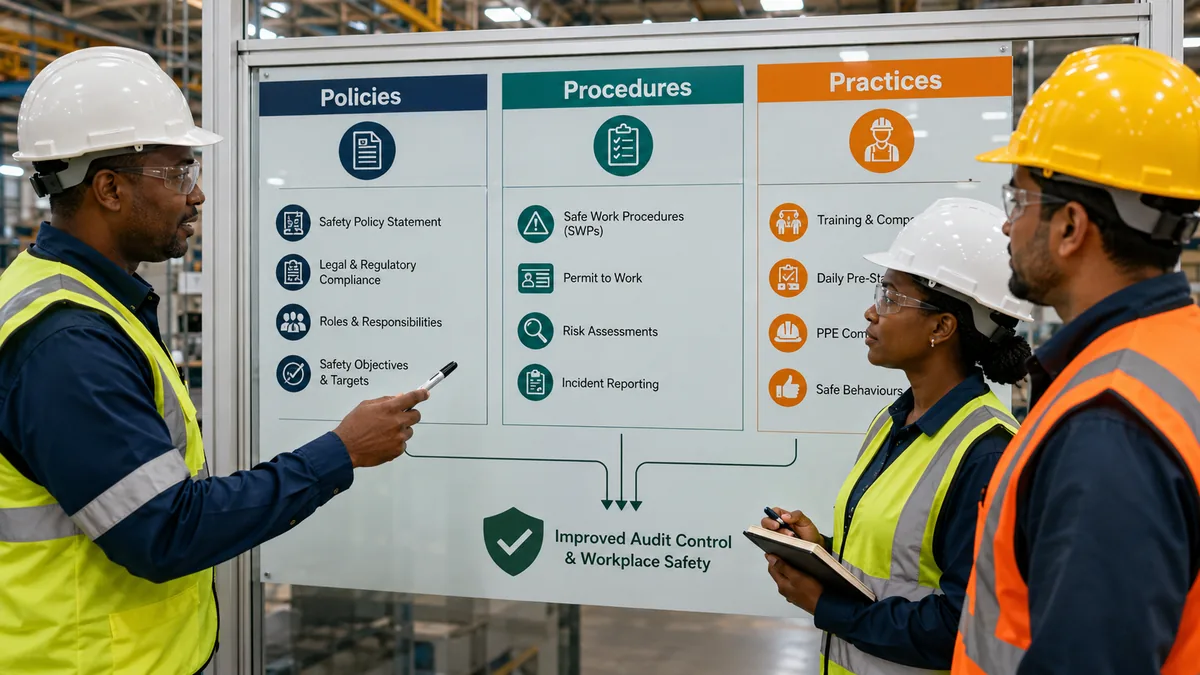
The strongest audit process turns every finding into an accountable control action.
What Is a Health and Safety Compliance Audit?
A Health and Safety Compliance Audit is a formal review of how well a business is managing its workplace Health and Safety duties. In South Africa, employers have a legal duty to provide and maintain, as far as reasonably practicable, a working environment that is safe and without risk to employee health under Section 8 of the Occupational Health and Safety Act 85 of 1993.
A proper audit looks at whether the company can show evidence of this duty in practice. It should not only ask, "Do you have a file?" It should ask whether the system is working where the work happens.
- Are the right policies in place?
- Are procedures linked to actual tasks?
- Are task-based risk assessments current?
- Are hazards and controls clearly identified?
- Are inspections being done?
- Are findings closed out and verified?
- Are appointees trained and active?
- Are registers maintained and visible?
- Are workers informed and involved?
- Are control measures working in real tasks?
This is why SafetyWallet connects compliance audits to task-based risk assessments, OHS Online registers, action requests, inspections, evidence and accountability.
Is a Health and Safety Compliance Certificate Enough?
A Health and Safety Compliance Certificate can be useful as evidence that an audit or verification process has taken place. It can help with tenders, client requirements, supplier onboarding and internal governance.
But a certificate is not the same as ongoing compliance. A workplace can receive a positive audit outcome and still become unsafe later if conditions change, equipment deteriorates, training expires, inspections are skipped, contractors arrive, or employees stop following procedures.
The better question is not only: "Can we get a certificate?" The better question is: "Can we prove that our controls are still working today?"
What Should a Health and Safety Compliance Audit Measure?
| Audit Area | What Should Be Checked |
|---|---|
| Legal duties | OHS Act, applicable regulations, standards, by-laws and internal requirements |
| Policies | Relevant, approved and communicated Health and Safety policies |
| Procedures | Clear procedures that explain implementation requirements |
| Practices | Daily work practices, SOPs and task controls that match the risk profile |
| Risk assessments | Current task-based risk assessments linked to hazards, risks and controls |
| Appointments | Responsible persons appointed in writing and clear on duties |
| Training | Employees and appointees competent for their roles |
| Inspections | Workplace inspections completed, evidenced and followed up |
| Registers | Legal and operational registers maintained and reviewed |
| Incidents | Incidents reported, investigated and converted into corrective actions |
| Contractors | Contractor risks, safety files and documentation controlled |
| Emergency readiness | Fire, first aid and emergency controls active and evidenced |
| Corrective actions | Audit findings closed, verified and monitored |
This is also why an audit should feed into a health and safety management system, not remain trapped inside a PDF report.
South African Context: Why Audits Matter
South African employers operate in a practical compliance environment. A business may need to show evidence to clients, auditors, insurers, tender committees, landlords, corporate head offices or inspectors. Inspectors have powers to enter workplaces and inspect plant, machinery, equipment and records under the OHS Act.
This means health and safety compliance in South Africa cannot live in scattered folders. When evidence is needed, the business should be able to show what risks were identified, what controls were implemented, who was appointed, what training was completed, what inspections were done, what findings were raised, what actions were closed, and what still needs attention.
For workplaces with more than 20 employees, Health and Safety representatives must also be designated in writing, subject to Section 17 of the OHS Act. A compliance audit should therefore test whether the Health and Safety structure is alive, not merely documented.
What We See Repeatedly in South African Workplaces
SafetyWallet's practical experience with South African businesses shows that compliance weakness is often not caused by the absence of documents. It is caused by a breakdown between documents, tasks, controls, evidence and ownership.
- Companies have policies, but workers do not always know what those policies mean in daily tasks.
- Risk assessments exist, but they are not always linked to inspections, SOPs and control measures.
- Health and Safety representatives are appointed, but not always confident in what to do.
- Registers exist, but they are not always updated or reviewed.
- Inspections are scheduled, but evidence and follow-through are weak.
- Audit findings are raised, but corrective actions are not always verified.
- Behaviour problems are visible, but the deeper mindset, trait and value layer is not coached.
- Management wants compliance, but lacks a clear dashboard of what is overdue, missing or unresolved.
This is the gap SafetyWallet is built to close. The employer remains responsible for Health and Safety, but the right system can help that responsibility become visible, practical and manageable.
The Better Audit Logic: From Finding to Control
A weak audit produces a report. A strong audit produces movement.
Every audit finding should become part of a practical control process:
Finding identified
Something is missing, weak, expired, unsafe or not evidenced.
Risk understood
The business understands what could go wrong if the gap is not closed.
Control measure defined
The company decides what must prevent harm or eliminate the gap.
Register updated
The issue is recorded in the correct register or action system.
Responsible person assigned
Ownership is clear. One person knows they are accountable for the action.
Evidence uploaded
Proof is captured so the action can be verified.
Verification completed
Someone checks whether the action actually solved the issue.
Monitoring continues
The control is reviewed through inspections or observations so it does not deteriorate again.
That is the difference between an audit as an event and compliance as a system.
Where OHS Online Fits Into a Compliance Audit
OHS Online supports the practical side of compliance by helping a business manage risk assessments, legal appointments, registers, inspections, corrective actions, evidence uploads, training records, dashboards, audit findings and action requests.
This matters because an audit score only has value if the business can manage what happens next. Software gives visibility, but visibility is not the same as control. A dashboard can show overdue inspections, but someone still needs to inspect. A register can show missing evidence, but someone still needs to upload and verify it. A risk assessment can identify hazards, but controls must still be implemented. A policy can exist, but people must still understand and follow it. A consultant can assist, but the client must still build internal ownership.
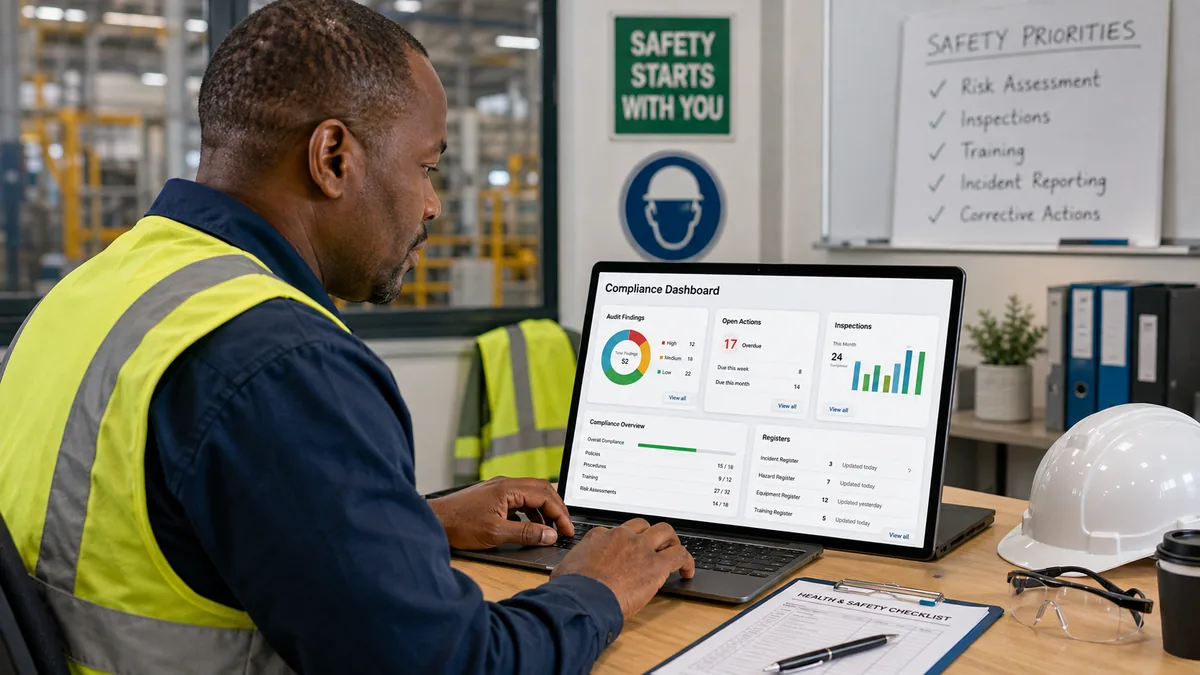
Visibility matters when audit findings are converted into actions, evidence and verification.
The Role of Triple P: Policies, Procedures and Practices
SafetyWallet's Triple P System gives structure to the audit process. Policies explain what the business commits to. Procedures explain how the policy must be implemented. Practices show what must happen in the actual task.
This is important because many companies have generic Health and Safety documents that are not linked to the real work. A policy on its own does not protect a worker. A procedure on its own does not control a hazard. A practice becomes meaningful when it is linked to the task, the hazard, the risk and the control measure.
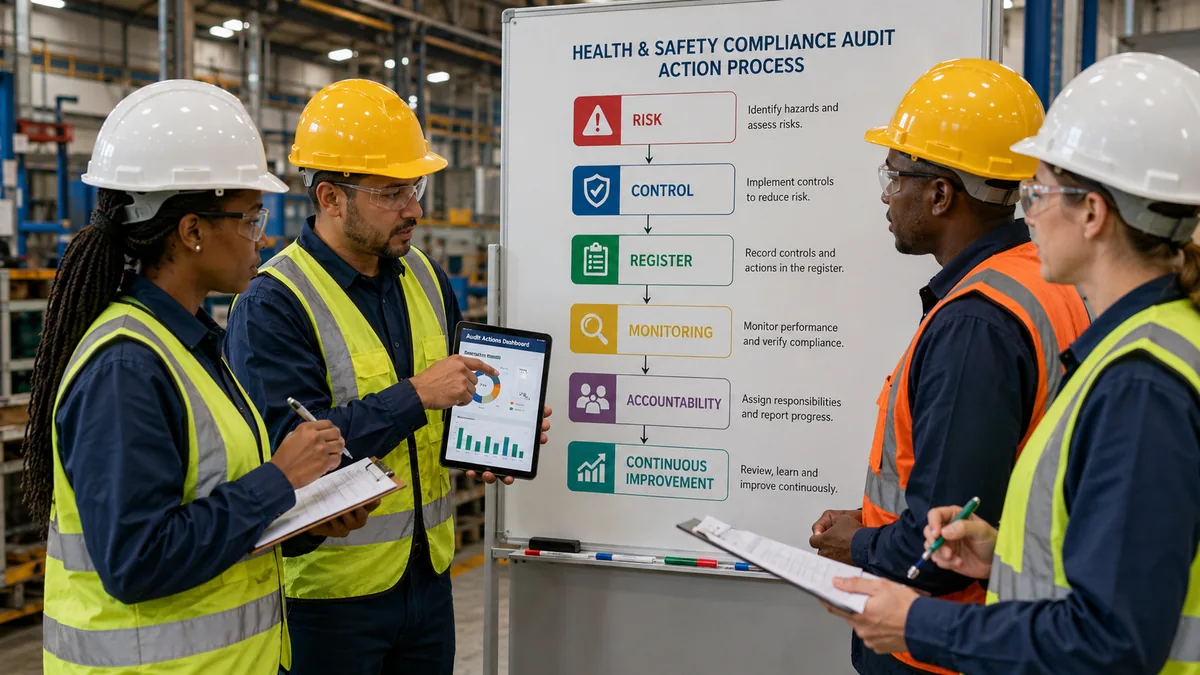
Triple P helps connect written requirements to the way work is actually performed.
Task-Based Risk Assessment: The Foundation of a Better Audit
A proper audit should not only check if a risk assessment exists. It should check whether the risk assessment reflects the work people actually perform.
A task-based risk assessment helps identify the task, hazard, risk, control measure, responsible person, required SOP, inspection requirement and monitoring method.
For example, a warehouse audit may identify forklift movement as a risk area. The finding should not end with "forklift risk present." It should test whether traffic separation is in place, operators are trained, pre-use inspections are done, pedestrian routes are marked, signage is visible, near misses are recorded, and supervisors are observing behaviour around the control.
MES: When the Audit Finding Is Behaviour
Some audit findings are technical. A fire extinguisher is missing. A register is outdated. A training record has expired. Other findings are behavioural. People bypass PPE. Supervisors accept shortcuts. Workers sign documents without understanding them. Teams treat inspections as paperwork.
This is where the MES layer matters. When behaviour, observations or culture are involved, SafetyWallet uses a deeper logic to understand what is really happening:
Behaviour should not be judged in isolation. It should be understood in context. Was the control clear? Was the person trained? Did the team believe the rule mattered? Was the supervisor reinforcing the right value? This is where behaviour based safety and MES coaching become an important part of closing audit findings that go beyond missing paperwork.
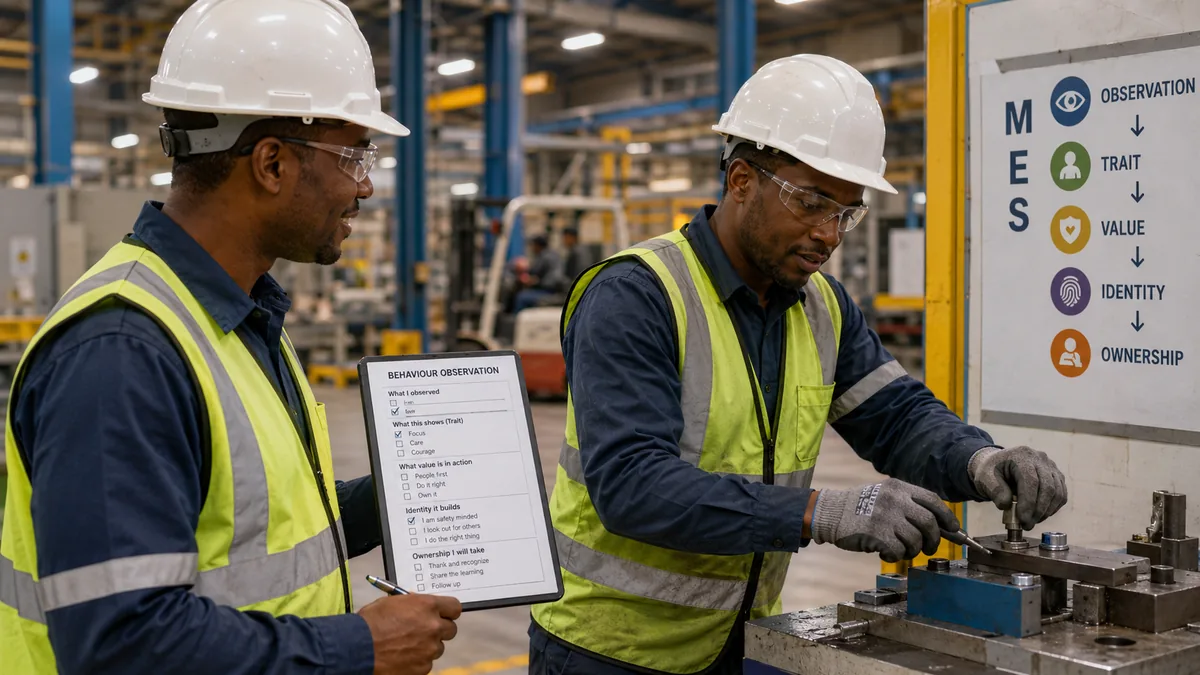
When audit findings involve behaviour, the deeper trait, value and ownership layer must be addressed.
Compliance Audits and ISO 45001
ISO 45001 support in South Africa is the international standard that specifies requirements for an occupational health and safety management system. A Health and Safety Compliance Audit is not the same as ISO 45001 certification, but the two can support each other.
A strong audit helps prepare the organisation for ISO 45001-aligned thinking by testing whether risks are identified, controls are implemented, evidence is available, leadership is involved, workers participate, findings are corrected, and improvement is ongoing.
Software Only vs Consultant Only vs The SafetyWallet Model
| Approach | What it solves | What it often misses | Best use | Long-term result |
|---|---|---|---|---|
| Software only | Visibility, dashboards and storage | Ownership, behaviour and implementation discipline | Tracking activities | Good data, weak action if people do not follow through |
| Consultant only | External expertise and audit input | Internal ownership and daily control | Specialist support | Dependency if the client does not build capacity |
| Safety file / document approach | Documents and basic evidence | Live registers, verification and behaviour | Tender or site access needs | A file that may not drive daily work |
| SafetyWallet model | Software, structure, support, risk, controls, behaviour and accountability | Requires client participation and ownership | Building a living Health and Safety management system | Measurable compliance rhythm and stronger internal ownership |
The SafetyWallet Model: One Platform, Multiple Layers of Support
The SafetyWallet platform is a connected workplace Health and Safety compliance approach that brings together software, policies, procedures, practices, risk assessments, control measure verification, behaviour based safety, training and implementation support.
- OHS Online: the digital Health and Safety management engine
- Triple P: the structure of Policies, Procedures and Practices
- TBRA: the risk foundation for tasks, hazards, risks and controls
- JSO and control measure verification: the practical check that controls are working
- MES: the mindset, behaviour and culture layer
- Expert and partner support: the capacity layer when clients need practical help
- SafetyWallet Shop and My Safety Shop: practical value-added support channels
- My Safety Hub: the education and awareness layer
- Health and safety eLearning: supporting competence and awareness at all levels
This is why SafetyWallet should not be seen as only software or only consulting. It is a workplace Health and Safety compliance platform designed to help employers build visible, practical and accountable compliance.
What Should Happen After the Audit?
After the audit, the business should not simply file the report away. The next steps should be:
- Review the audit score and findings
- Prioritise high-risk gaps first
- Convert findings into action requests
- Link each action to a responsible person
- Add evidence requirements
- Update registers
- Verify closure
- Monitor the control through inspections
- Review trends in management meetings
- Use MES coaching where behaviour affects the control
This is where expert health and safety support can help without removing the employer's responsibility.
Turn your audit findings into daily control.
SafetyWallet helps South African businesses move from audit score to accountability through OHS Online, Triple P, task-based risk assessments, MES and structured support.
Explore health and safety compliance in South Africa →Conclusion
A Health and Safety Compliance Audit is important, but it is not the finish line. The audit tells you where you stand. The system determines whether you improve.
For South African businesses, the real goal is not only to pass an audit or receive a certificate. The real goal is to build a workplace where risks are understood, controls are implemented, evidence is visible, people are accountable and workers return home healthy and safe to their loved ones.
That is the SafetyWallet view of health and safety compliance in South Africa. Audit. Control. Verify. Coach. Improve.
Ready to move from audit score to daily Health and Safety control? Talk to the SafetyWallet team and see how the SafetyWallet platform helps your business turn findings into a living compliance system.