
Many South African organisations only start thinking seriously about Health and Safety when they need an audit report, client approval, QCTO readiness, site approval, or evidence for a Department of Employment and Labour inspection. The problem is that a Health and Safety Audit should not be the starting point. An audit measures whether a system exists, whether it is suitable for the workplace, and whether it is being implemented and maintained in practice.
A Health and Safety Audit checks what is already there. It does not build what is missing. That is why the correct route is to build a practical Health and Safety Management System first, supported by a proper Risk Assessment, control measures, registers, inspections, appointees, training, action tracking and continuous improvement. Once that system is active, the audit can test, verify and improve what has already been built.
Why a Health and Safety Audit Should Not Be the Starting Point
One of the biggest misunderstandings in workplace Health and Safety is the belief that the first step is to request a Health and Safety Audit. In reality, an audit is a measurement tool. It checks whether the organisation has a working system, suitable controls, active registers and reliable evidence.
Many businesses ask for an audit when only a few basic items are in place. They may have first aid training, serviced fire extinguishers, evacuation signs, a few checklists and a basic file. Those items are useful, but they are not the same as a working Health and Safety Management System.
A real system brings risk assessment, control measures, safe operating procedures, registers, inspections, role-player accountability, corrective actions, reporting and review into one connected process. This is where SafetyWallet can support businesses through a practical Health and Safety Management System that helps organisations manage their own responsibilities through structure, visibility and accountability.
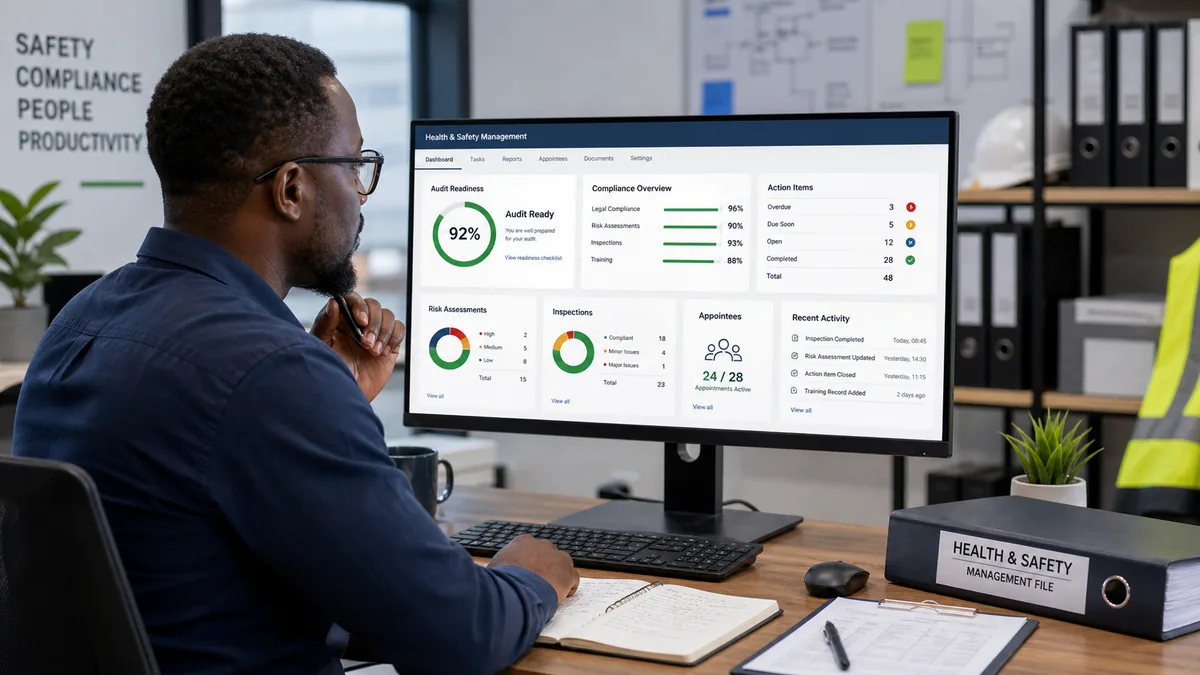
Audit readiness starts with a working Health and Safety Management System, not a last-minute safety file.
Basic Compliance Is Not the Same as a Health and Safety Management System
Basic compliance usually means that a few visible items are in place. There may be first aiders, fire extinguishers, evacuation signage, appointment letters, a safety file and some inspection records. These items matter, but they do not prove that Health and Safety is being managed properly every day.
A business can have the basics and still have no structured way of identifying task exposure, assigning responsibilities, monitoring control measures, tracking corrective actions, reviewing registers or proving consistency across departments and sites.
A checklist asks, "Do you have this?" A Health and Safety Management System asks, "How do you manage this every day?" That is the difference between paper readiness and practical readiness.
Why a Risk Assessment Is the Foundation of the Whole Programme
If an organisation wants to build a meaningful Health and Safety programme, it should start with a proper Health and Safety Risk Assessment. A Risk Assessment is not just another document. It identifies the actual work being done, the hazards linked to that work, the level of exposure, the controls required, and the responsibilities needed to manage those controls.
Without a proper Risk Assessment, the rest of the programme becomes guesswork. Policies become generic. Training becomes broad. Inspections become superficial. Audits become frustrating because there is nothing real to measure.
This is why a task-based Health and Safety Risk Assessment is so important. It connects specific tasks to hazards, control measures, SOPs, registers, inspections, accountability and audit evidence. For example, "working in the kitchen" is too broad. The real tasks may include cleaning a deep fryer, handling hot oil, receiving stock at the back door, operating a pallet jack, storing cleaning chemicals, inspecting a gas cage or completing a first aid box inspection.
Each task has its own hazards, controls, responsible persons and monitoring requirements. When the task is clear, the control can be practical. When the control is practical, the register can be managed. When the register is managed, the organisation can produce real audit evidence.
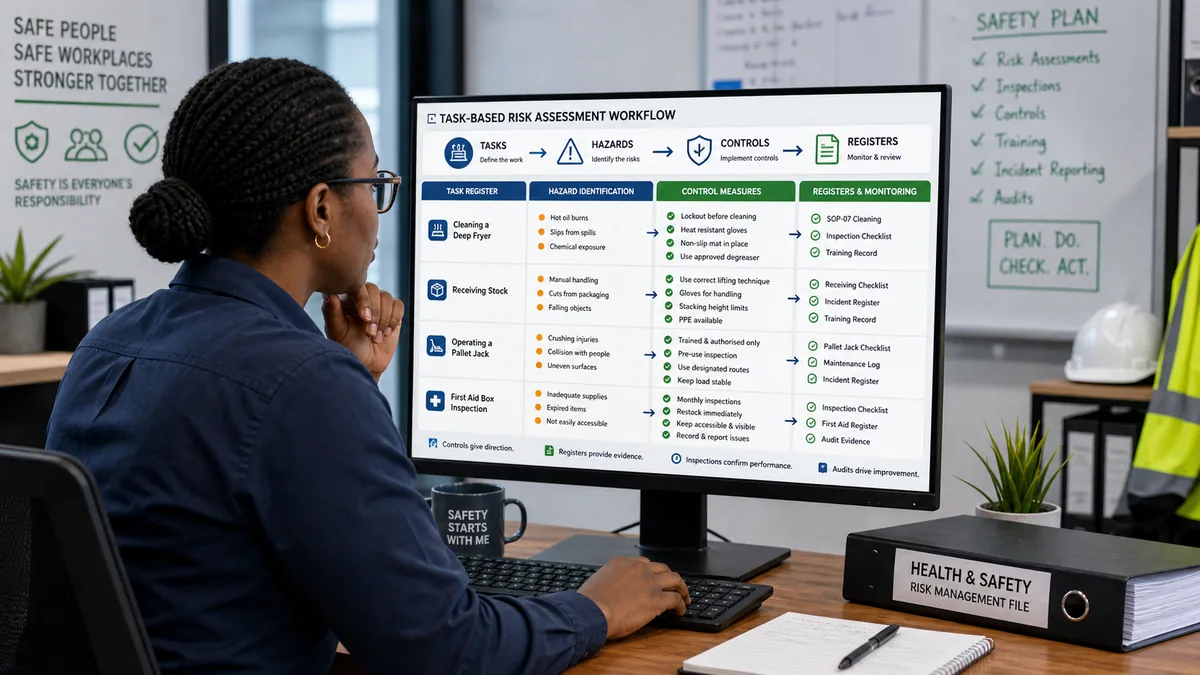
Risk Assessments give direction to controls, registers, inspections and audit evidence.
Need to understand where your Health and Safety risks really start? SafetyWallet helps South African businesses move from scattered compliance documents to a structured Health and Safety Management System built around task-based Risk Assessments, control measures, registers, inspections and accountability. Explore SafetyWallet's Health and Safety Management System solution to see how your organisation can build the system before requesting an audit.
Why a Health and Safety Management System Must Exist Before the Audit
A proper Health and Safety Management System gives the organisation something real to audit. It turns scattered effort into a connected process. The system should already show which tasks are performed, which hazards are linked to those tasks, which controls are required, who is responsible, which inspections must be completed, which findings require action, and how management reviews performance.
That is the right order: first build the system, then audit it. First define the structure, then test the structure. First identify the risks, assign responsibilities, implement controls, train role-players and activate the register cycle. Then the audit can evaluate whether the system is adequate, active and improving.
Why This Matters for QCTO and Training Provider Readiness
This misunderstanding becomes even more serious when organisations want to register as training providers or prepare for regulatory approval. The problem is often not that providers do not want compliance. The problem is that they want the outcome of compliance before they have built the system that supports it.
Training providers may need to show Health and Safety readiness for a premises, training environment or site of delivery. That readiness is much stronger when it comes from an active system that includes risk assessments, induction, emergency preparedness, inspections, appointees, registers, corrective actions and evidence of review.
A rushed file may help a provider gather documents. A working Health and Safety Management System shows that the organisation understands its risks, controls its tasks, manages its role-players and maintains its responsibilities.
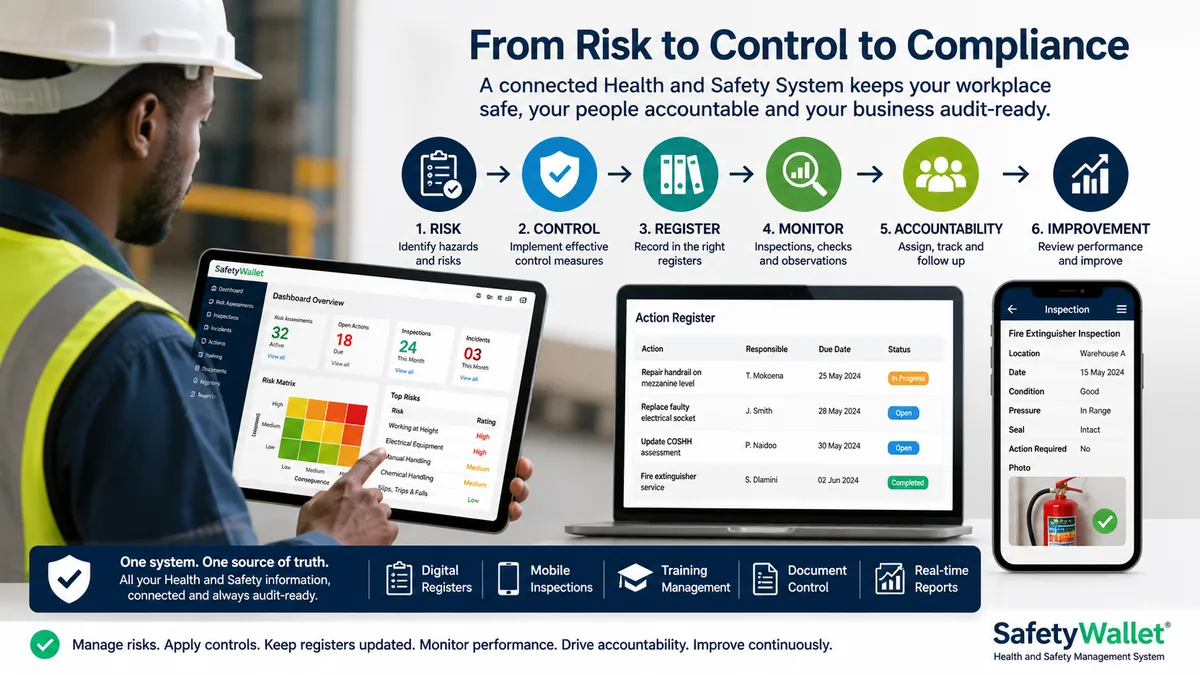
A management system turns inspections into evidence, actions and accountability.
Why First Aid and Basic Inspections Are Not Enough
First aid training matters. Fire extinguisher servicing matters. Emergency signage matters. Inspections matter. The issue is not that these elements are unimportant. The issue is that they are only parts of a larger system.
Completing a first aid box inspection is useful, but the system must also answer deeper questions. Who is appointed to inspect the box? How often must the inspection be done? What happens if items are missing or expired? Who receives the action request? How is the corrective action closed? How does management know the inspection is being done?
That is the difference between an isolated activity and a system. A real Health and Safety Management System connects inspections to registers, appointees, corrective actions, evidence and review.
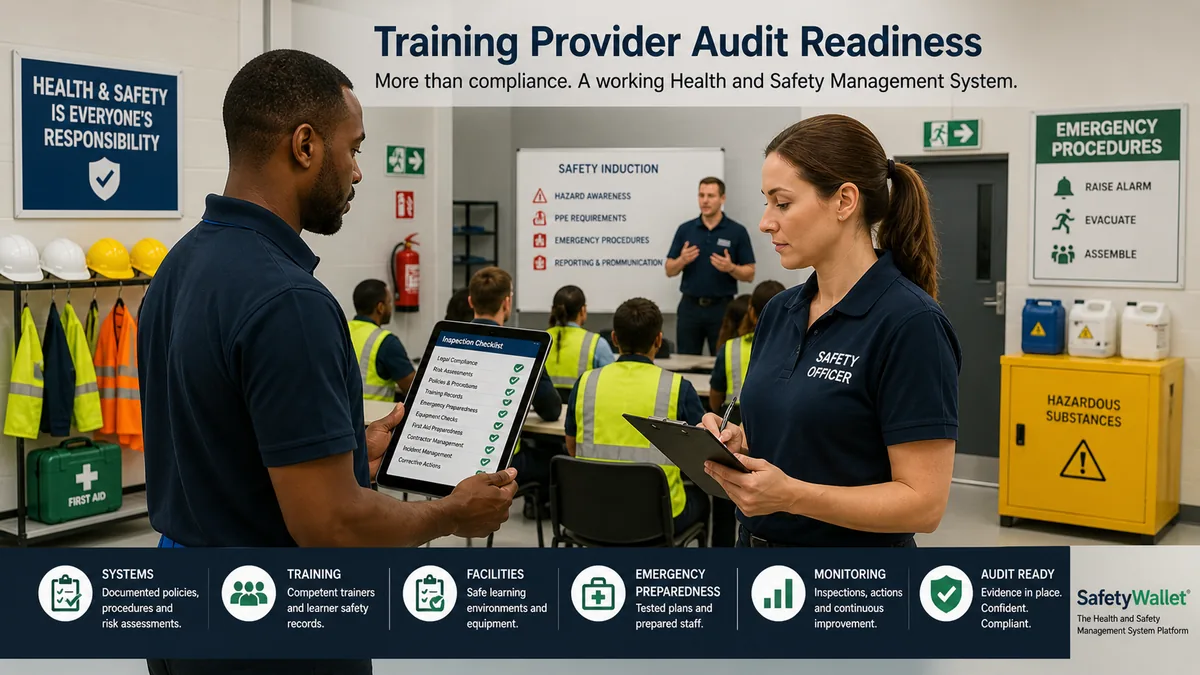
Training providers need more than paperwork; they need a working Health and Safety system.
Why ISO 45001 Helps Explain the Difference
Even if an organisation is not seeking ISO 45001 certification, the standard helps explain what a serious Health and Safety system should look like. It is not simply about more paperwork. It is about leadership, worker participation, planning, risk-based thinking, operational control, performance evaluation and continual improvement.
The principle is simple. Policy must connect to risk. Risk must connect to controls. Controls must connect to procedures. Procedures must connect to training. Training must connect to inspections. Inspections must connect to corrective actions. Corrective actions must connect to review. Review must connect to continual improvement.
That is what an audit should measure. If the business has not yet built that structure, the first priority should not be the audit. The first priority should be building the system that the audit is meant to evaluate.
Why Behaviour-Based Safety Also Needs a System
Behaviour-Based Safety depends on more than reminders, warnings or observation cards. People cannot consistently work safely inside a weak system. If employees are expected to follow safe work practices, the organisation must make those expectations clear, visible, practical and measurable.
For example, if an employee is observed cleaning a deep fryer without following the correct control measures, the finding should not only be treated as unsafe behaviour. The organisation should ask whether the task was assessed, whether the SOP was issued, whether the person was trained, whether PPE was available, whether supervision was in place, and whether the control was practical.
This is where system, behaviour and culture meet. Sustainable behaviour comes from a workplace where the following cycle becomes part of how the organisation manages safety:
Why Consulting Support Helps When Internal Capacity Is Limited
Some organisations understand that they need more than a checklist, but they do not have the internal capacity to build and maintain the system alone. Structured support can help, but it should not remove ownership from the business. Health and Safety responsibility remains with the organisation.
SafetyWallet is positioned as a Health and Safety SaaS platform and compliance enablement system that supports internal ownership through OHS Online, Triple P training, e-learning, My Safety Hub, My Safety Shop and structured guidance. The goal is not to outsource responsibility. The goal is to build internal capability, structure and accountability. Where extra guidance is needed, Health and Safety Consulting Services in South Africa can provide structured implementation support without removing organisational ownership.
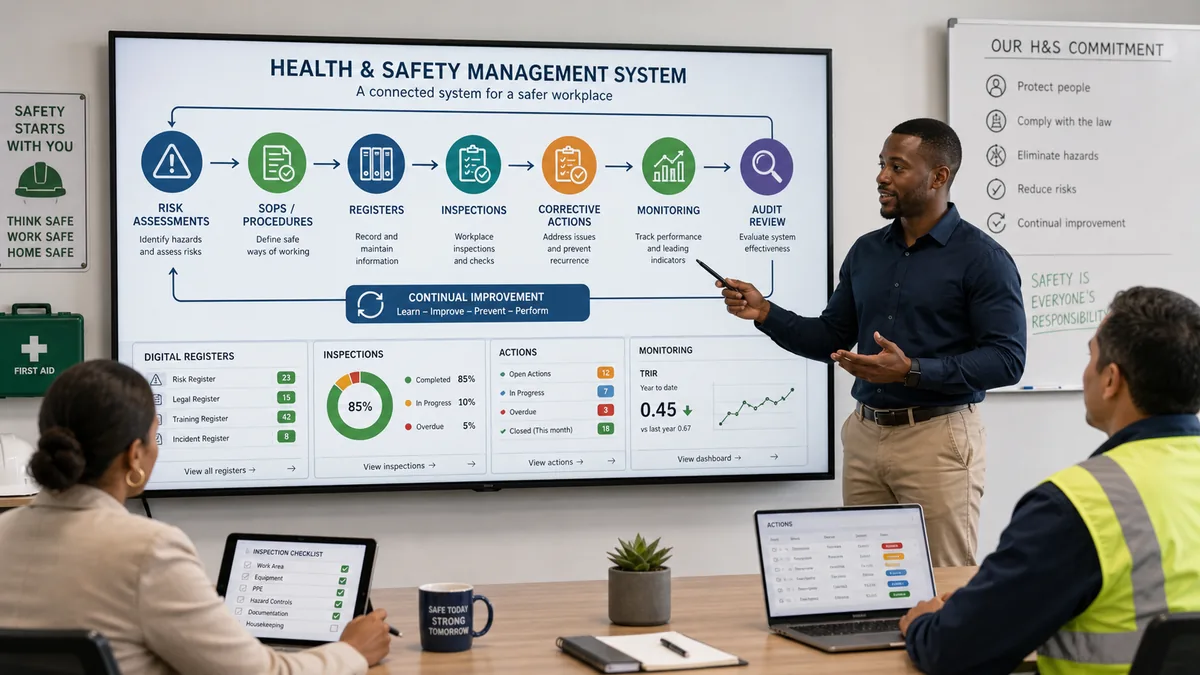
A real Health and Safety system connects risk, control, registers, monitoring and improvement.
What South African Organisations Should Understand Before Requesting an Audit
Before requesting a Health and Safety Audit, every organisation should understand five important points.
- An audit is not the beginning of compliance. It is a measurement of whether compliance has been built and maintained.
- Basic compliance items are not the same as a Health and Safety Management System.
- Risk Assessment is the foundation of the entire programme.
- The system must be active, not only documented.
- The organisation remains responsible for its own Health and Safety.
External support can guide, assist and strengthen the process, but internal ownership is what keeps the system alive. That is why SafetyWallet positions itself as a Health and Safety SaaS platform that enables businesses to manage their own responsibilities more practically.
Build the system before you audit it.
A Health and Safety Audit should measure a working system, not expose that nothing meaningful exists. SafetyWallet gives your organisation the structure to manage Risk Assessments, control measures, registers, appointees, inspections, corrective actions and evidence through one practical SaaS platform.
Visit the Health and Safety Management System page →Conclusion: Build the System First, Then Audit It
The biggest mistake organisations make is treating a Health and Safety Audit as the solution. It is not the solution. It is the measurement tool. If there is no real Health and Safety Management System in place, the audit will not create one. It will simply expose the gaps.
The smarter route is to build the system first. Start with a task-based Risk Assessment. Identify the hazards. Allocate the control measures. Build the registers. Train the role-players. Implement the procedures. Monitor inspections. Track actions. Review performance. Improve the system. Then audit it.
That approach is stronger legally, operationally and practically. It helps South African organisations move from audit panic to daily risk control, accountability and continuous improvement.
Ready to move from audit panic to daily Health and Safety control? SafetyWallet Health and Safety SaaS platform helps businesses manage their own Health and Safety responsibilities through OHS Online, Triple P training, e-learning, My Safety Hub, structured support and practical system guidance. Start with the right foundation and learn how to build, manage and improve your Health and Safety Management System before your next audit.