
In many workplaces, Health and Safety failure is not caused by people who simply do not care. More often, it is caused by people who have become comfortable with risk.
That difference matters.
When an employee ignores a procedure, takes a shortcut, fails to wear PPE, walks past a hazard, blocks an emergency exit, skips a pre-use inspection or treats unsafe work as normal, it does not always mean that person is reckless. It may mean their thinking, beliefs, environment, workload, leadership exposure and workplace culture have shaped how they see risk.
Health and Safety is therefore not only a compliance issue. It is also a psychology issue.
The Health and Safety Executive explains human factors as environmental, organisational, job-related and individual factors that influence behaviour at work in a way that can affect Health and Safety. In simple terms, people's behaviour is shaped by more than rules. It is shaped by the task, the pressure, the work environment, the supervisor, the team and the culture around them.

Safe behaviour starts before the task begins.
People do not always ignore Health and Safety because they do not care. Many unsafe behaviours are shaped by familiarity, pressure, weak culture, poor risk perception and beliefs formed through past experience. A stronger safety culture is built when risk, controls, registers, monitoring, accountability and behaviour ownership work together in one practical system.
People Do Not Always Ignore Risk — They Reinterpret It
Most people do not arrive at work planning to be unsafe. Instead, they often reinterpret risk based on past experience.
If they have completed a task many times and nothing serious has happened, the brain begins to form a belief: This is safe enough.
That belief becomes dangerous because the absence of an incident is mistaken for the presence of control.
A restaurant employee may clean a deep fryer without following the full procedure because they have done it many times before. A warehouse worker may operate a pallet jack too quickly because no incident has happened yet. A maintenance worker may climb a short ladder without checking its condition because the task only takes two minutes.
The problem is not always knowledge. The problem is belief.
The company may have policies, procedures, risk assessments and safe operating procedures, but if the employee's internal belief is stronger than the written control, behaviour will follow the belief.
What people believe about risk will often determine how they behave around risk.
Familiarity Makes Risk Feel Normal
One of the biggest psychological barriers in Health and Safety is familiarity.
When people see the same hazard every day, they slowly stop seeing it as a hazard. The wet floor, the trailing cable, the overloaded plug, the unguarded edge, the blocked fire extinguisher, the missing PPE or the unsafe shortcut becomes part of the workplace environment.
It becomes how we do things here.
This is why poor safety culture is so dangerous. It does not always look dangerous to the people inside it. It feels normal. Research published in Safety Science confirms that risk perception and safety behaviour are closely linked — when people stop perceiving a hazard as dangerous, they stop protecting against it.
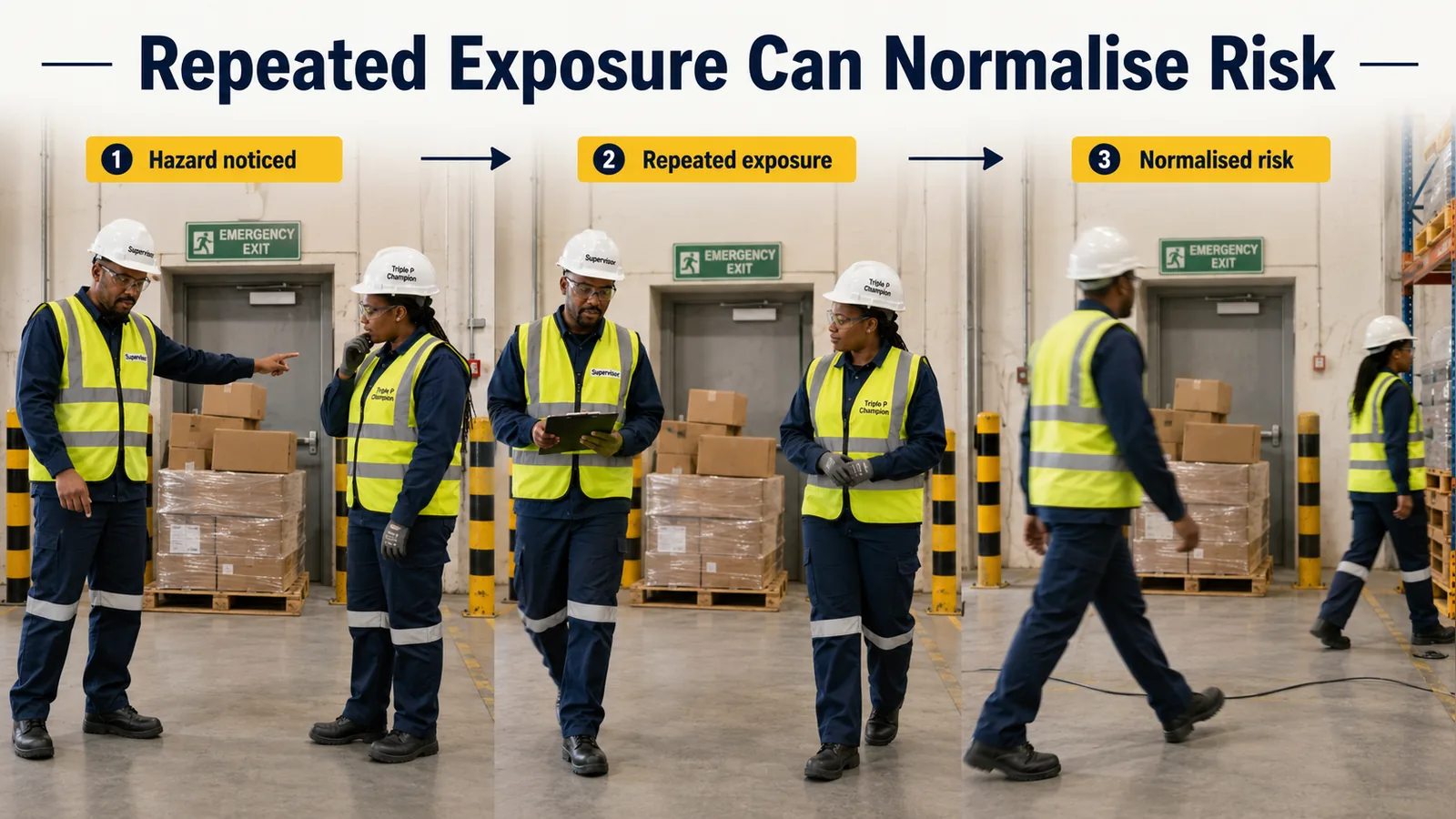
Familiar hazards can become invisible when unsafe conditions feel normal.
People Follow What the Culture Rewards
Employees quickly learn what the organisation truly values. If production is praised more than safe work, people will chase production. If shortcuts are ignored, shortcuts become acceptable. If supervisors only react after incidents, employees learn that Health and Safety is not a daily priority.
Culture is not built by posters. Culture is built by repeated signals.
- What leaders allow becomes normal.
- What leaders reward becomes important.
- What leaders inspect becomes real.
- What leaders ignore becomes culture.
Risk Perception Is Personal
Two people can look at the same hazard and respond differently. One person sees danger. Another sees inconvenience. Another sees just part of the job.
The Health and Safety Authority explains that human factors include job, individual and organisational factors. Job-related factors include procedures and workload. Individual factors include risk perception and fatigue. Organisational factors include safety culture and safety-critical communication.
This is important because it explains why training cannot only tell people what to do. It must also help people understand why the control exists.
People Are Influenced by Pressure
People often take risks when they feel under pressure: pressure to finish faster, avoid conflict, please a supervisor, keep production moving, avoid looking difficult or avoid delaying the team.
In that moment, unsafe behaviour may feel logical to the person. They may believe they are helping the company by getting the job done quickly.
This is why Health and Safety cannot only rely on rules. The system must make the safe choice easier, clearer and more supported than the shortcut.
The Goal Is Not Obsession — The Goal Is Risk Intelligence
A healthy safety culture does not need people to obsess about Health and Safety. Obsession can create fear. Paperwork alone can create box-ticking. Risk intelligence creates ownership.
Risk intelligence means people are able to pause, think, recognise hazards, understand consequences, follow controls and speak up when something is not safe.
This is where a task-based Health and Safety Risk Assessment becomes powerful. It connects risk perception to the work being done. When people understand the specific hazard linked to their specific task, risk stops being abstract and starts being real.
If your organisation wants to build stronger risk intelligence at task level, SafetyWallet's task-based Health and Safety Risk Assessment support helps your team connect workplace tasks to hazards, controls, registers and accountability.
Mindset Determines Whether Controls Are Followed When Nobody Is Watching
Policies explain what must be done. Risk assessments identify what can go wrong. Safe operating procedures explain how the work must be done safely. Registers create structure. Inspections create visibility.
But mindset determines whether people believe the control matters enough to follow it when nobody is watching.
A person who only sees PPE as a rule may remove it when it becomes uncomfortable. A person who sees PPE as a control that protects their hands, eyes, lungs or hearing is more likely to respect it.
This distinction is supported by research into risk perception. When people understand why a control exists, they are more likely to apply it consistently, including in low-supervision situations and under pressure.
From Risk Control to Behaviour Ownership
A strong Health and Safety Management System follows a practical chain:
When behaviour and culture are part of the discussion, the chain goes deeper:
This means we do not only ask whether the person followed the rule. We ask what risk was present, what control was required, whether the control was registered and visible, what behaviour was observed and how that behaviour can build ownership.
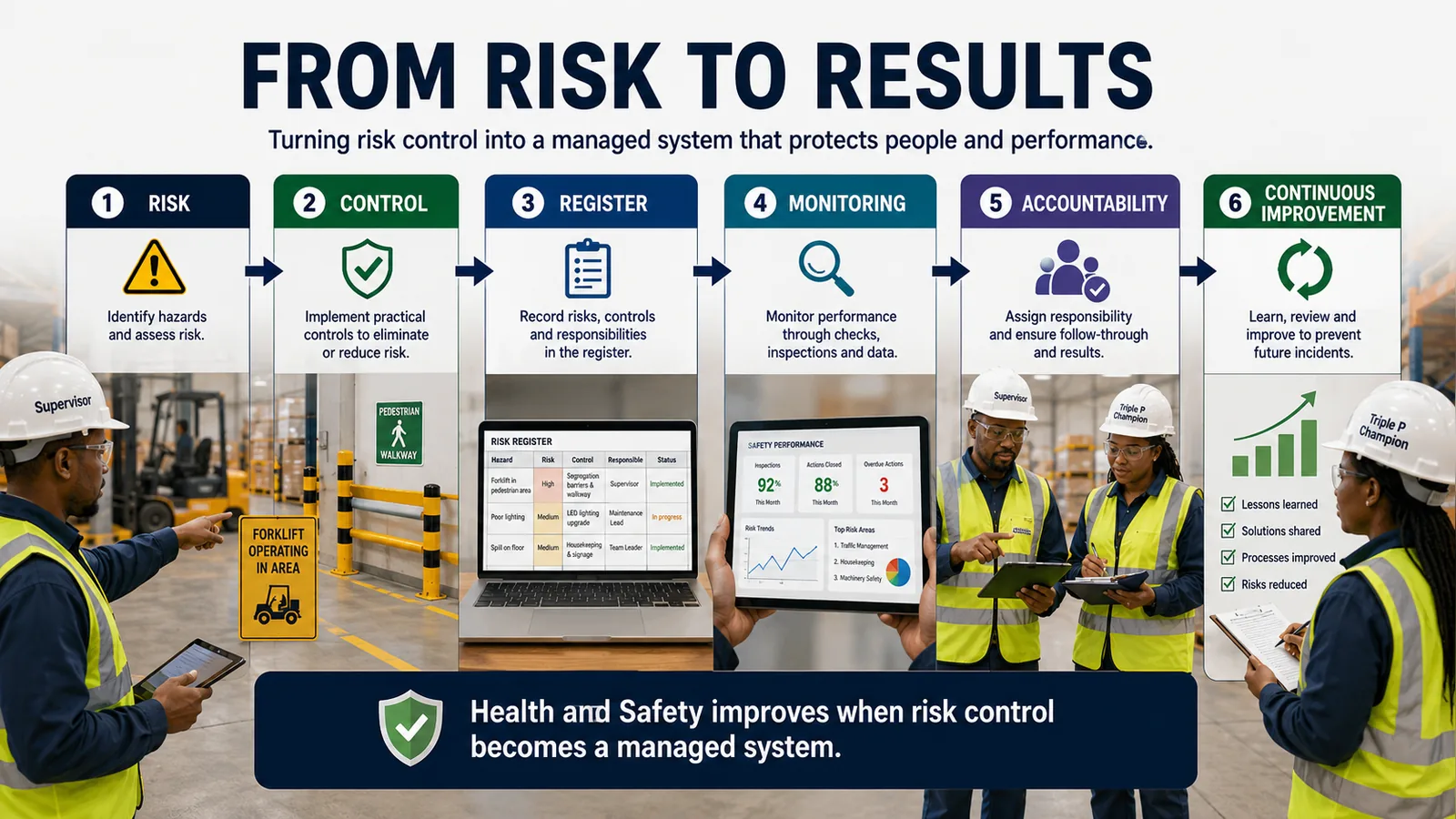
Health and Safety improves when risk control becomes a managed system.
Why Behaviour-Based Safety Must Be More Than Observation
Many Behaviour-Based Safety programmes focus heavily on observation. Observation is important, but observation alone is not enough.
If the task is poorly designed, the control is unclear, the register is not active, the supervisor is not engaged and the culture rewards shortcuts, then observing the worker will not fix the system.
A mature Behaviour-Based Safety programme must connect behaviour to task risk and control measures.
- What task was being performed?
- What hazard and control measure applied to that task?
- Was the control visible and working in the workplace?
- What behaviour supported or weakened the control?
- What trait or belief may be influencing that behaviour?
- Which value was visible, missing or under pressure?
- What action, coaching or recognition should follow?
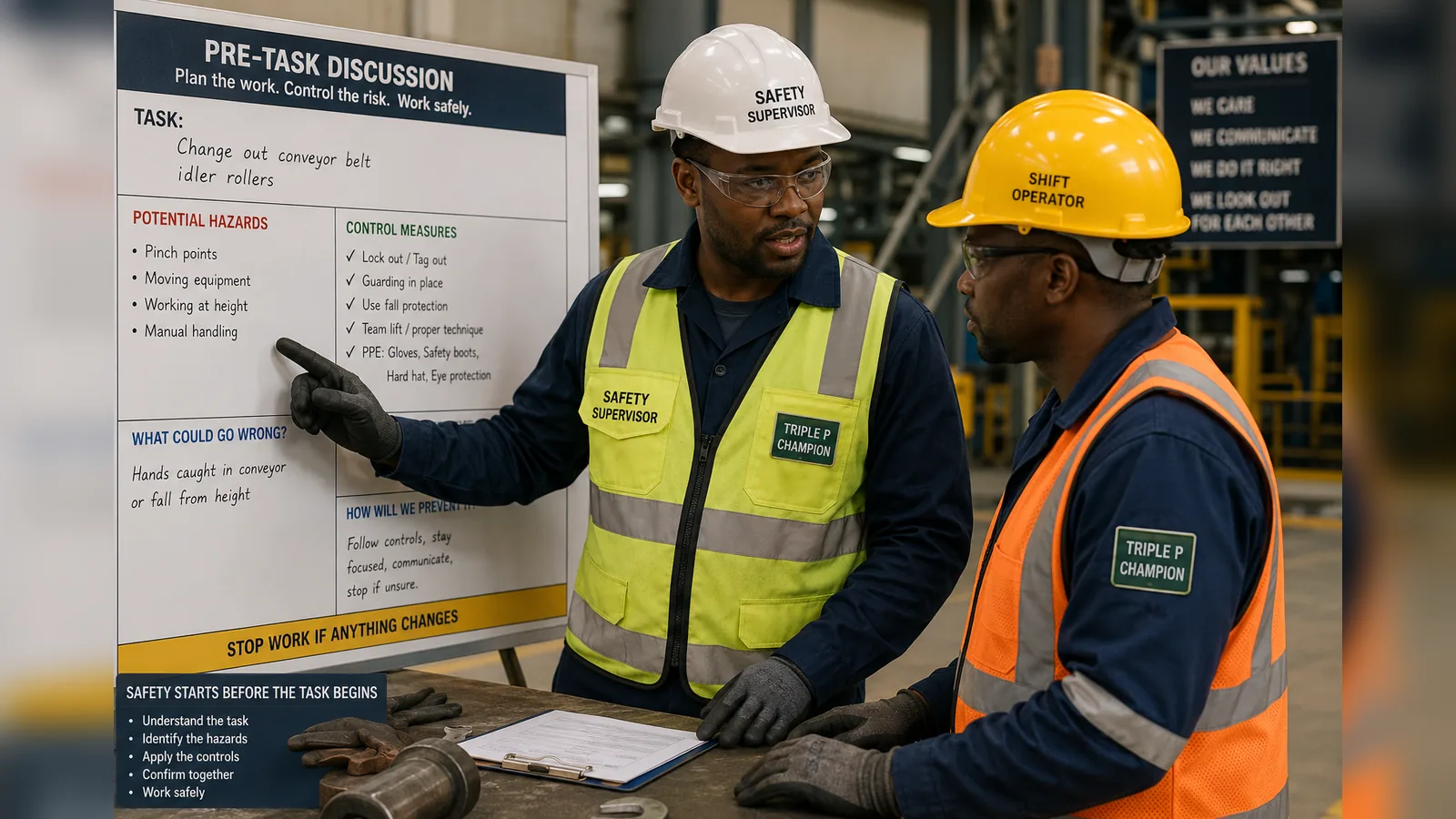
Behaviour becomes easier to coach when it is linked to a specific control.
The SafetyWallet Roots-to-Fruits View of Safety Behaviour
SafetyWallet's Roots-to-Fruits model helps explain why behaviour is not only about what people do. It is also about what sits underneath the behaviour.
- Roots are the traits that shape people internally.
- Trunk is the belief system that gives meaning to their actions.
- Branches are the values that guide daily decisions.
- Fruits are the visible behaviours we see in the workplace.
When people believe Health and Safety protects lives, families, dignity and the future of the business, their attitude changes. When attitude changes, behaviour changes. When behaviour changes consistently, culture changes.
SafetyWallet's purpose is clear: We believe in making sure your loved ones return home healthy and safe after work.
South African Context: Health and Safety Is a Practical Duty
In South Africa, Health and Safety Compliance in South Africa must not be treated as a file prepared for an audit. The Occupational Health and Safety Act 85 of 1993 places practical duties on employers to provide and maintain, as far as reasonably practicable, a working environment that is safe and without risk to employees.
That means the organisation must be able to show more than documents. It must show that:
- Risks are understood and assessed at task level.
- Controls are implemented and verifiable.
- Employees are informed and trained.
- Supervisors are involved and accountable.
- Inspections are happening and evidenced.
- Actions are tracked and closed.
- Improvements are made when controls fail.
Compliance gives the structure. Culture gives the daily behaviour. The system connects the two.
How SafetyWallet Helps Businesses Build Safer Behaviour
SafetyWallet Health and Safety SaaS platform helps South African businesses manage their own Health and Safety responsibilities through OHS Online, Triple P training, e-learning, My Safety Hub, My Safety Shop and structured support.
SafetyWallet does not remove the organisation's responsibility. It helps the organisation make that responsibility visible, structured and easier to manage.
Through OHS Online, businesses can connect risk assessments, SOPs, registers, inspections, appointees, action requests, training and monitoring. This helps Health and Safety move from isolated paperwork to a working Health and Safety Management System.
Through a Behaviour-Based Safety programme, SafetyWallet helps organisations connect risk control to observation, mindset, values, identity and ownership.
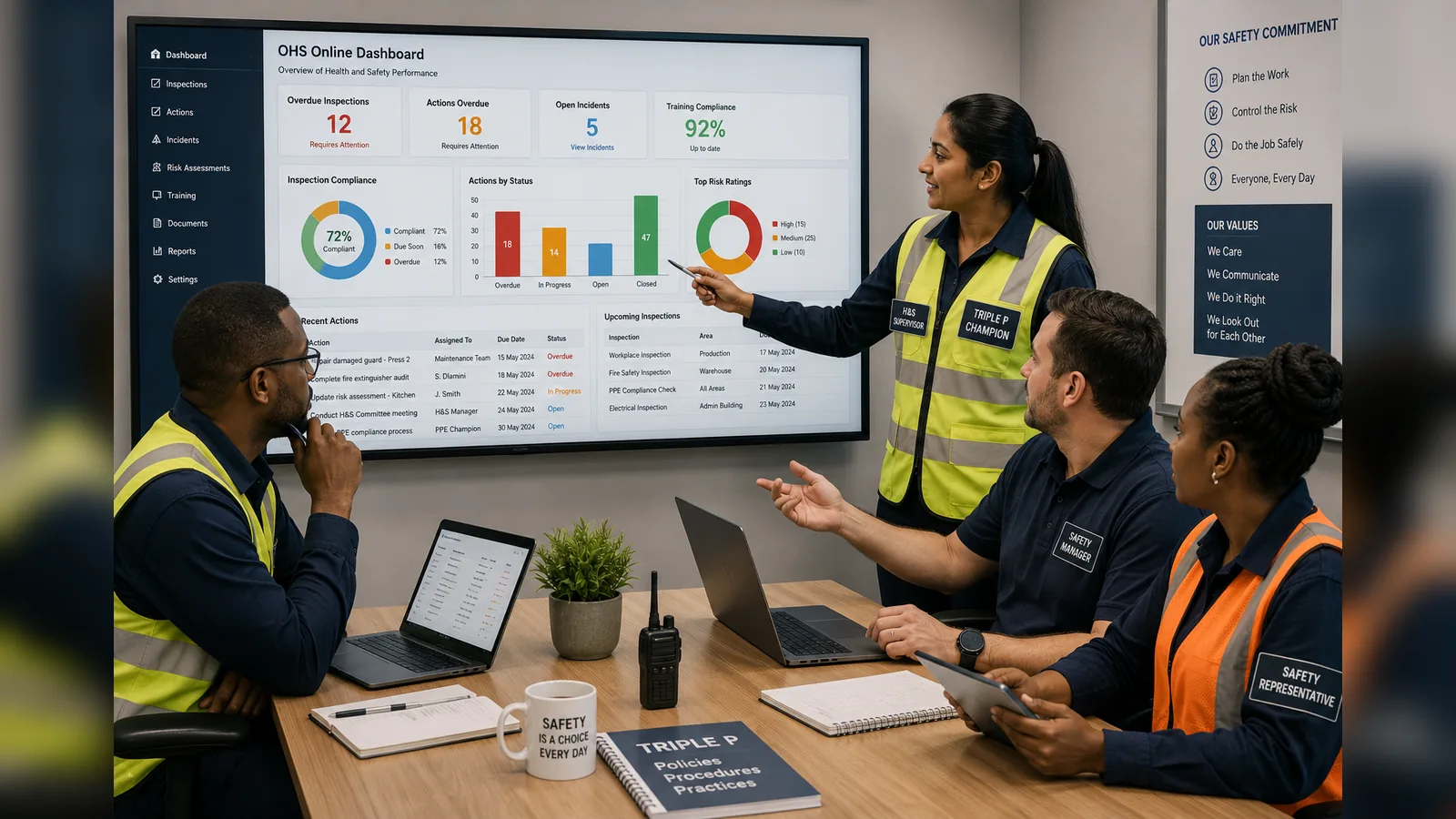
A living Health and Safety system helps turn behaviour into accountability.
SafetyWallet Package Positioning
For stable organisations that already have internal capability, Enterprise Secure provides platform access and internal support to help the business manage its Health and Safety system.
For businesses that need more structured guidance, Expert Guidance supports the organisation in maturing its Health and Safety system through practical enablement, Triple P alignment and ongoing support.
For complex environments, Apex AI provides advanced support and AI-enabled assistance to help the organisation manage more demanding Health and Safety requirements.
These options are not simple service agreements. They are compliance enablement and platform support options designed to help the organisation take ownership of its own Health and Safety responsibilities.
Build safer behaviour through structure, observation and ownership.
SafetyWallet's Behaviour-Based Safety programme helps organisations connect workplace risk controls to daily behaviour, culture and accountability.
Explore the Behaviour-Based Safety programme →Conclusion
People who do not prioritise Health and Safety are not always careless. Many have been shaped by familiarity, pressure, culture, past experience and incorrect beliefs about risk.
The solution is not to force obsession. The solution is to build belief, risk intelligence and ownership.
Health and Safety becomes powerful when people understand that every control measure, every inspection, every SOP, every appointment, every register and every risk assessment exists for one reason: to make sure someone's loved one returns home healthy and safe after work.
That is when Health and Safety moves from compliance to culture. That is when rules become ownership. That is when behaviour becomes belief in action.
Visit the SafetyWallet Health and Safety SaaS platform or explore the Behaviour-Based Safety programme to see how SafetyWallet helps organisations connect risk control, behaviour, mindset and accountability into one practical system. Talk to the SafetyWallet team to get started.