
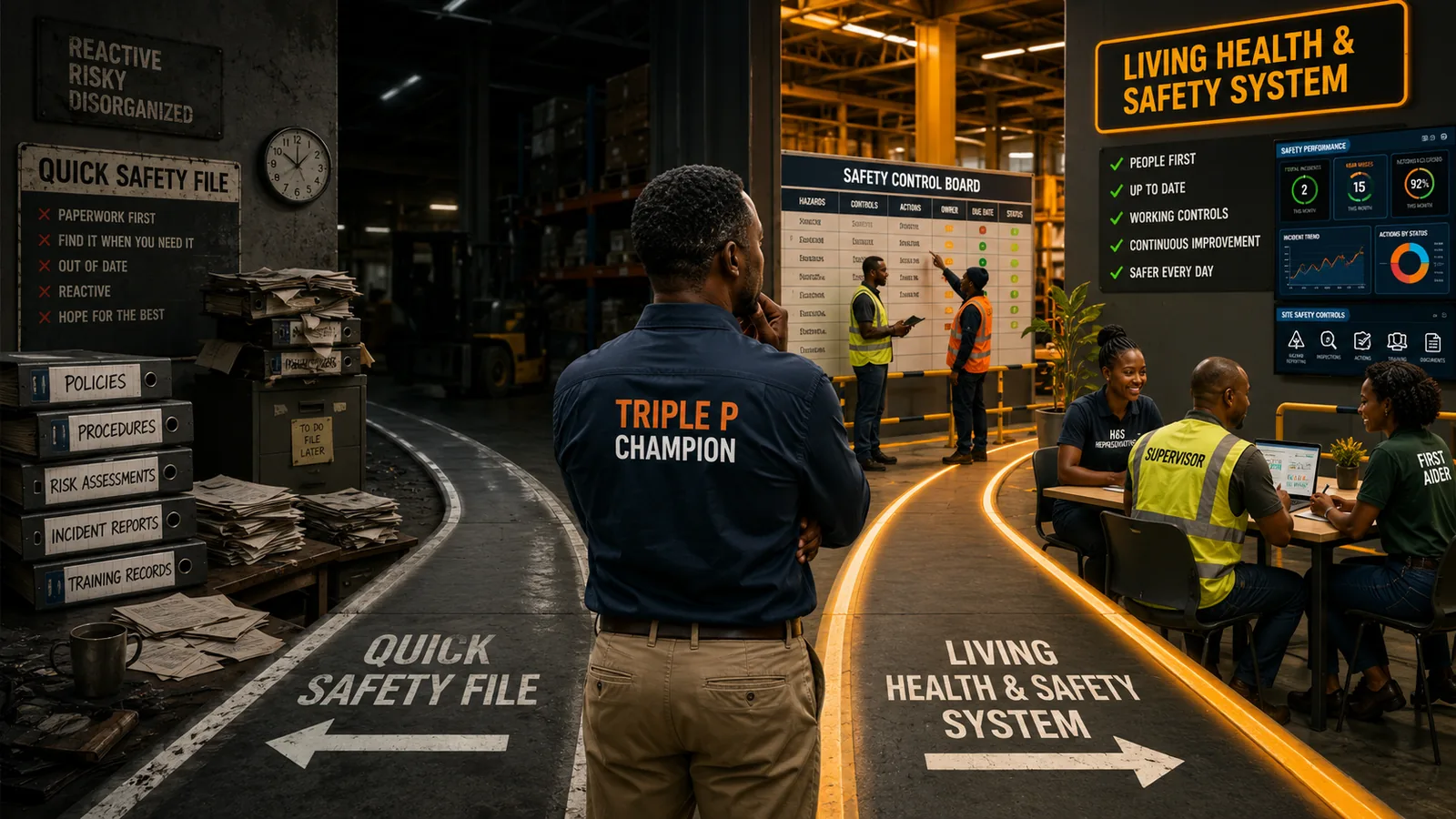
A quick safety file may solve an urgent request, but a living system helps manage risk every day.
Many South African companies do not start looking for Health and Safety support because they suddenly want a complete Health and Safety Management System.
They start looking because something has created pressure.
A client asks for a safety file. A tender requires compliance documents. The Department of Employment and Labour arrives for an inspection. A franchisor asks for proof. A principal contractor wants documentation before work can begin. An incident happens and management suddenly needs records, evidence and control measures.
When this happens, the natural response is to look for the quickest solution.
"Can we get a safety file?" "Can someone sort this out for us?" "Can we get the documents by Friday?" "Can we just pass the audit?"
This is understandable. Business owners, managers and supervisors are under pressure. Operations must continue. Staff must be managed. Clients must be serviced. Nobody wants Health and Safety to become a slow, expensive or complicated process.
But this is where many companies fall into the quick fix trap.
A safety file may help a company respond to an immediate request, but a safety file alone does not manage workplace risk. It does not make sure control measures are implemented. It does not ensure inspections are completed. It does not train appointed persons. It does not coach behaviour. It does not create ownership.
That is why the SafetyWallet platform helps businesses move beyond once-off paperwork and into a living Health and Safety system where risk, control measures, registers, monitoring, accountability and continuous improvement work together.
Need more than a once-off safety file? Explore how the SafetyWallet platform helps your business move from quick-fix compliance to daily Health and Safety control.
Short Answer
A quick safety file can help a business respond to an urgent compliance request, but it is not the same as managing Health and Safety. Real health and safety compliance in South Africa requires a practical health and safety management system that connects risk assessments, control measures, registers, inspections, training, appointees, evidence, dashboards, behaviour and accountability. SafetyWallet, supported by OHS Online, Triple P, MES, eLearning, My Safety Hub, SafetyWallet Shop, My Safety Shop and expert support, helps businesses move from quick-fix compliance to ongoing control and ownership.
Why the Quick Fix Feels Attractive
The quick fix is attractive because it appears to solve the visible problem.
A business needs documents, so it buys documents. A client asks for a safety file, so the business gets a safety file. An audit is coming, so someone prepares paperwork. A site needs access, so the company scrambles to meet the file requirement.
On the surface, this feels practical. The business gets something it can submit, upload, print or show.
But the visible problem is not always the real problem.
The real problem is usually deeper. The company may not know whether its risk assessments still reflect the work being done. The control measures may be listed but not implemented. Registers may exist but not be completed. Inspections may be scheduled but not followed up. Training records may be scattered. Appointees may have signed letters but may not understand what they are responsible for. Supervisors may not know which controls must be checked. Management may only see the gaps when pressure arrives.
This is why the quick fix becomes expensive over time. The business keeps paying to fix the file, but the system underneath remains weak.
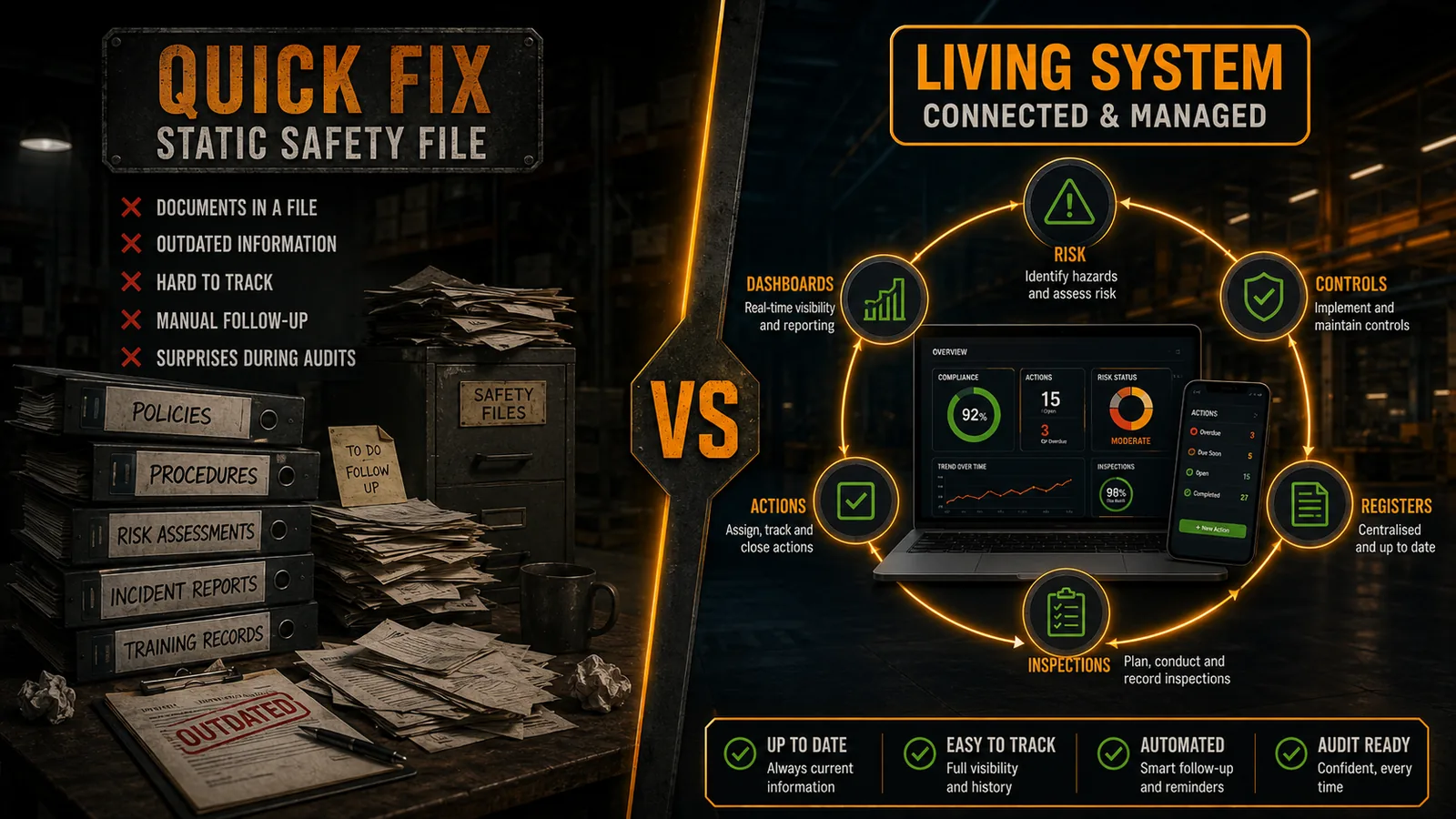
A safety file stores documents; a living system connects documents to control, evidence and accountability.
A Safety File Is Not a Health and Safety Management System
A safety file can be important. It can organise documents, appointments, risk assessments, registers, certificates and evidence.
But a safety file is not the same as a Health and Safety Management System.
A file can show that a document exists. A management system shows whether work is being controlled. A file can store a risk assessment. A management system helps link the assessment to tasks, hazards, control measures, SOPs, inspections and corrective actions.
A file can contain an appointment letter. A management system helps the appointed person understand, act, report and take ownership. A file can include inspection templates. A management system helps make sure inspections happen, findings are recorded and actions are closed out.
Businesses that want to move beyond a quick fix need a practical health and safety management system that helps them manage Health and Safety daily, not only when someone asks for a file.
Software Gives Visibility, but Visibility Is Not the Same as Control
This is one of the most important lessons in Health and Safety.
Software is powerful, but software alone does not make a workplace safe.
A dashboard can show overdue inspections, but someone still needs to inspect. A register can show missing evidence, but someone still needs to upload and verify it. A risk assessment can identify hazards, but controls must still be implemented. A policy can exist, but people must still understand and follow it. A consultant can assist, but the client must still build internal ownership.
This is where many companies misunderstand the role of OHS software.
The purpose of OHS software is not to remove the employer's responsibility. The purpose is to make Health and Safety visible, structured, trackable and easier to manage.
OHS Online gives the business the digital structure. Triple P gives the business the policy, procedure and practice framework. Task-based risk assessments identify the actual work and the controls needed. Registers and inspections help monitor what is happening. MES supports the behaviour and ownership layer. Training and support help people understand their roles.
The value is not only the software. The value is the full operating rhythm behind it.
What We See Repeatedly in South African Workplaces
SafetyWallet's practical experience with South African businesses shows a repeated pattern.
Many companies have documents, but the documents do not drive daily action.
A risk assessment is completed, but the control measures are not transferred into a register or inspection rhythm. A fire extinguisher inspection is expected, but nobody is checking whether it is done, signed, uploaded and followed up. A Health and Safety Representative is appointed, but the person is not always confident enough to inspect, report, challenge and escalate.
This is not always a lack of care. Often, it is a lack of structure.
- Companies have Health and Safety documents, but the documents are not connected to daily work.
- Health and Safety Representatives are appointed, but not always trained or confident in what to do.
- Risk assessments are completed once, but not always connected to SOPs, registers and control measures.
- Inspections are scheduled, but evidence and follow-through are weak.
- Consultants can help, but over-reliance can prevent internal ownership.
- Behaviour problems are visible, but the deeper belief and value layer is not coached.
- Management wants compliance, but needs visibility, accountability and a practical rhythm.
These observations matter because they explain why Health and Safety cannot be solved by paperwork alone. The problem is not only the absence of documents. The problem is often the absence of a working system.
The SafetyWallet Way: From Quick Fix to Continuous Control
SafetyWallet uses a practical logic:
This matters because Health and Safety must begin with the real work being done.
A business cannot manage risk properly if it does not understand the tasks employees perform. A warehouse receiving delivery vehicles has different risks from a restaurant kitchen, a manufacturing line, a retail storeroom, an office environment or a contractor working on a client site.
The first question should not be, "What documents do we need?"
The better question is, "What work is being performed, what can harm people, and what controls must be in place?"
From there, the system should help the business identify tasks, assess hazards and risks, define control measures, create or support SOPs, assign responsibilities, activate registers, schedule inspections, capture evidence, follow up on actions, train the right people, monitor behaviour, report to management and improve continuously.
This is how Health and Safety becomes practical. Not a file. Not a panic. Not a once-off exercise. A managed system.
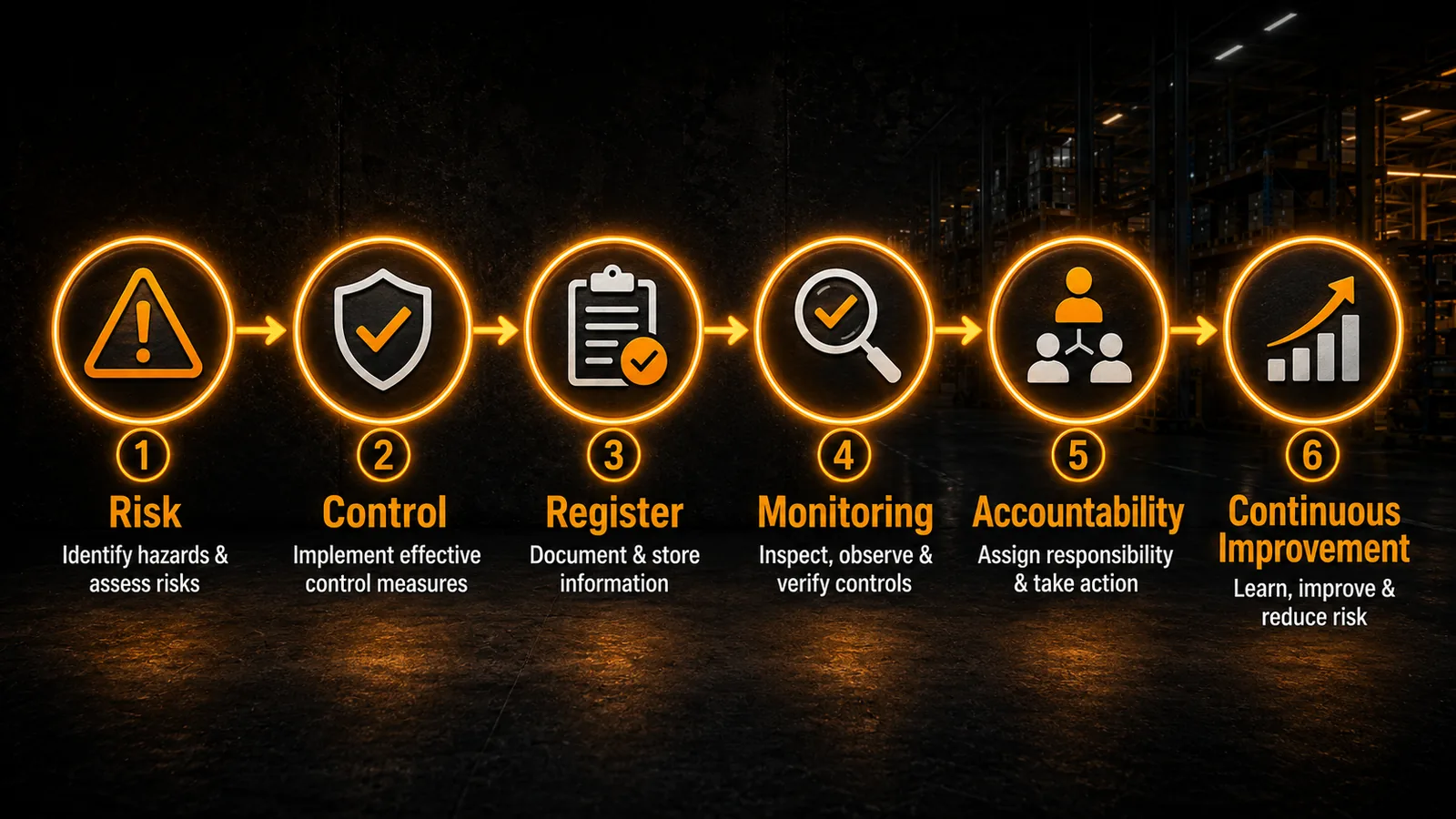
Risk, control, registers, monitoring and accountability must work together for continuous improvement.
The SafetyWallet Model: One Platform, Multiple Layers of Support
The SafetyWallet model is a connected workplace Health and Safety compliance approach that brings together software, structure, risk assessment, control measure verification, training, behaviour, support and practical products.
It is designed for businesses that need more than a quick fix, but still need a practical and manageable way to take control.
1. OHS Online: The Digital System
OHS Online is the digital Health and Safety management engine inside the SafetyWallet ecosystem. It helps businesses manage risk assessments, registers, inspections, incidents, appointments, training records, corrective actions, dashboards and evidence.
2. Triple P: The Structure
The Triple P System stands for Policies, Procedures and Practices. Policies show intent. Procedures explain how work should be done. Practices show whether people are actually following the system.
3. Task-Based Risk Assessment: The Risk Foundation
Task-based risk assessments focus on the actual tasks performed in the workplace. This makes the risk assessment more practical because the control measures are linked to real work.
4. JSO and Control Measure Verification: The Execution Check
A control measure on paper is not a control measure in practice. Job Safety Observations and control measure verification help businesses move from written intention to operational evidence.
5. MES: The Behaviour and Culture Layer
Many Health and Safety failures are not caused by the absence of paperwork. They happen because people do not believe in the system, do not understand the purpose, do not feel ownership or do not connect Health and Safety to their values and identity. Where behaviour based safety and culture are involved, the SafetyWallet logic expands:
6. Expert and Partner Support: The Capacity Layer
SafetyWallet does not position itself as a consultant that takes over the employer's responsibility. The employer remains responsible for Health and Safety. However, many businesses need support to implement, understand and improve their system. Health and safety consulting services can help bridge that gap.
7. SafetyWallet Shop and My Safety Shop: The Practical Support Layer
When gaps are identified, businesses often need practical products or services to close those gaps. SafetyWallet Shop and My Safety Shop help connect the gap identified in the system to practical support that can help the business take action.
8. My Safety Hub: The Education Layer
Health and Safety improves when people understand what they are doing and why it matters. My Safety Hub supports ongoing awareness, education and practical learning.
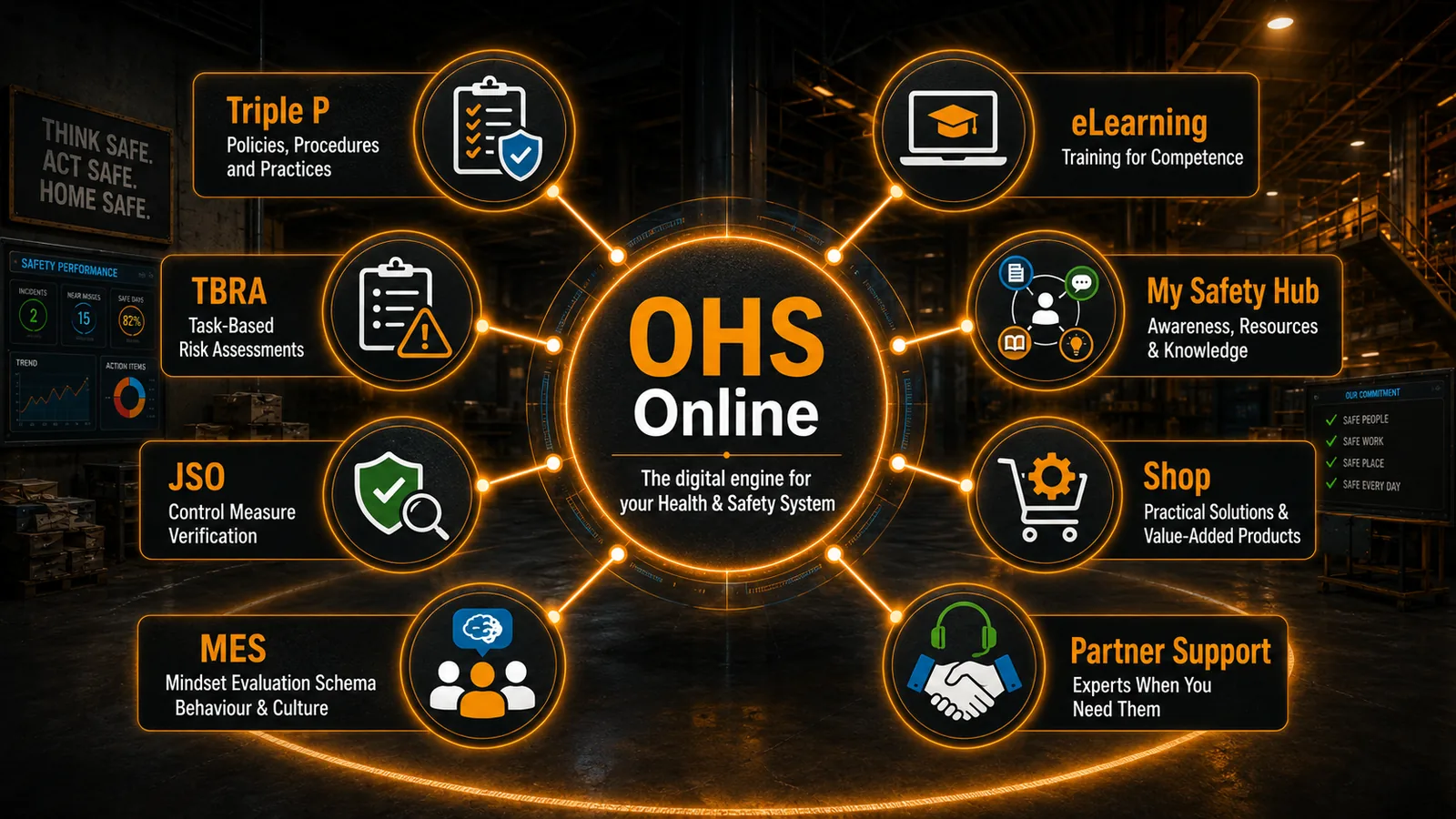
OHS Online connects the SafetyWallet ecosystem into one practical Health and Safety management engine.
Software Only vs Consultant Only vs The SafetyWallet Model
| Approach | What it solves | What it often misses | Best use | Long-term result |
|---|---|---|---|---|
| Software only | Visibility, digital records, reminders and dashboards. | Behaviour, ownership and implementation discipline if the client does not act. | Businesses with strong internal Health and Safety capacity. | Useful visibility, but control depends on internal action. |
| Consultant only | Expert input, documents, audits, inspections and advice. | Internal ownership and knowledge transfer if the client becomes dependent. | Specialist support, technical guidance and implementation assistance. | Helpful short-term support, but weak if ownership does not transfer. |
| Safety file / document approach | Documents for audits, sites, tenders or client requests. | Daily controls, follow-up, training, behaviour and accountability. | Immediate document requirement. | Quick relief, but recurring compliance pressure. |
| SafetyWallet model | Connects software, training, support, risk, control measures, behaviour and accountability. | Requires client participation and ownership. | Businesses that want sustainable Health and Safety control. | Living system with visibility, structure, ownership and continuous improvement. |
Is SafetyWallet Only OHS Software?
No. SafetyWallet is not only OHS software.
SafetyWallet is a Health and Safety SaaS platform and compliance enablement ecosystem. OHS Online is the digital management engine, but the full value comes from the way the ecosystem connects software, structure, training, support, behaviour and practical action.
A company can buy software and still fail to manage Health and Safety if no one uses it properly. A company can hire a consultant and still fail if the knowledge does not transfer internally. A company can create a safety file and still fail if the controls are not implemented.
SafetyWallet is designed to help businesses connect OHS Online, Triple P, task-based risk assessments, registers, inspections, MES, eLearning, My Safety Hub, SafetyWallet Shop, My Safety Shop and expert and partner support.
South African Context: Why This Matters
In South Africa, employers must manage workplace Health and Safety as a practical responsibility, not only as a documentation exercise.
Department of Employment and Labour inspections, client audits, franchise requirements, tender submissions and contractor controls all create pressure on businesses to prove that Health and Safety is being managed.
But the real goal should never be only to satisfy an inspector, client or auditor. The real goal is to control risk before someone gets hurt.
This is where many businesses need a mindset shift.
Health and Safety should not only become urgent when someone asks for proof. It should be visible in the way tasks are assessed, controls are implemented, employees are trained, appointees understand their responsibilities and management reviews the system.
That is why the SafetyWallet purpose matters: "We believe in making sure your loved ones return home healthy and safe after work."
This purpose moves the conversation beyond paperwork.
Task-Based Examples: What the Quick Fix Misses
Receiving Deliveries
A quick safety file may include a general risk assessment for receiving stock. But a proper system asks whether delivery vehicles are separated from pedestrians, whether there is a reversing procedure, whether employees are trained to unload safely, whether lifting aids are available and whether slips, trips and manual handling risks are inspected regularly.
Restaurant Kitchen Work
A restaurant may need documents for a landlord, franchisor or inspection. But kitchen safety depends on daily controls such as wet-floor control, knife handling, hot surface and steam controls, chemical labelling, fire controls, emergency procedures and incident reporting.
Office and Facility Management
Office environments are often seen as low risk, but they still require management. Electrical safety, emergency exits, fire equipment, ergonomics, housekeeping, first aid, contractor access and incident reporting all need structure.
Contractor Work
A contractor may have documents, but the client still needs to manage contractor risk. Contractor documents must be valid, site-specific risks must be assessed, permits or approvals may be required, employees must be trained and control measures must be verified while work is being done.
Why Internal Ownership Is the Real Competitive Advantage
The strongest Health and Safety systems are not the ones where everything depends on one consultant, one safety officer or one file.
The strongest systems are the ones where ownership is distributed.
Management understands its role. Supervisors check controls. Health and Safety Representatives know what to observe. Appointees understand their responsibilities. Employees know why controls matter. The committee reviews evidence and action. The system shows what is overdue and what needs attention.
SafetyWallet supports this by helping the business build a rhythm of visibility, action and accountability.
The quick fix may help the company look ready for a moment. Internal ownership helps the company become ready every day.
How SafetyWallet Supports ISO 45001 Thinking
Not every company wants certification, but many businesses want a more disciplined and recognised way to manage occupational Health and Safety.
ISO 45001 support in South Africa should not be treated as a certificate chase only. The stronger approach is to build a system that already behaves like a management system. SafetyWallet can support ISO 45001-aligned thinking by helping companies organise key management system elements such as risk assessment, documented information, operational controls, competence, communication, monitoring, incident management and continual improvement.
That means Health and Safety must be planned, implemented, checked and improved.
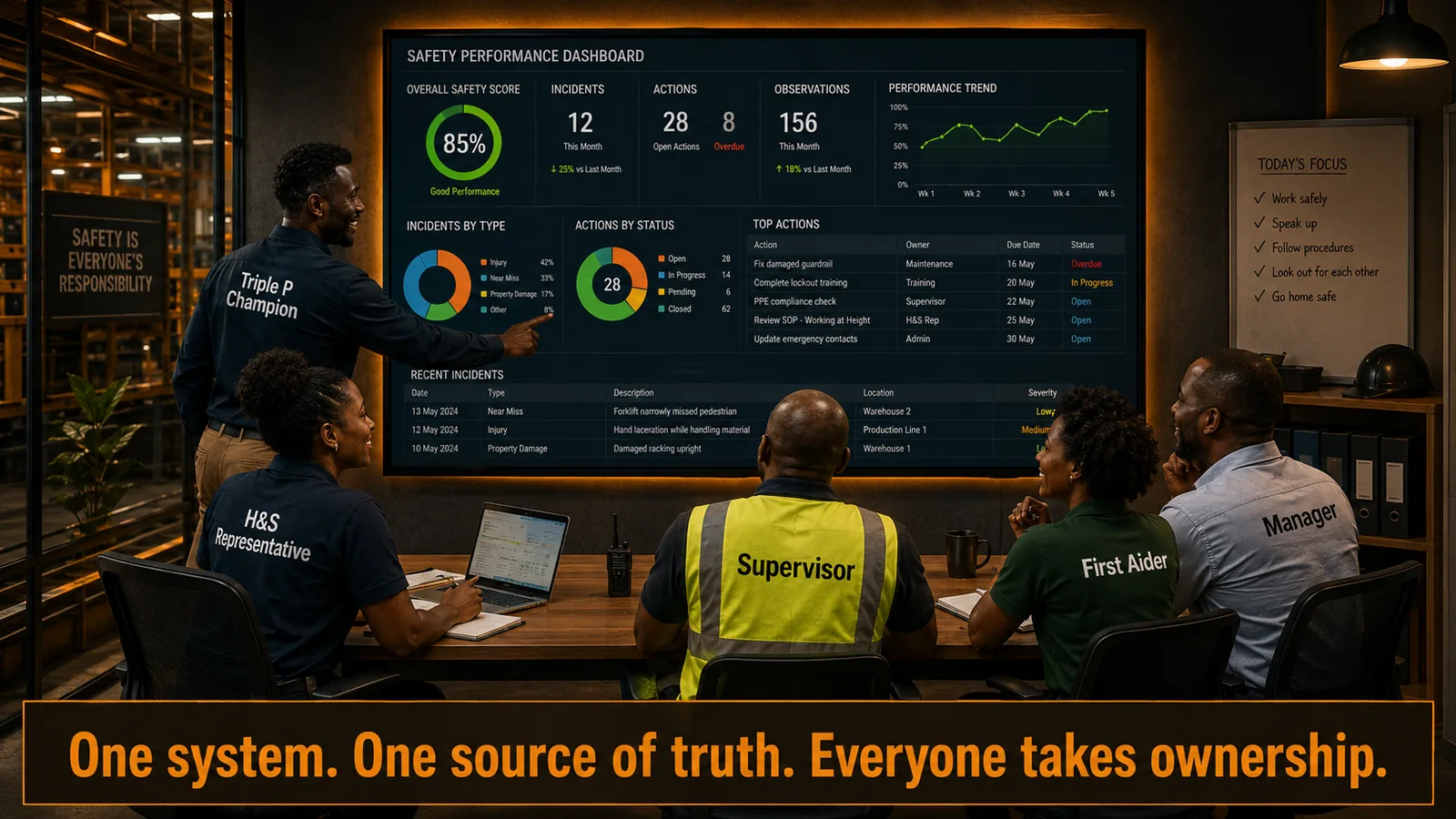
Sustainable compliance improves when everyone works from one source of truth and takes ownership.
See how OHS Online connects risk assessments, control measures, registers, inspections, evidence and dashboards inside one practical Health and Safety Management System.
Visit the Health and Safety Management System page →Conclusion
The quick fix will always be attractive because it feels simple.
But Health and Safety is not only about having a file. It is about knowing what work is being performed, what risks exist, what controls are required, who is responsible, what evidence is available, what actions are overdue and whether people are taking ownership.
A safety file can support compliance, but it cannot replace a living Health and Safety Management System.
SafetyWallet, supported by OHS Online, Triple P, task-based risk assessments, JSO and control measure verification, MES, eLearning, My Safety Hub, SafetyWallet Shop, My Safety Shop and expert support, helps businesses move from quick-fix compliance to daily control.
The goal is not only to pass an audit or satisfy a client request. The goal is to make sure every worker returns home healthy and safe to their loved ones, every day.
Ready to move beyond the quick fix? Talk to the SafetyWallet team and start building a living Health and Safety system.