
Restaurant owners, franchisees and franchisors in South Africa are under real pressure to prove that Health and Safety is being managed properly. When a Department of Employment and Labour inspection happens, the question is not only whether documents exist. The real question is whether the restaurant can show that risks are understood, controls are implemented, inspections are completed, training is recorded, appointees know their duties and corrective actions are followed up.
In a recent discussion with a well-known South African restaurant environment facing regular Department of Employment and Labour inspections, one thing became clear: the real problem is not that restaurant owners do not care about Health and Safety. The real problem is that many restaurants still manage Health and Safety as inspection preparation instead of daily operational control.
That is the shift restaurant owners and franchise groups need to make.
But there is another important shift. The solution is not only software. The solution is not only a checklist. The solution is not only training. The solution is not only support. The real value is a connected Health and Safety subscription platform that gives the business structure, visibility, training, guidance, support, accountability and peace of mind.
That is where SafetyWallet fits in.
The SafetyWallet Health and Safety SaaS platform helps restaurants, franchisees and franchisors manage their own Health and Safety responsibilities with more confidence. OHS Online is the digital Health and Safety management system inside the SafetyWallet platform, while Triple P training, Health and Safety eLearning, My Safety Hub, structured support, approved SafetyWallet partners and the broader SafetyWallet ecosystem help the business build internal ownership.
OHS Online helps manage the daily execution. Triple P helps develop internal champions. eLearning helps train staff and appointees consistently. My Safety Hub supports ongoing education. Structured support and approved partners can provide additional guidance when a business needs help maturing or implementing the system. SafetyWallet Shop supports access to practical Health and Safety products and services where relevant.
Together, this gives the restaurant a better way to know what must be done, who must do it, what is overdue, what evidence exists, where support is needed and where improvement is required.
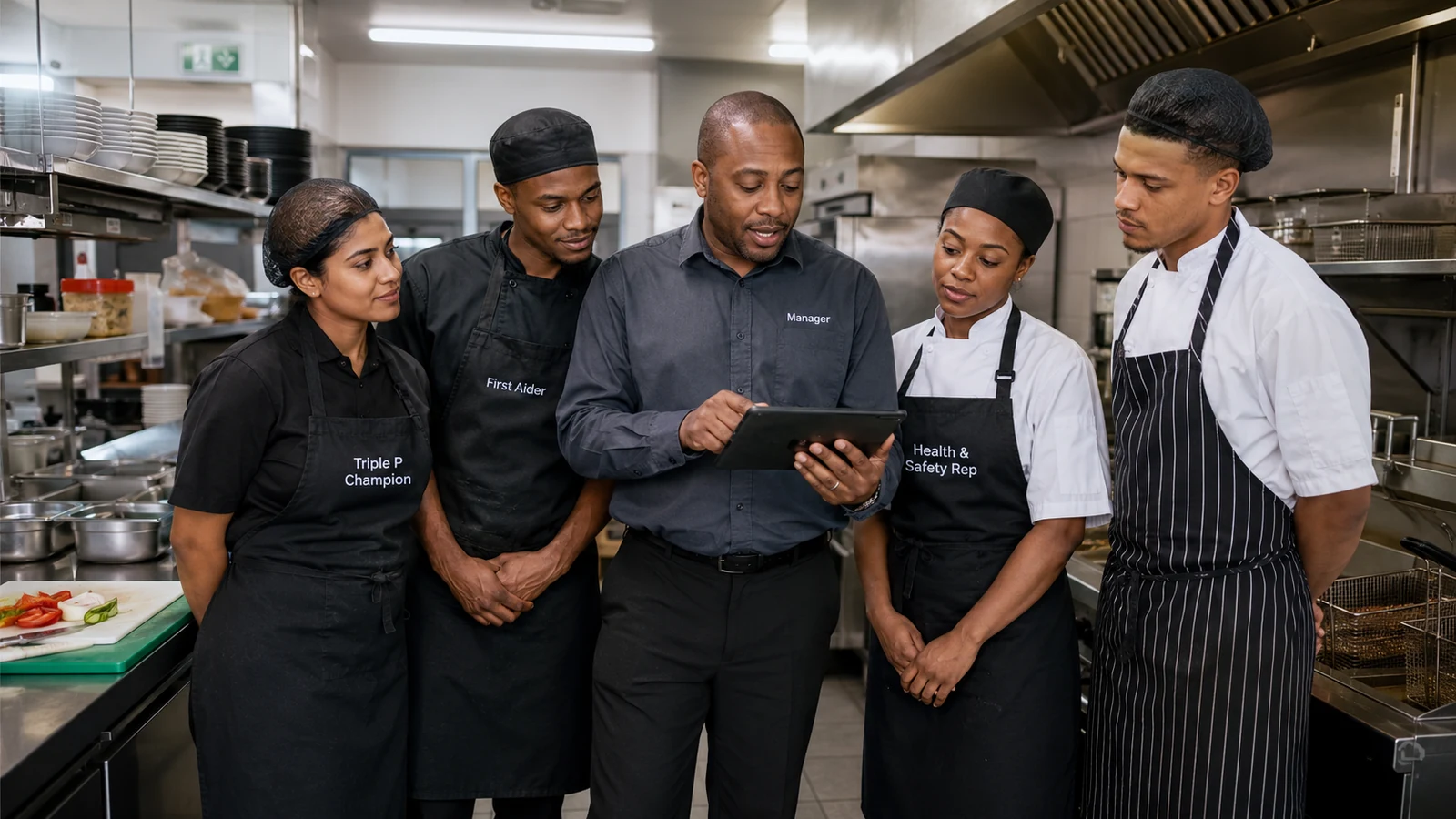
Restaurant Health and Safety works best when daily controls are managed before inspection pressure arrives.
The Real Issue Is Not the Inspection. The Real Issue Is What Happens Every Day.
Many restaurants only start focusing on Health and Safety when an inspector arrives, when a customer complaint is raised, when a staff member is injured, when an incident happens, or when a franchisor requests proof.
That creates panic.
Managers search for records. Training proof is collected. Registers are updated late. Inspection evidence is chased. Fire and first aid checks are reviewed under pressure. Corrective actions are remembered only when someone asks.
This is not sustainable.
The Department of Employment and Labour inspection is not the risk. The real risk is that daily Health and Safety controls may not be visible, current, assigned, monitored or closed out.
The question every restaurant owner should ask is: can we prove that our Health and Safety controls are being managed during normal trading operations?
For franchise groups, the question becomes even more important: can we see whether every branch is managing Health and Safety consistently?
If your restaurant or franchise group wants to move away from inspection panic and into daily operational control, Health and Safety Compliance in South Africa through the SafetyWallet platform helps structure responsibilities, inspections, registers, training records, corrective actions and evidence in one connected subscription.
Why Restaurant Health and Safety Compliance Matters in South Africa
Restaurants are fast-moving workplaces. They combine customer service, food preparation, equipment, cleaning, pressure, people movement and legal duties in one environment.
- Hot oil and hot surfaces
- Gas and electrical equipment
- Knives, slicers and sharp utensils
- Wet floors and slip hazards
- Cleaning chemicals
- Manual handling of stock
- Cold rooms and storage areas
- Waste handling
- Fire risks
- First aid incidents
- Contractors and maintenance work
- Long shifts and fatigue
- Customer-facing pressure
This is why restaurant Health and Safety compliance in South Africa must be managed as a practical daily system. It protects employees from harm. It protects customers from unsafe conditions. It protects managers from uncertainty. It protects franchisees from operational disruption. It protects franchisors from brand inconsistency. It protects the business from poor evidence when inspections or incidents occur.
Good Health and Safety is not only about avoiding penalties. It is about building a workplace where people understand risks, follow controls and take ownership of safe work.
Restaurants Are Inspected From More Than One Angle
Restaurant owners and franchise groups must understand that workplace Health and Safety and food premises hygiene are connected, but they are not the same thing.
A Department of Employment and Labour inspection focuses on workplace Health and Safety responsibilities under South Africa's Occupational Health and Safety framework. This may include safe working conditions, first aid arrangements, fire and emergency readiness, appointees, incident records, training, supervision, inspections, registers and other workplace controls.
Food premises hygiene requirements may also apply through municipal or environmental health processes. Restaurants may need to manage hygiene, food handling, food premises conditions, storage, transport of food and Certificate of Acceptability requirements.
This means a restaurant should not think too narrowly. A restaurant is not only a food business. It is also a workplace. That workplace must be managed through a proper Health and Safety system.
What the SafetyWallet Subscription Gives a Restaurant
A SafetyWallet subscription should not be understood as only access to software. It should be understood as access to a Health and Safety platform ecosystem that helps a business manage its responsibilities with more structure, guidance and confidence.
The subscription gives the restaurant a practical way to bring the following together:
- OHS Online digital system access — risk assessments, registers, inspections, legal appointments, training records, incident records, corrective actions, dashboards and reporting
- Triple P Health and Safety training
- Health and Safety eLearning
- My Safety Hub educational support
- Structured support and guidance
- Approved SafetyWallet partner support where additional guidance is needed
- SafetyWallet Shop access where relevant
- Ongoing accountability and visibility
The value is not only that information is stored. The value is that the restaurant has a clearer way to manage what must happen every day. This creates peace of mind because management can see what is required, what is completed, what is overdue, who is responsible, what evidence exists and where improvement or support is needed.
How OHS Online Fits Inside the SafetyWallet Platform
OHS Online is the operational Health and Safety management system inside the SafetyWallet platform. It helps restaurants manage daily execution across:
- Task-based risk assessments and safe operating procedures
- Health and Safety appointments and first aid arrangements
- First aid box inspections and fire extinguisher checks
- Employee training records and eLearning completion records
- Chemical registers, PPE issue records and equipment inspection records
- Maintenance follow-ups, incident reports and corrective actions
- Branch-level dashboards, management visibility and review actions
This is the difference between scattered documents and a live Health and Safety Management System. Documents can show what was planned. OHS Online helps show what is being managed. SafetyWallet gives the platform, support, training, partner ecosystem and wider subscription structure around that management process.
Restaurant Risk Lives in Daily Tasks
A major weakness in many restaurant environments is that risks are described too broadly. A restaurant may know that it has "kitchen risks," "chemical risks," "manual handling risks" or "fire risks," but those broad categories do not always show where exposure happens. Exposure happens during tasks.
Restaurants need a task-based Health and Safety Risk Assessment because the risk becomes clearer when the actual work is understood.
Task Example 1: Cleaning a Deep Fryer
Cleaning a deep fryer may expose employees to burns, chemical contact, slips, poor drainage, manual handling, awkward posture and time pressure. Controls may include:
- Cool-down procedures and safe draining method
- Correct PPE and chemical dilution rules
- Spill response, training and supervision
- Inspection records and corrective actions for damaged equipment
Task Example 2: Receiving Stock at the Back Door
Receiving stock may expose employees to manual handling, vehicle movement, pallet movement, awkward lifting, wet floors, poor lighting and rushed delivery pressure. Controls may include:
- Clear receiving zones and pallet jack training
- Housekeeping, delivery procedures and lifting aids
- Supervision, incident reporting and corrective action tracking
Task Example 3: Handling Cleaning Chemicals
Cleaning chemicals are used every day in restaurants. Risks may include skin contact, eye contact, inhalation, incorrect dilution, poor labelling and incompatible products. Controls may include:
- Chemical register and safety data sheet availability
- PPE issue records, storage rules and labelling
- Training, emergency response procedure and supervisor monitoring
Task Example 4: Inspecting Fire Extinguishers
Fire extinguishers may be installed, but that does not mean the control is active. Fire equipment must be accessible, visible, checked and serviced. Controls may include:
- Branch inspection schedule and service provider records
- Register updates and corrective actions where equipment is blocked, missing or expired
- Manager sign-off and review during Health and Safety meetings
Task Example 5: Completing a First Aid Box Inspection
A first aid box may be present, but if the contents are missing, expired or not checked, the control is weak. Controls may include:
- Inspection schedule and appointed responsible person
- Stock replacement process and incident review
- Register update and corrective action closure
OHS Online should help the restaurant connect the task, hazard, control, training record, inspection and action follow-up.
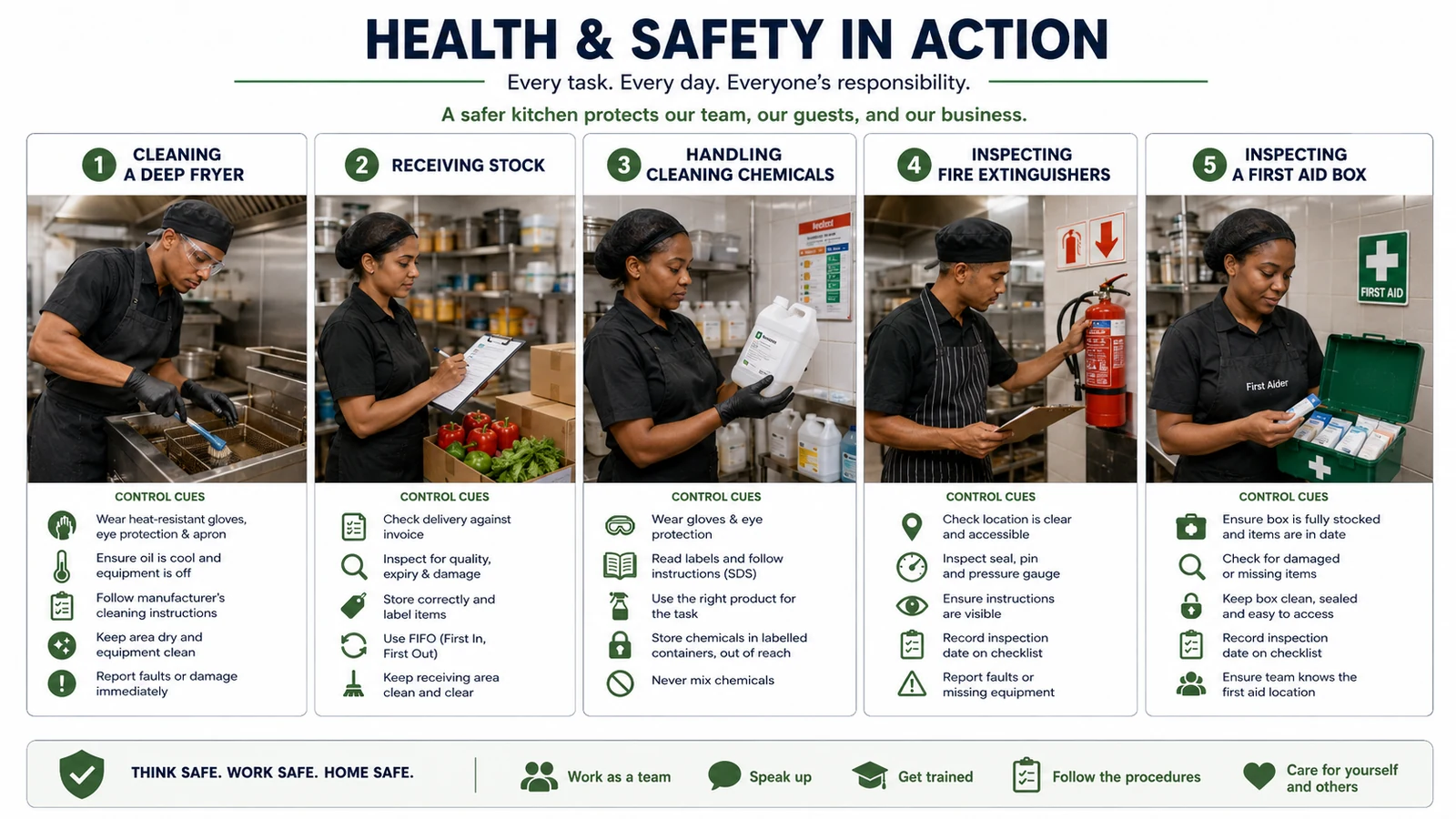
Restaurant risk becomes easier to manage when controls are linked to daily tasks.
Common Mistakes Restaurants Make
From practical Health and Safety experience, the same issues often appear in restaurant environments.
- A first aid box exists, but no one can prove it was checked on schedule.
- Fire extinguishers are installed, but branch-level inspections are inconsistent.
- Employees receive training, but completion records are scattered.
- Cleaning chemicals are used daily, but chemical controls are weak.
- Risk assessments exist, but they are not connected to restaurant tasks.
- Corrective actions are raised, but no one tracks them to closure.
- Managers rely on memory instead of system reminders.
- Franchisees manage branches differently, with no standardised approach.
- Franchisors only see weak branches after an incident, complaint or inspection.
This is why SafetyWallet platform thinking is important. Health and Safety cannot depend on someone remembering what must be done. It must be built into the way the branch is managed.
Why Franchisors Should Care
For franchisors, Health and Safety is not only a branch-level issue. It is a brand governance issue.
A franchise can have one menu, one uniform, one recipe standard, one customer experience and one marketing message, but still have many different ways of managing Health and Safety if the system is not standardised. Customers experience the brand as one brand. Employees experience the branch as their workplace. Inspectors evaluate what is happening at the site. The franchisor needs visibility across the network.
Franchisors should ask:
- Can we see which branches are up to date?
- Are branch managers completing inspections?
- Are appointees trained?
- Are first aid and fire registers active?
- Are risk assessments current?
- Are corrective actions being closed?
- Are contractors being inducted?
- Can we identify weak branches before an incident or inspection?
Without system visibility, franchisors are forced to rely on emails, manual updates, scattered documents and last-minute reporting. A franchise system needs more than trust. It needs evidence.
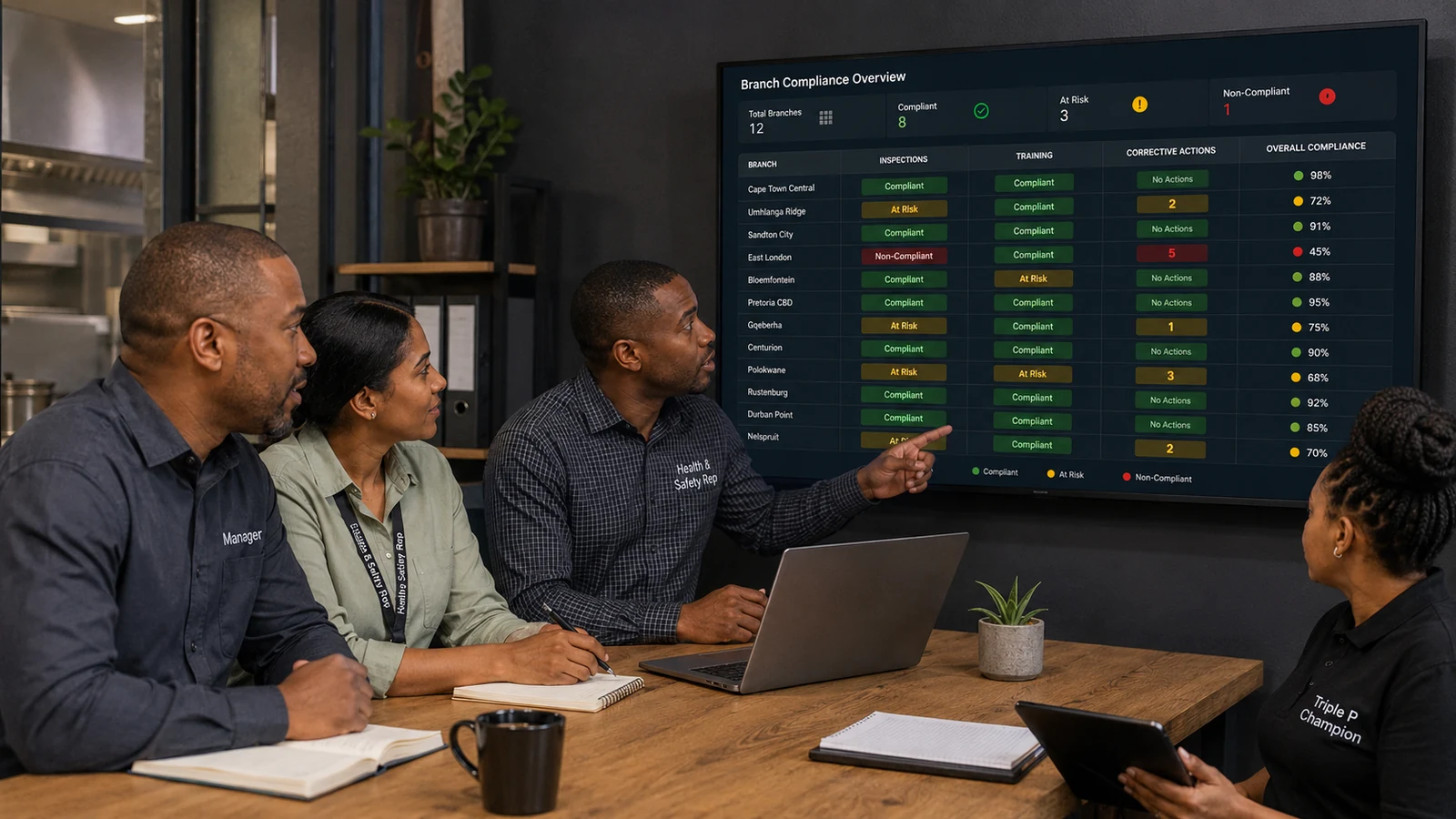
Franchise groups need visibility across branches before inspections or incidents expose weak controls.
The SafetyWallet Operating Logic for Restaurants
SafetyWallet's practical Health and Safety logic for restaurants is:
For restaurants, this is powerful because it turns Health and Safety into an operational system. Using the deep fryer task as an example: the risk of burns, chemical exposure and slips is identified. Controls including cool-down, PPE, drainage and spill response are defined. PPE, chemical, training and equipment registers are activated. The responsible person monitors whether controls are followed. The manager reviews completion and closes corrective actions. Incidents, inspection findings and repeated failures are then used to improve the system.
This is how a restaurant moves from inspection preparation to daily Health and Safety control.
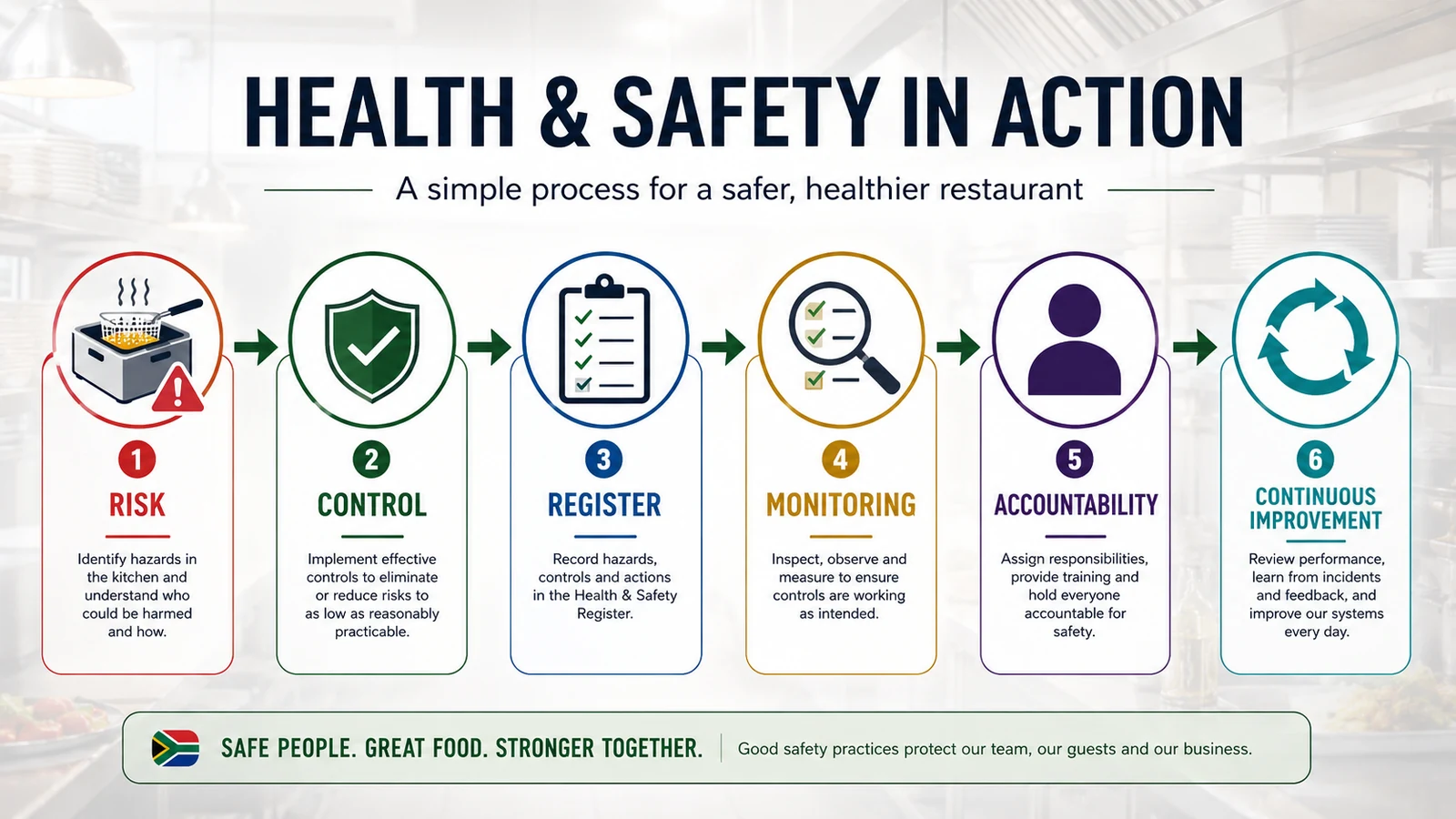
The SafetyWallet platform helps turn Health and Safety duties into a visible cycle of control, monitoring and improvement.
Why SafetyWallet Gives Restaurants More Than Software
SafetyWallet is a Health and Safety SaaS subscription platform that helps businesses manage their own Health and Safety responsibilities through OHS Online, Triple P training, eLearning, My Safety Hub, SafetyWallet Shop, structured support, approved partners and practical guidance.
For restaurant owners, franchisees and franchisors, the value is the combination of software structure, daily management visibility, risk and control logic, training pathways, internal role-player development, eLearning access, action tracking, evidence management, branch visibility and peace of mind.
This matters because:
- A restaurant owner does not only need somewhere to store information — they need to know whether the branch is managing Health and Safety properly.
- The franchisor does not only need occasional proof from branches — they need visibility across the franchise network.
- The manager does not only need a checklist — they need a structure that shows what must be done and what is overdue.
- The appointee does not only need a title — they need training, reminders, responsibilities and a way to complete tasks.
OHS Online supports the daily Health and Safety management process. Triple P supports internal ownership. eLearning supports consistent training. My Safety Hub supports ongoing education. Structured support and approved partners help the organisation mature. SafetyWallet gives the subscription platform that brings the ecosystem together.
How Triple P Training Helps Restaurant Managers and Appointees
A system only works when people understand how to use it. That is where Triple P Health and Safety training becomes important.
Triple P stands for Policies, Procedures and Practices. In a restaurant, many Health and Safety failures happen between what the policy says and what people actually do during daily work. A policy may say the restaurant will provide a safe working environment. A procedure may explain how cleaning chemicals must be controlled. The practice is what the employee actually does when cleaning the kitchen at closing time. If the practice does not match the policy and procedure, the system becomes weak.
Triple P training helps internal role-players understand how to take ownership of the Health and Safety programme — covering restaurant managers, branch supervisors, franchisee representatives, Health and Safety representatives, first aiders, fire team members and internal champions. Areas covered include:
- Why Health and Safety matters and how responsibilities are structured
- How policies and procedures connect to daily tasks and registers
- How inspections must be completed and corrective actions followed up
- How branch managers can stay inspection-ready through routine execution
- How OHS Online supports daily accountability
- How the SafetyWallet platform supports the wider compliance journey
Triple P training builds ownership rather than dependency.
How eLearning Supports Restaurant Teams
Restaurants are difficult training environments. Employees work shifts, weekends, evenings, split schedules and busy service periods. Staff turnover can also be high. This makes Health and Safety eLearning valuable.
eLearning can help restaurant groups deliver consistent Health and Safety learning across branches without depending only on classroom sessions. It supports onboarding, refresher learning, appointee development and role-player awareness.
For franchise systems, eLearning helps create a common message across branches. Every branch can receive the same foundation, the same language and the same expectations.
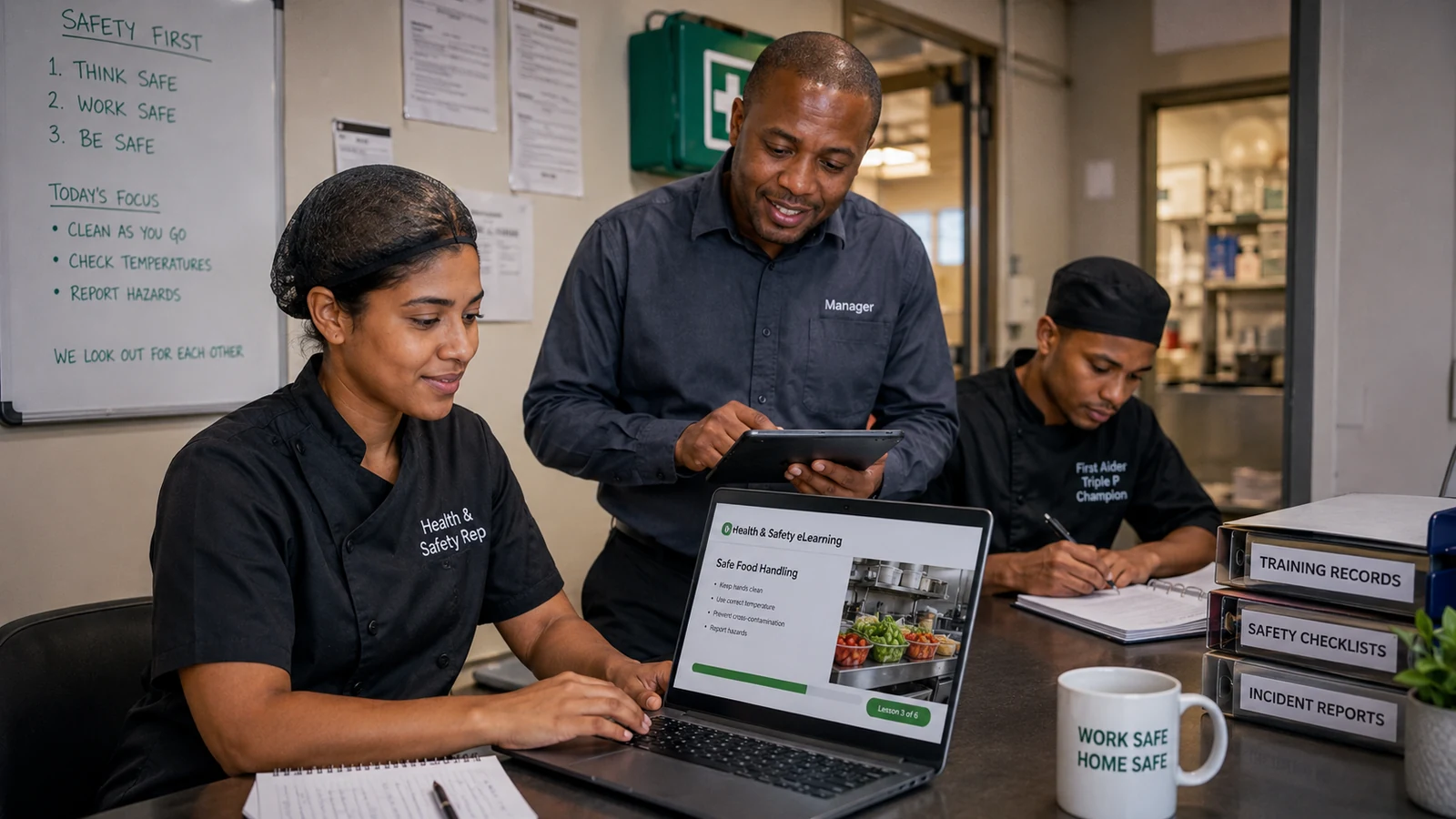
Triple P training and eLearning help restaurant teams turn Health and Safety expectations into daily practice.
Where SafetyWallet Support and Partner Structure Fit In
Different restaurants need different levels of support. Some restaurants are stable and mainly need platform access, digital structure, reminders and internal execution. Others need more structured guidance to mature their Health and Safety system.
SafetyWallet can support different maturity levels through practical subscription and support options.
| Support Option | Who It Suits |
|---|---|
| Enterprise Secure | Stable organisations ready to manage Health and Safety internally but needing platform access and structured support. |
| Expert Guidance | Companies that need more guidance to mature their Health and Safety system and strengthen implementation. |
| Apex AI | More complex environments needing advanced support and AI-enabled assistance. |
SafetyWallet's wider support ecosystem may also include approved SafetyWallet partners where additional implementation guidance is required. This is important for restaurant and franchise groups because not every branch will be at the same maturity level. Some branches may be confident with OHS Online, Triple P training and eLearning. Others may need extra guidance to activate registers, understand risk assessments, complete inspections, close corrective actions, train appointees or build better branch accountability.
The partner structure gives SafetyWallet the ability to support businesses without turning the subscription into a dependency model. The restaurant owner, franchisee and franchisor remain responsible for Health and Safety. SafetyWallet, its internal support teams and approved partners provide structure, guidance, training and practical support to help the business manage its own responsibilities.
Where extra support is required, Health and Safety Consulting Services in South Africa can assist through structured guidance, without removing the organisation's ownership.
Peace of Mind Comes From Visibility, Not Paperwork
Restaurant owners often want peace of mind. Franchisees want to know that the branch is ready. Franchisors want confidence that the brand is protected. Managers want clarity on what needs to be done. That peace of mind does not come from a once-off document. It comes from visibility.
- Can we see our risk assessments, registers, inspections and training records?
- Can we see our incidents, corrective actions and what is overdue?
- Can we see who is responsible and which branch needs help?
- Can we see when partner or support guidance may be needed?
This is why the SafetyWallet subscription should be understood as a platform for ongoing Health and Safety management, not as a once-off compliance exercise.
Behaviour Matters in Restaurants
Restaurant Health and Safety is not only about registers, inspections and dashboards. It is also about behaviour. Employees must follow safe practices when they are tired, rushed, under pressure or dealing with peak service.
- Wearing PPE when handling chemicals
- Cleaning spills immediately
- Not blocking fire equipment
- Reporting damaged equipment
- Following deep fryer cleaning procedures
- Completing inspections honestly and reporting near misses
This is where a Behaviour-Based Safety programme can support long-term improvement. For restaurants, the behaviour logic becomes:
The more employees understand the value behind safe behaviour, the more Health and Safety becomes part of the branch culture.
Restaurant Owner's SafetyWallet Readiness Checklist
- Do we understand SafetyWallet as the full subscription platform, not only OHS Online?
- Do we have a current task-based risk assessment connected to restaurant tasks?
- Are first aid inspections scheduled and recorded?
- Are fire equipment checks visible and current?
- Are chemical registers active?
- Are employees trained and are training records visible?
- Are appointees appointed and aware of their duties?
- Are inspections completed on time and corrective actions closed?
- Are incidents recorded and investigated?
- Can managers see what is overdue and where to get support?
- Are Triple P and eLearning being used to build ownership?
- Do we know when internal support or approved partner guidance may be needed?
- Can we prove what is being managed if an inspector arrives?
If the answer to these questions is unclear, the restaurant may not only have a compliance gap. It may have a platform adoption gap.
Franchisor's SafetyWallet Readiness Checklist
- Do all branches manage Health and Safety in the same way?
- Can we see branch Health and Safety status?
- Are franchisees completing required inspections?
- Are appointees trained across branches?
- Are incidents and corrective actions visible?
- Are high-risk restaurant tasks controlled consistently?
- Are new branches onboarded into the same Health and Safety structure?
- Can we identify weak branches before inspections or incidents?
- Is Health and Safety part of franchise governance?
- Are franchisees using the full SafetyWallet subscription ecosystem?
- Are OHS Online, Triple P, eLearning, support and partner guidance being used appropriately?
A franchise model depends on consistency. Health and Safety should form part of that consistency.
Restaurant Health and Safety should not depend on inspection pressure.
SafetyWallet helps restaurant owners, franchisees and franchisors manage Health and Safety Compliance in South Africa through a full subscription platform that includes OHS Online, Triple P training, eLearning, structured support, approved partner guidance, registers, inspections, corrective actions, dashboards and daily accountability.
Explore Health and Safety Compliance in South Africa →Conclusion
Restaurant Health and Safety compliance in South Africa is not only about passing an inspection. It is about protecting employees, customers, managers, franchisees, franchisors and the brand.
A Department of Employment and Labour inspection should not be the reason a restaurant starts managing Health and Safety. It should confirm that the restaurant already has a working system in place. But the system is not only software.
The strongest restaurant Health and Safety programmes are built through a connected platform approach. SafetyWallet provides the subscription platform. OHS Online supports daily Health and Safety management. Triple P training builds internal ownership. eLearning supports consistent training. My Safety Hub supports ongoing education. Structured support and approved partners provide guidance when needed. SafetyWallet Shop supports access to practical Health and Safety products and services where relevant.
Together, this helps the restaurant understand risk, implement controls, activate registers, monitor inspections, record training, close actions, support appointees, guide managers and give leadership better peace of mind.
The goal is not to create more paperwork. The goal is to help restaurants manage Health and Safety properly so that every employee can return home healthy and safe after work.
Build inspection readiness into daily restaurant operations through the full SafetyWallet Health and Safety SaaS platform. Visit the Health and Safety Compliance in South Africa page to see how the subscription helps restaurants and franchise groups manage risk, controls, registers, training, inspections, support, partner guidance and accountability.