
Why a Health and Safety Compliance Audit Must Go Beyond Paperwork
In South Africa, a health and safety compliance audit should never be treated as a paperwork exercise. The Occupational Health and Safety Act places a practical duty on employers to provide and maintain, as far as reasonably practicable, a working environment that is safe and without risk to employees' health. That duty also requires safe systems of work, hazard identification, precautionary measures, the means to apply those measures, and the information, instruction, training and supervision needed to make those measures work.
That matters because an audit is not really asking, "Do you have documents?" A useful audit is asking, "Can you show evidence that your legal and operational requirements are understood, implemented, monitored and reviewed?" This is where task-based risk assessment becomes powerful. It links the hazard to the task, the step in the task, the person exposed, the control required, the responsible role and the evidence that the control is actually being applied.
This is the practical difference between a file-based audit and an evidence-based audit. A file-based audit may confirm that a document exists. An evidence-based audit tests whether the document reflects the work being done, whether the controls are visible at the point of work, and whether the organisation is managing its Health and Safety responsibilities continuously.
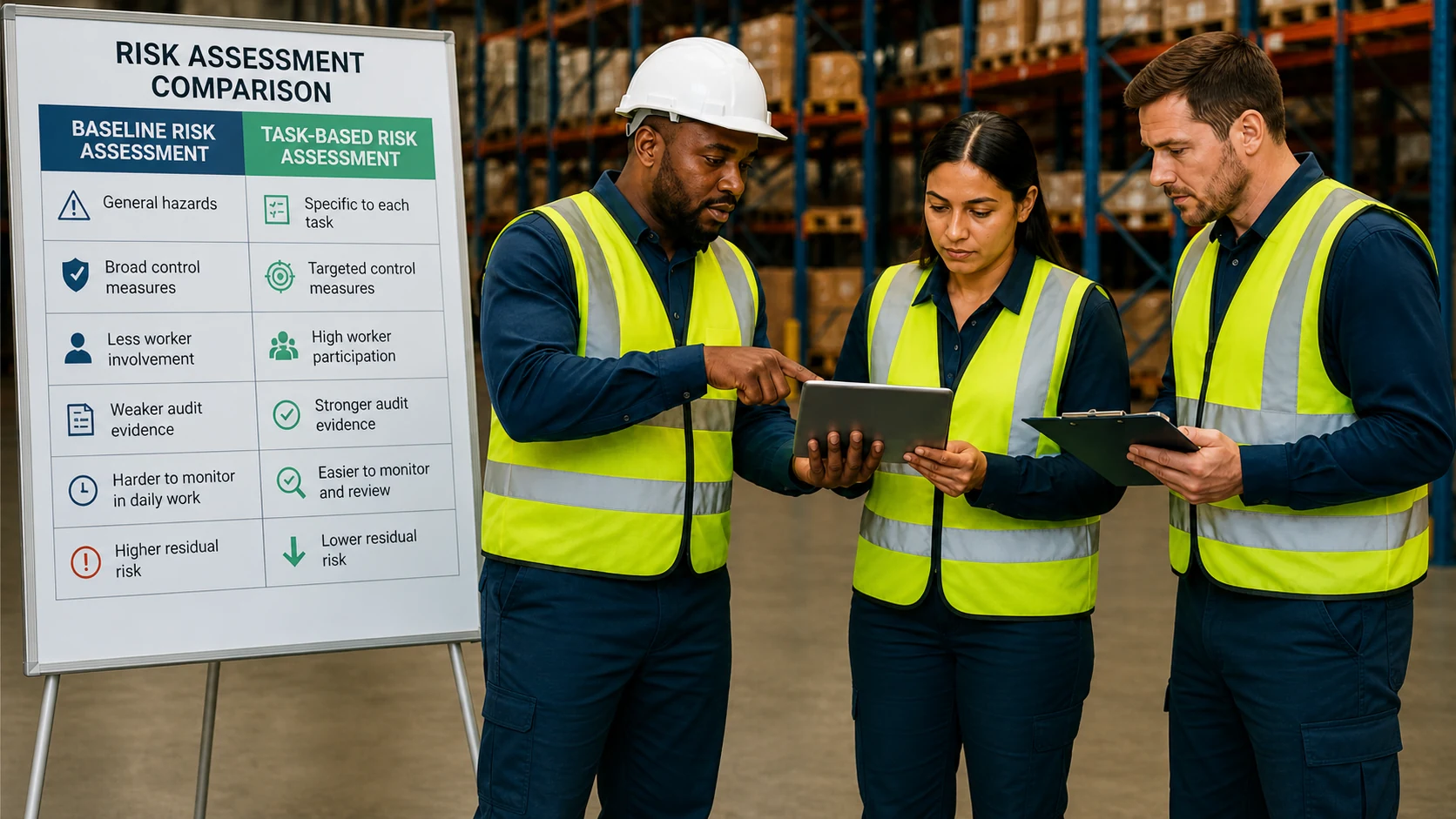
Audit readiness becomes practical when the task, hazard, control and evidence are reviewed together.
If your business wants stronger audit evidence, start with the work itself. SafetyWallet's task-based Health and Safety Risk Assessment solution helps organisations connect tasks, hazards, controls, SOPs, registers and follow-through through OHS Online.
What Health and Safety Auditors Are Really Looking For
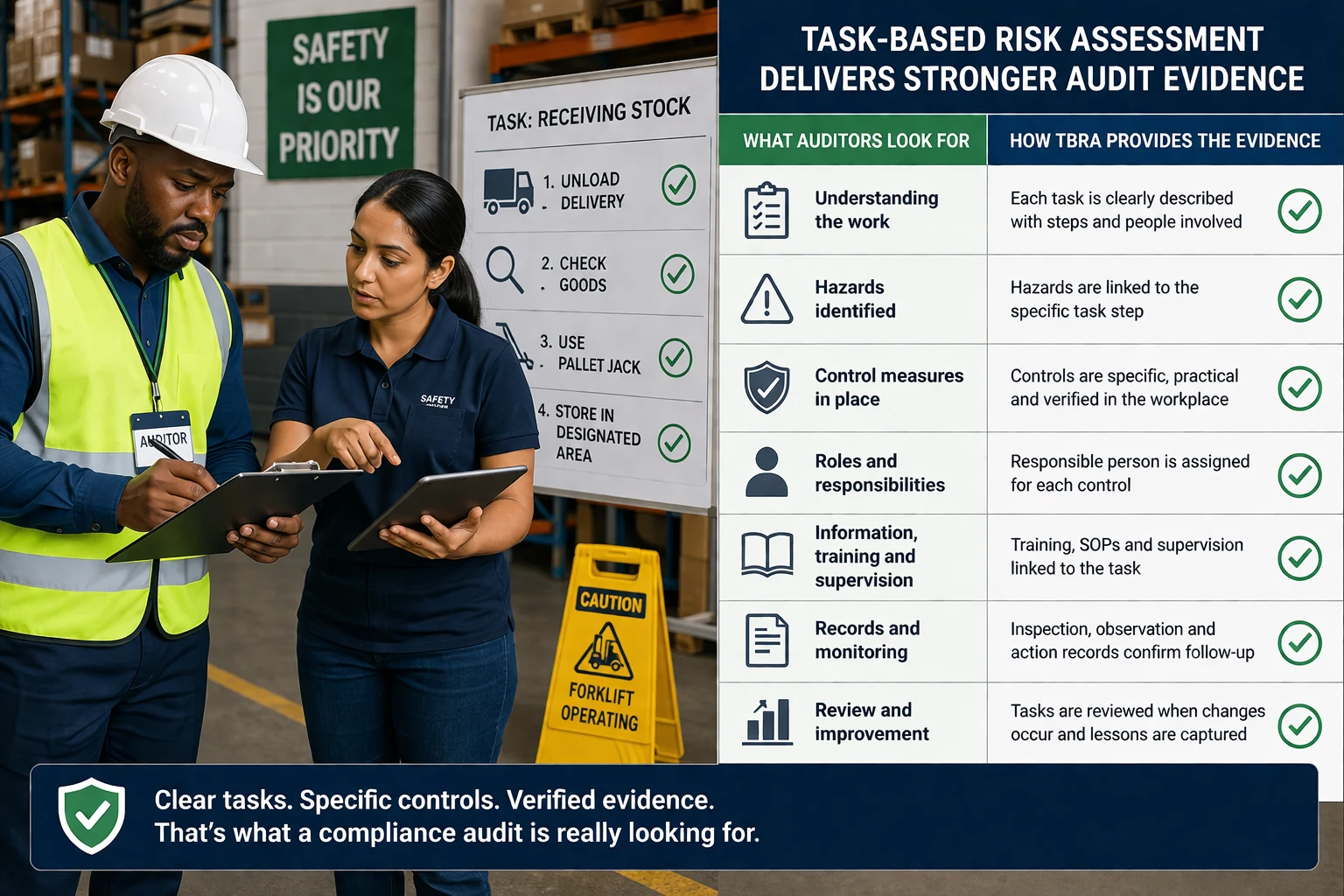
A good health and safety compliance audit is not limited to checking whether a risk assessment exists. In practice, the audit looks for evidence that the employer understands the work being done, the hazards attached to that work, the controls required, the information given to workers, the role of supervision, and the way the organisation reviews and improves its measures.
The same pattern appears in modern South African regulatory thinking. The Physical Agents Regulations published in 2025 require an exposure risk assessment for tasks where an employee is exposed to a physical agent. The assessment must identify the work process or task, the employees exposed, the exposure level, the existing controls and their effectiveness, any additional controls, the risk rating and the recommendations needed to eliminate or reduce exposure.
This is why a task-based assessment is so useful in an audit. It already follows the audit trail an auditor wants to test: task to hazard, hazard to control, control to implementation, implementation to evidence, and evidence to review.
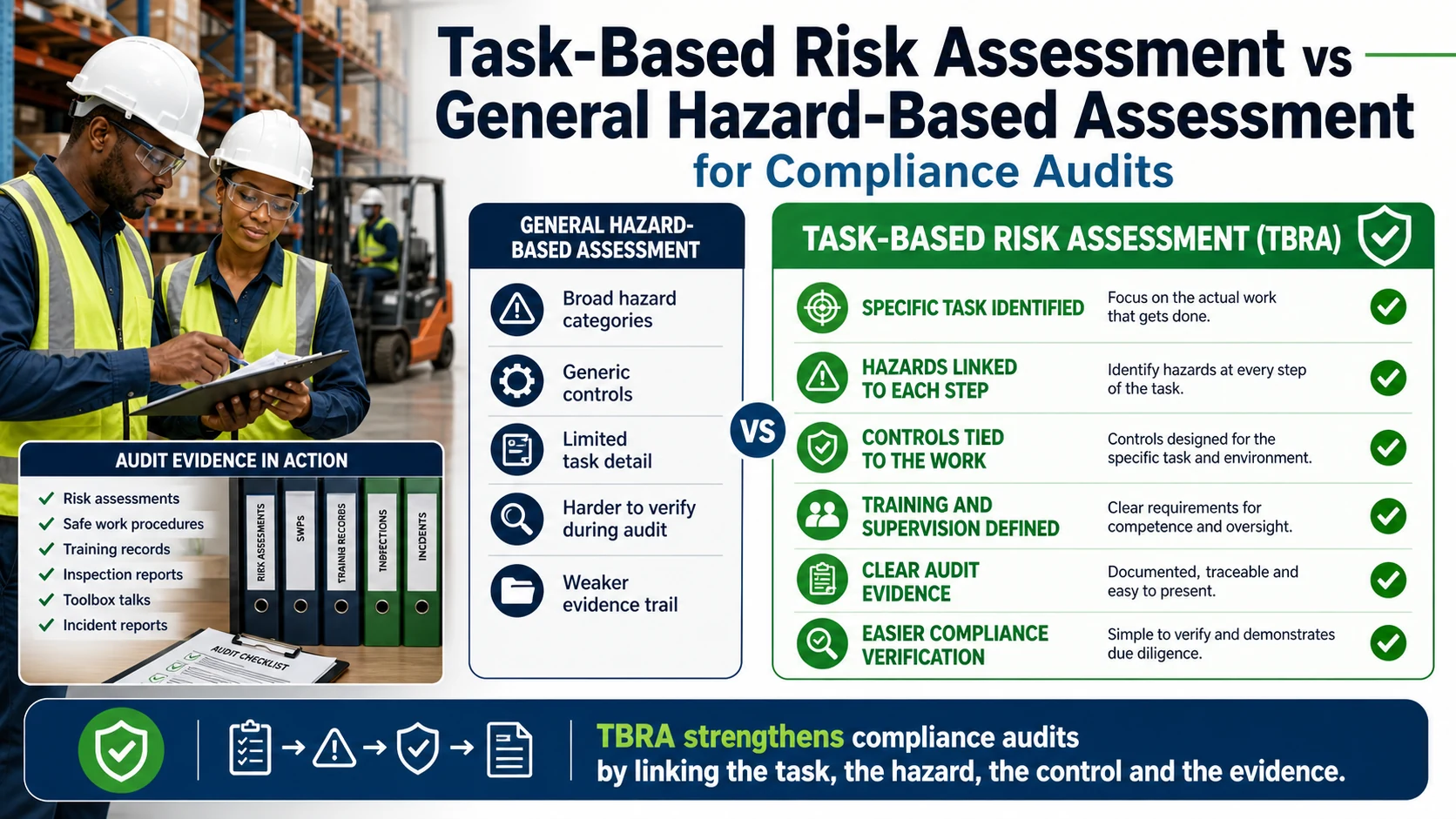
A task-based risk assessment creates a traceable path from work to evidence.
How a Task-Based Risk Assessment Creates Better Audit Evidence
The greatest strength of a task-based risk assessment in an audit is traceability. It creates a clear line from the task being performed to the hazard attached to that task, the people exposed, the controls required, the training needed, the supervision expected and the records that should exist.
For example, "manual handling" as a broad hazard heading is useful, but it is not enough. An auditor may need to know what is being handled, where it is being handled, how often it is being handled, whether a pallet jack is used, whether the floor is uneven, whether stock is stacked too high, whether the worker has been trained, and whether a supervisor checks the task.
A task-based risk assessment makes that evidence easier to test. If the task is "receiving stock at the back door using a pallet jack," the audit can check the floor condition, traffic route, load weight, pallet condition, pedestrian separation, operator instruction, inspection record, and corrective actions raised when the control fails. The audit becomes objective because the evidence is linked to the task itself.
The same applies in a restaurant when cleaning a deep fryer, in a warehouse when operating a pallet jack, in an office when completing a first aid box inspection, or on a site when replacing signage at height. The task tells the auditor where the exposure happens and what evidence should be visible.
Specific tasks create stronger audit evidence than broad hazard headings.
How Task-Based Risk Assessment Supports Legal Compliance in an Audit
South African legal compliance is built around practical duties, not broad intentions. Employers need to understand hazards attached to the work, establish precautionary measures, provide the means to apply those measures and give the information, instruction, training and supervision needed to keep work controlled.
A task-based risk assessment supports this because it starts where the legal duty is most visible: at the work itself. Instead of asking only whether chemicals, machinery, electricity or ergonomic strain are present, it asks which task creates the exposure, at what step the risk appears, what control should be present there, and who is responsible for ensuring that the control is in place.
This is also where the link to Health and Safety Compliance in South Africa becomes important. Compliance is not only about having a policy, a file or a certificate. It is about showing that the organisation has translated legal duties into safe work, control measures, records, supervision and review.
Why Task-Based Risk Assessment Makes Audit Findings Easier to Verify
One of the biggest frustrations in compliance audits is when findings are too general to verify properly. If an audit finding says, "Improve manual handling controls," that can mean many things. But if the finding is linked to a specific task step, the organisation can identify the exact control gap, assign responsibility, implement the corrective action and then re-audit the same point in the process.
For example, if the finding relates to "operating a pallet jack while receiving stock," the corrective action may include repairing the receiving area floor, adding pedestrian demarcation, introducing a pre-use pallet jack inspection, training the operator, and adding the inspection to the relevant register. Closure evidence can then include photographs, training records, inspection records, action requests and supervisor verification.
This is much stronger than closing an audit finding with a generic statement such as "training completed." The task-based approach shows what changed, who changed it, where it changed and how the organisation will monitor that the change continues.
How Task-Based Risk Assessment Supports Training, Supervision and Safe Systems of Work
A compliance audit does not stop at the written risk assessment. It usually extends into questions of training, instruction, competency and supervision. A task-based risk assessment supports this because it provides a practical structure for what workers must know and what supervisors must verify.
If the task is broken into clear steps with clear controls, induction, refresher training, toolbox talks, method statements and supervision checklists can all be built around the same structure. When a worker is cleaning a deep fryer, the assessment can guide what must happen before the task starts, what controls must be checked during the task and what records must be completed afterwards.
This also helps the auditor. The auditor can ask a worker to explain the task, ask a supervisor how the control is checked, review the training records, inspect the safe operating procedure and observe whether the work matches the documented method. The audit chain is stronger when the risk assessment is written in the language of the task.
How Task-Based Risk Assessment Strengthens Worker Participation and Audit Credibility
In South Africa, worker participation is not a side issue. Health and safety representatives and committees play an important role in inspection, consultation, communication and review. A task-based risk assessment makes this participation more meaningful because workers can speak about the real work they do every day.
A driver can explain loading and reversing exposure. A cleaner can explain chemical splash, slip risk and awkward movement. A maintenance employee can explain isolation, stored energy and tool use. A first aider can explain what is checked during a first aid box inspection. A contractor controller can explain what must happen during contractor induction before a contractor starts work.
This gives representatives and committees something practical to inspect, question and verify. It also improves audit credibility because evidence is not built only from management assumptions. It is built from the operational truth of the people closest to the task.
How Task-Based Risk Assessment Supports a Health and Safety Management System During Audit
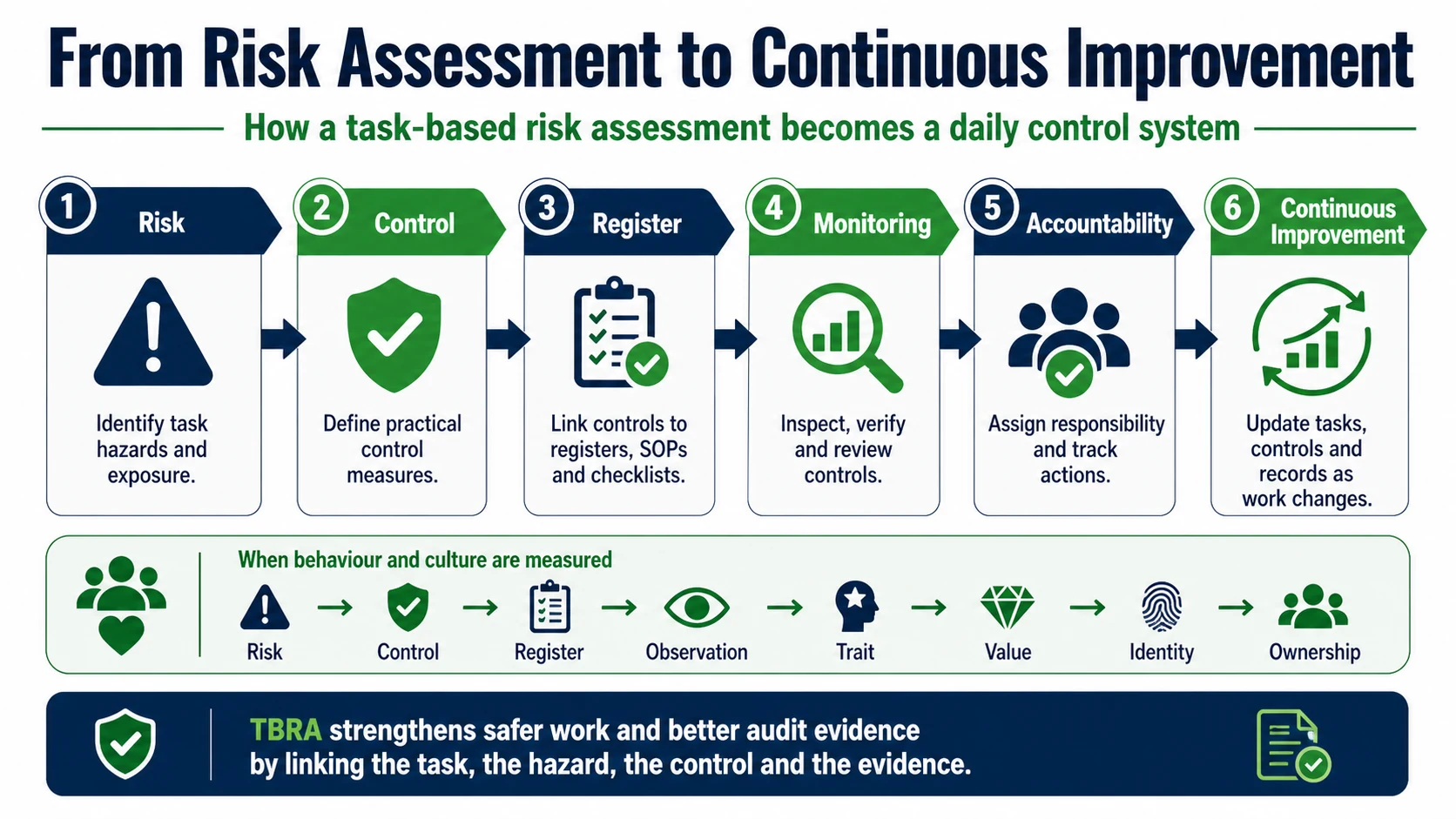
A health and safety compliance audit is always stronger when the risk assessment is not a stand-alone document. A task-based risk assessment links naturally into a Health and Safety Management System because each task can be connected to procedures, training records, inspections, maintenance checks, incident reports, corrective actions, committee discussions and review triggers.
This is where OHS Online supports the SafetyWallet approach. SafetyWallet is a Health and Safety SaaS platform that helps organisations manage their own Health and Safety responsibilities by connecting tasks, hazards, control measures, SOPs, registers, inspections, action requests and evidence in one practical system.
A task-based assessment gives this logic a starting point. It shows what must be controlled, which register must be active, what needs to be inspected, who is accountable, and how the organisation reviews whether the control is still working.
A living Health and Safety Management System connects task risk to daily evidence.
How Task-Based Risk Assessment Supports ISO 45001 and Structured Audits
Even where the audit is not strictly an ISO audit, ISO 45001 support in South Africa helps explain why task-based assessment is useful. ISO 45001 is built around a structured occupational health and safety management system, including leadership, worker participation, hazard identification, risk assessment, operational control, competence, performance evaluation and continual improvement.
A task-based risk assessment supports these themes naturally. Leadership becomes visible through proper control design. Worker participation becomes visible through task-level consultation. Hazard identification becomes more robust because it is connected to the work sequence. Operational control becomes easier to test because the expected actions are clearer.
ISO 19011 also matters because it provides guidance for auditing management systems. The stronger message is that task-based risk assessment gives auditors better evidence because the management system can be tested against real work.
Why a General Baseline Assessment Is Useful but Not Enough for Audit
A general hazard-based or baseline assessment still has an important place. It can help identify the major hazard groups across a workplace and give management a broad view of exposure. It can also help prioritise areas that require deeper task analysis.
But a compliance audit usually needs more than a broad hazard picture. It needs verifiable evidence that specific work is controlled. It needs to test whether the right person is trained for the right task, whether the right control exists at the right step, whether the right records are maintained, whether representatives and committees can engage meaningfully with the issue, and whether review happens when work or controls change.
So the real choice is not between identifying hazards and identifying tasks. A task-based risk assessment still identifies hazards. It simply identifies them where the auditor can test them most effectively: in the work itself.
How SafetyWallet Supports Task-Based Risk Assessment for Audit Readiness
SafetyWallet helps organisations manage their own Health and Safety responsibilities through OHS Online, Triple P training, e-learning, My Safety Hub, My Safety Shop and structured support. It does not remove the organisation's accountability. It gives the organisation a practical system to understand, implement, monitor and improve its controls.
Through SafetyWallet and OHS Online, a business can build a task inventory, identify hazards linked to real work, assess exposure, define control measures, support SOPs, activate registers, monitor inspections, track actions and strengthen accountability before an audit exposes the gaps.
Build audit readiness from the task up.
SafetyWallet's Health and Safety Risk Assessment solution helps your team connect tasks, hazards, control measures, SOPs, registers and accountability so audit evidence is easier to manage and verify.
Visit the Health and Safety Risk Assessment page →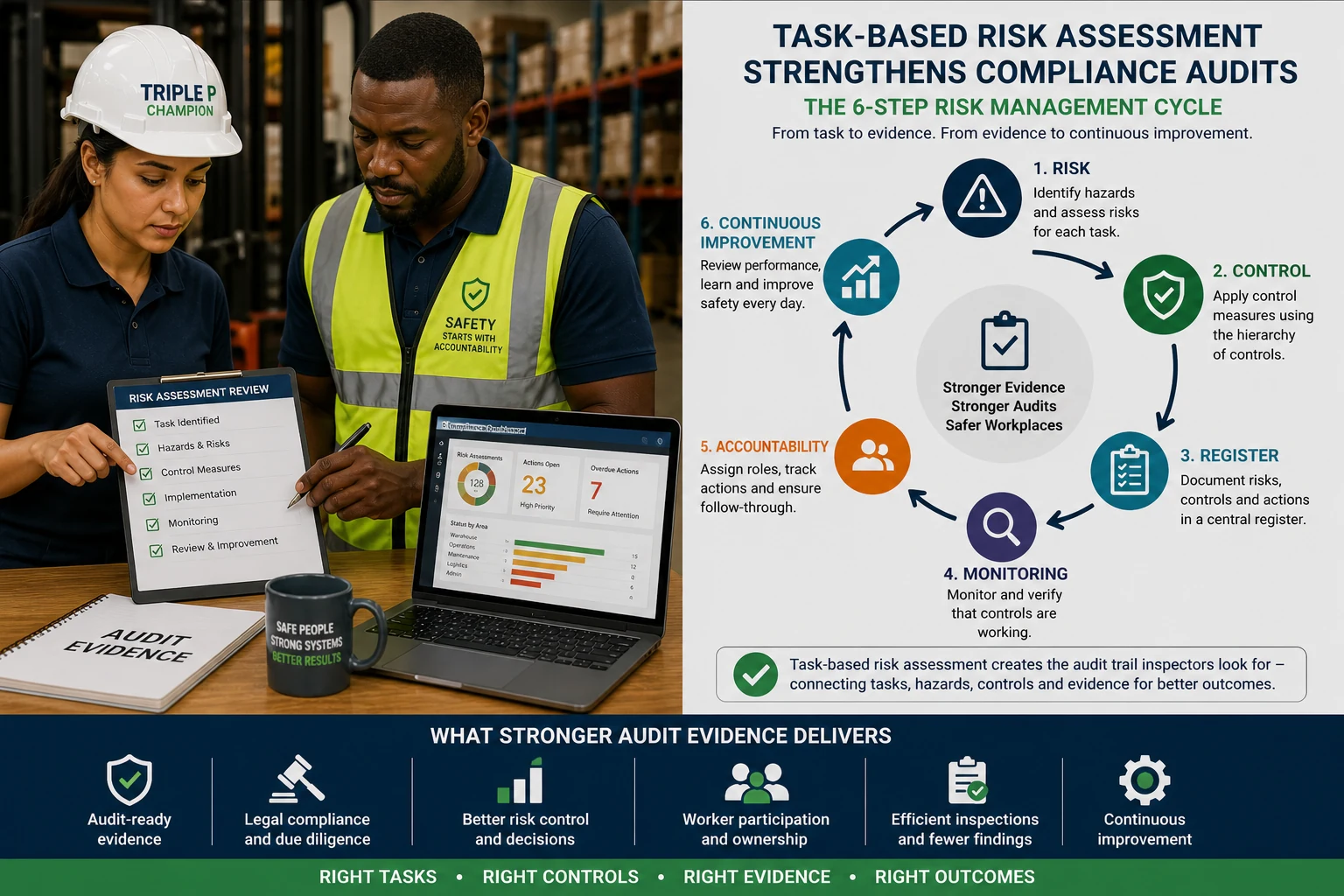
Worker participation strengthens audit credibility when evidence is linked to real tasks.
Conclusion: Why Task-Based Risk Assessment Makes Compliance Audits Stronger
From a South African compliance point of view, a task-based risk assessment gives a health and safety audit what it needs most: objective, operational evidence. It supports legal duties around safe systems of work, hazard identification, precautionary measures, training and supervision. It strengthens worker participation, committee engagement and representative inspections. It makes corrective actions easier to define, assign and verify.
A baseline assessment may help you describe exposure. A task-based risk assessment helps you prove control. When the purpose of a health and safety compliance audit is to test whether legal and operational requirements are actually being met, that difference is decisive.
The strongest audit evidence is not created on audit day. It is created every day through the tasks people perform, the controls they apply, the registers they maintain, the observations they complete, and the improvements the organisation makes over time.
Start with the task, then build the control system around it. Visit the SafetyWallet Health and Safety SaaS platform or the Health and Safety Risk Assessment solution page to see how OHS Online helps organisations turn risk assessment into daily control, audit readiness and ownership.