
Why Risk Assessment Must Go Beyond Paperwork in South Africa
In South Africa, risk assessment should never become a paperwork exercise that exists only to satisfy an auditor or fill a file. The Occupational Health and Safety Act places a clear duty on employers to provide and maintain, as far as reasonably practicable, a working environment that is safe and without risk to the health of employees. That duty is practical. It expects safe systems of work, suitable precautionary measures, information, instruction, training and supervision.
The real question is therefore not whether an organisation has a risk assessment document. The real question is whether the organisation can show that it understands how work is actually done, where people are exposed, what controls are required, and how those controls are being implemented and supervised in practice.
This is where task-based risk assessment becomes the stronger route for most workplaces. It anchors hazard identification, control selection, worker participation, training and supervision in the reality of the work itself. It helps South African organisations move from compliance on paper to operational control in practice.

Risk assessment becomes practical when it starts with the task being performed.
If your business wants to move from broad hazard lists to practical risk control, explore SafetyWallet's task-based Health and Safety Risk Assessment solution. It helps teams identify tasks, assess hazards, apply controls and track follow-through through OHS Online.
Task-Based Risk Assessment vs General Hazard-Based Risk Assessment
A general hazard-based risk assessment, often called a baseline assessment, usually starts with broad hazard categories. It asks whether there is electricity, manual handling, chemicals, working at height, moving machinery, fire, noise, vehicles, dust, awkward postures, or slips and trips. This approach is not wrong. It can help an organisation identify the main hazard groups across a site, department or operation and build a broad picture of the risk landscape.
In practice, a general hazard-based risk assessment often follows a familiar sequence: identify the hazards, consider the controls already in place, evaluate the current risk, and then decide what additional controls are needed. This gives a baseline view of exposure and existing control, but it can remain too far removed from the actual work.
The challenge is simple: broad categories do not perform the work. People perform tasks. People isolate equipment, lift stock, decant chemicals, clean machinery, load vehicles, inspect plant, enter storerooms, work on ladders, repair belts, capture data, move waste and conduct maintenance. That is where risk lives.
A task-based risk assessment begins with the job and the steps within that job. It asks what happens at each step, what could go wrong, who may be affected, what controls are already in place, what additional controls are required, and what safe behaviour must be visible while the task is being done.
This is the core reason task-based risk assessment is better. It does not reject hazard identification. It identifies hazards in context. That makes the assessment far more useful for employers trying to build real operational control, meaningful consultation and better supervision.
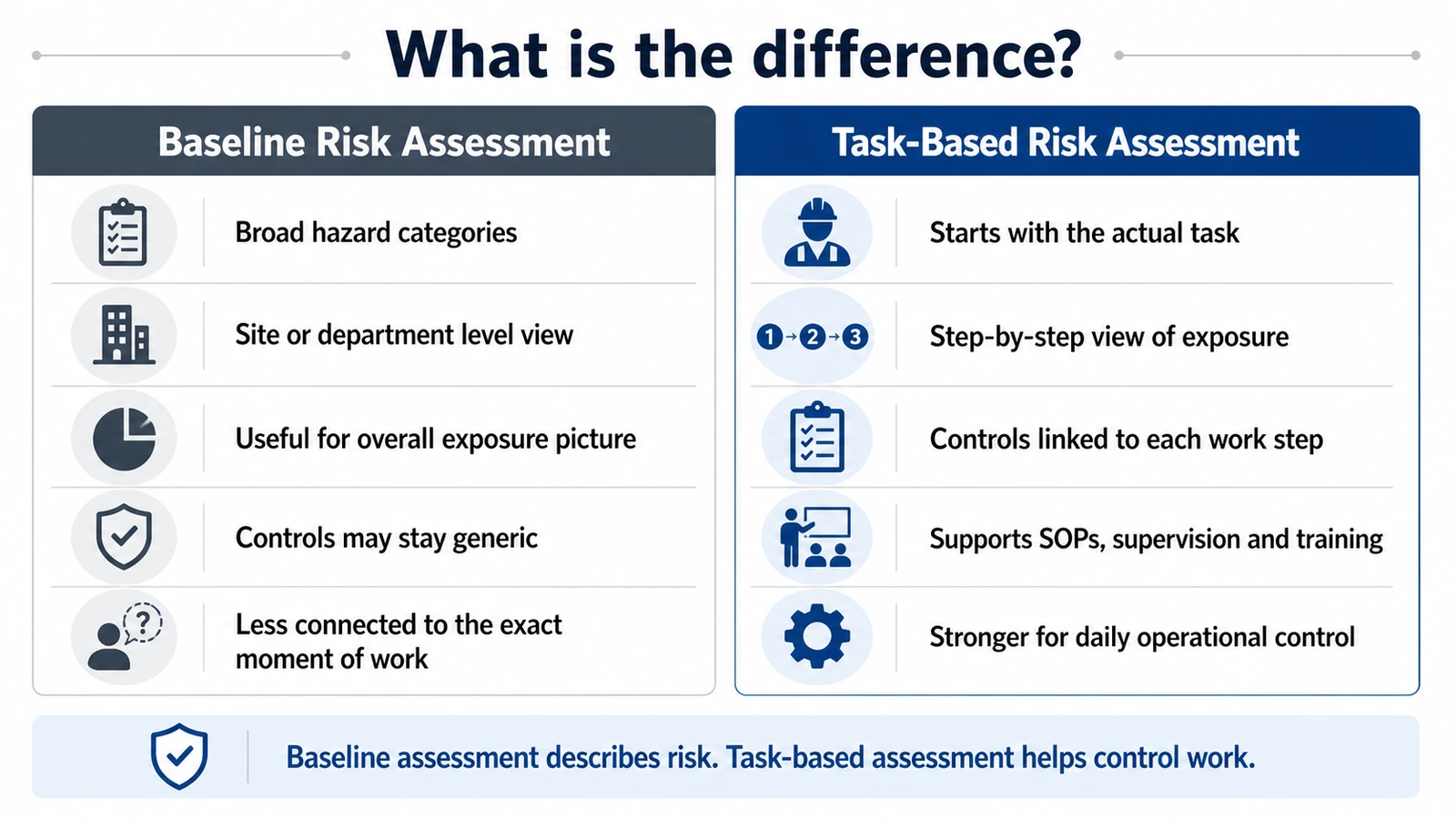
Baseline assessment describes broad hazards; task-based assessment helps control real work.
Why General Hazard-Based Risk Assessment Is Not Enough
The weakness of a general hazard-based approach is not that it identifies hazards. Its weakness is that it can stay too far away from the actual point of work. For example, "manual handling" as a hazard category may lead to a general control such as "train employees in lifting techniques". That may sound responsible, but it often does not change the task itself.
A task-based assessment forces the organisation to ask more specific questions. Which item is being lifted? From what height? In what space? At what frequency? With what grip? Over what distance? Under what floor conditions? At what pace? With what production pressure? By one person or two? Using what tool or aid?
Once the task is examined properly, the controls become more intelligent and practical. The organisation is no longer managing a category. It is managing the work.
How Task-Based Risk Assessment Improves Control Measures
Once the task is broken down properly, control selection improves. The organisation can ask whether the task can be eliminated, substituted, redesigned, isolated, engineered, sequenced differently or supported by better tools before it falls back on administrative controls or PPE.
A task-based assessment makes the hierarchy of controls easier to apply because it shows exactly where in the work sequence the control must sit. It helps the organisation see whether the job can be redesigned, whether the worker can be separated from the hazard, whether equipment or layout can be changed, whether handling distances can be shortened, or whether the task must stop until stronger measures are in place.
This is why task-based assessments usually produce better control measures than assessments that remain at the level of broad hazard categories.
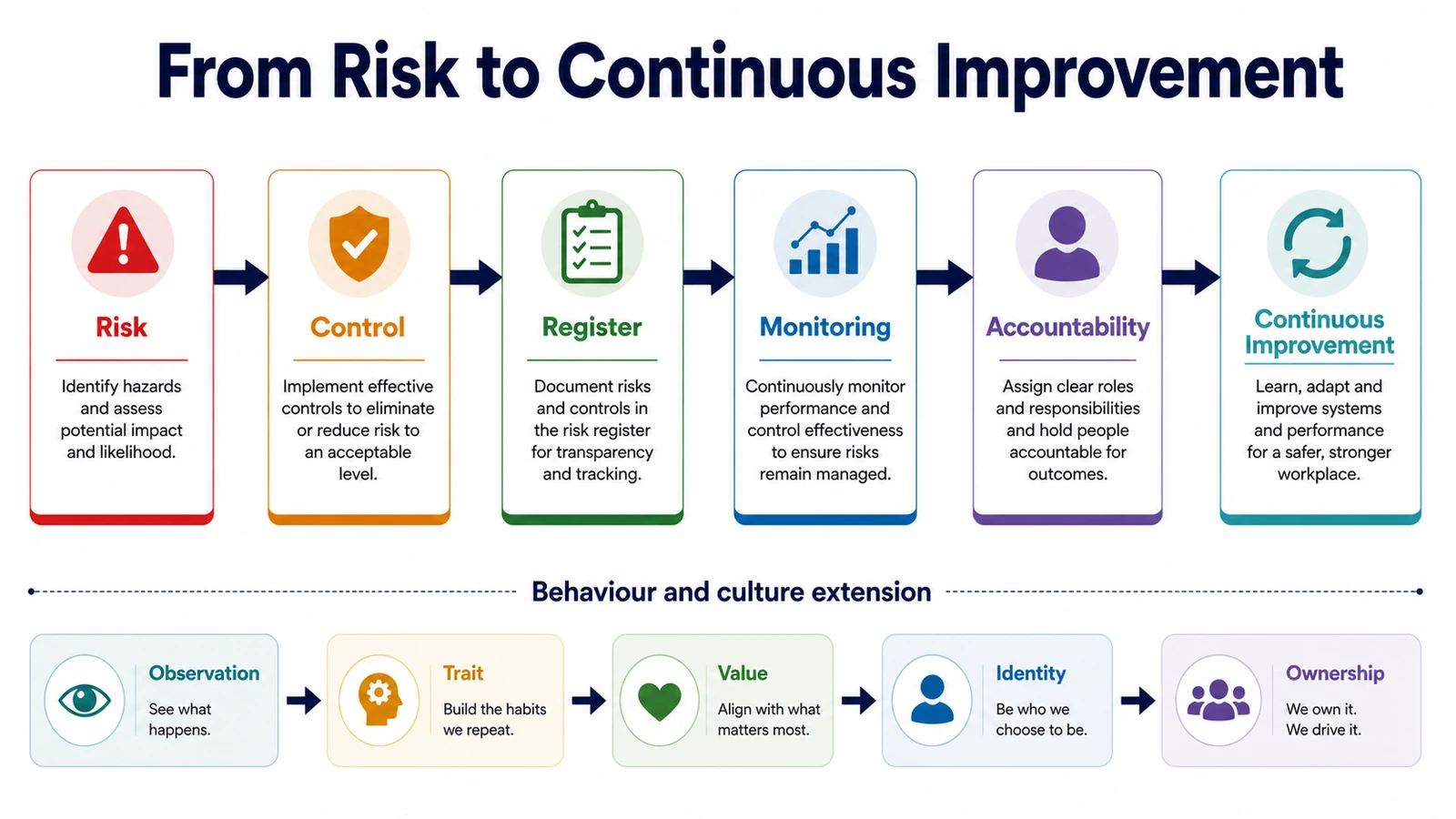
Task-based risk assessment creates a line of sight from risk to accountability.
Why Worker Participation Is Stronger in a Task-Based Risk Assessment
The South African health and safety framework is participative. Health and safety representatives, committees, supervisors, managers and employees all have a role to play. That participation becomes far more meaningful when workers are consulted about actual tasks instead of abstract hazard headings.
A fitter can explain what really happens during shutdown maintenance. A driver can explain the exposure during loading and reversing. A cleaner can explain where splash, slip or chemical contact really occurs. A storeman can explain what happens when stock is lifted from awkward shelves. A general hazard register often encourages generic input. A task-based assessment encourages operational truth.
How Task-Based Risk Assessment Supports Training, Supervision and Safe Systems of Work
Task-based risk assessment links directly to instruction, supervision and safe systems of work. It gives the organisation a practical way to explain what must happen before, during and after the task.
Instead of giving employees only general warnings, it gives them a structured understanding of how the work must be done safely. It can feed safe operating procedures, method statements, induction, refresher training, toolbox talks, supervision checklists and contractor control.
This creates a line of sight from the hazard to the task, from the task to the control, and from the control to the person responsible for implementation.
How Task-Based Risk Assessment Supports a Health and Safety Management System
This same task-based logic becomes even more powerful when it is supported inside a Health and Safety Management System such as OHS Online. A task-based risk assessment gives the system a practical foundation because the work is already broken down into tasks, steps, hazards, controls and responsibilities.
When the task sits at the centre of the system, the risk assessment can feed directly into safe operating procedures, control measure checklists, inspections, registers, training requirements, supervision points, legal appointments, corrective actions and review triggers.
That allows OHS Online to become more than a storage place for documents. It becomes a working management system that links hazards to tasks, tasks to controls, controls to responsible persons, and responsible persons to ongoing verification.
Where a health and safety management system is built around tasks, leadership can see which controls are required for which jobs, supervisors can verify what should be happening in the field, employees can understand what safe work looks like in practice, and the organisation can review findings, incidents, inspection results and control failures against the actual work being done.
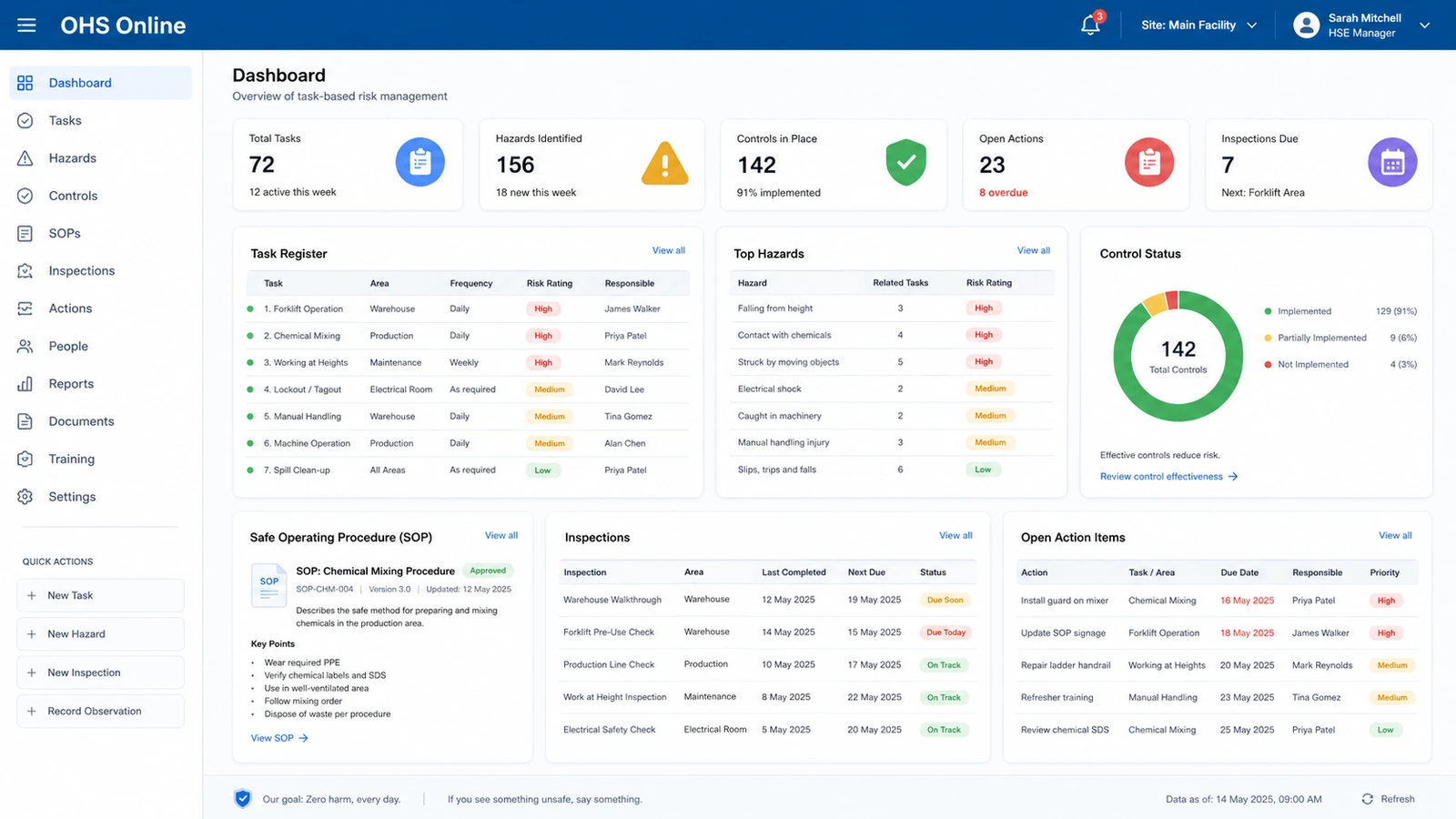
A living Health and Safety Management System connects task risk to daily follow-through.
How Task-Based Risk Assessment Strengthens ISO 45001 Implementation
Task-based risk assessment is particularly valuable in an ISO 45001 support in South Africa implementation because ISO 45001 does not exist to create more paperwork. The standard is about a structured occupational health and safety management system that includes leadership commitment, worker participation, hazard identification, risk assessment, operational control, competence, performance evaluation and continual improvement.
A task-based risk assessment supports those requirements naturally. Leadership commitment becomes visible when the business invests in real task analysis, proper supervision and control design. Worker participation becomes stronger because those closest to the job help identify what really happens. Operational control becomes clearer because the assessment points directly to what must happen before, during and after the task.
This is where many organisations go wrong with ISO 45001. Policies exist. Objectives exist. Registers exist. Meetings happen. Yet the sharp end of work remains disconnected from the management system. Task-based risk assessment closes that gap by building the management system around real operational exposure.
Why Task-Based Risk Assessment Supports a Behaviour-Based Health and Safety Programme
Behaviour can only be improved meaningfully when the expected safe actions are clear. If a risk assessment stays broad, behavioural coaching also stays broad. People hear phrases such as "be careful", "follow procedure", "wear PPE" or "stay alert". Those messages may have some value, but they are often too vague to create consistent habits.
A task-based risk assessment gives behaviour a practical anchor. It shows what safe behaviour looks like at the point of work: isolate before opening, inspect before climbing, position before lifting, verify before energising, secure before cutting, clean before starting, communicate before moving, and stop when controls are missing.
This produces a more mature Behaviour-Based Safety programme: one that shapes conditions and behaviours together instead of blaming the worker for weaknesses in task design, control selection, workflow, supervision or tools.
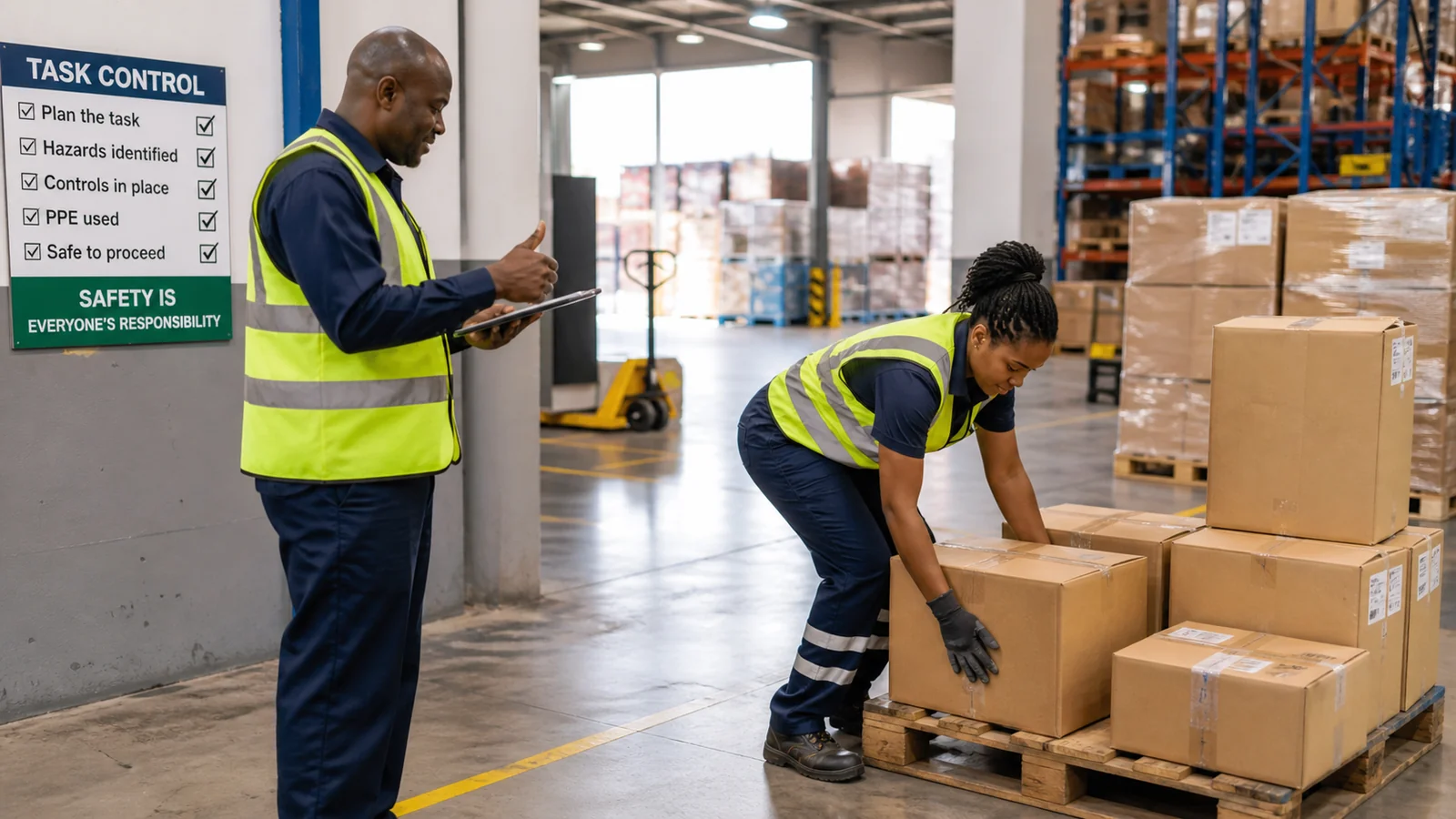
Behaviour becomes easier to coach when the expected safe action is linked to a specific task control.
How Task-Based Risk Assessment Improves Review and Change Management
South African workplaces are dynamic. Staff change. Production changes. Tools change. Materials change. Sites change. Contractors come and go. Incidents expose hidden weaknesses. A task-based model is highly responsive to this because changes in work are visible immediately at task level.
If a new tool is introduced, the affected step can be reassessed. If the job sequence changes, the controls can be revisited. If a non-routine task becomes more frequent, the assessment can be upgraded. If supervision is weak during a specific stage of the job, that weakness becomes easier to see.
This makes task-based risk assessment better for continual improvement because it creates a tighter loop between what happens in the workplace and what gets updated in the risk management system.
Task-Based Risk Assessment Strengthens Hazard Identification
Supporting task-based risk assessment does not mean rejecting hazard identification. Hazard identification remains essential. A task-based assessment still identifies hazards. It simply identifies them in context.
A general hazard-based risk assessment asks, "What hazards exist here?" A task-based risk assessment asks, "At what point in the job does the hazard arise, who is exposed there, what control is required there, and how do we know that control is working there?" The second question is far more useful when the goal is real implementation.
This also answers a common criticism of task libraries and predefined task hazards. A structured task library is not automatically weak. It can promote consistency, speed up hazard recognition, reduce omissions and create a controlled base for review. The real test is whether the final assessment is specific, suitable, systematic and responsive to the actual workplace.
How SafetyWallet Supports Task-Based Risk Assessment
SafetyWallet is a Health and Safety SaaS platform that helps organisations manage their own health and safety responsibilities through OHS Online, Triple P training, e-learning, My Safety Hub, My Safety Shop and structured support. It does not remove the organisation's responsibility. It helps make that responsibility visible, structured and easier to manage.
Through SafetyWallet and OHS Online, a business can build task inventory visibility, identify hazards linked to real work, assess exposure, define control measures, support SOPs, activate registers, monitor inspections, track actions and strengthen accountability.
Build your risk assessment from the task up.
SafetyWallet's Health and Safety Risk Assessment solution helps your team connect tasks, hazards, control measures, SOPs, registers and accountability in one practical system.
Visit the Health and Safety Risk Assessment page →Why Task-Based Risk Assessment Is the Better Route for South African Workplaces
From a South African business perspective, task-based risk assessment is the better route because it aligns with the employer's duty to provide safe systems of work. It supports the requirement to identify hazards attached to the work being performed. It gives health and safety representatives and committees something practical to engage with. It strengthens information, instruction, training and supervision.
It also helps organisations choose stronger controls before defaulting to PPE. It creates evidence for ISO 45001 operational control, worker participation and continual improvement. It gives behaviour-based safety programmes a real foundation in observable work.
The conclusion is simple. A general hazard-based risk assessment may help you describe risk. A task-based risk assessment helps you control work. In South Africa, where compliance, implementation, supervision, worker consultation and proof of precaution matter, that difference is decisive.
A business that wants safer work, stronger ISO 45001 implementation and a more mature behaviour-based health and safety culture should not stop at general hazard categories. It should go to the task, because that is where exposure happens, where controls must live, and where safety becomes real.
Start with the task, then build the control system around it. Visit the SafetyWallet Health and Safety SaaS platform or the Health and Safety Risk Assessment solution page to see how OHS Online helps organisations turn risk assessment into daily control, monitoring and ownership.