
A control measure is not just something written in a risk assessment to satisfy an audit.
It is not just a sentence in a safety file.
It is not just a line item for the Department of Employment and Labour.
It is not just a compliance requirement.
A control measure is a promise.
It is a promise that the person doing the task matters. It is a promise that the business has looked at the hazard, understood the risk and decided not to leave that worker exposed. It is a promise to the husband, wife, child, parent or friend waiting at home that the person they love is not just a number in the workplace.
This is why SafetyWallet believes a control measure in a Task Based Risk Assessment (TBRA) is one of the most important parts of a Health and Safety system.
Because when a control measure is understood, implemented, monitored and owned, it does more than support compliance. It helps people return home healthy and safe after work.

TBRA control measures are more than compliance; they protect people and families.
Explore how SafetyWallet helps connect TBRA control measures to real workplace accountability through Task Based Risk Assessment (TBRA), OHS Online, Triple P and MES.
Short Answer
A control measure in a Task Based Risk Assessment (TBRA) is the action, system, procedure, equipment or behaviour used to prevent or reduce harm from a workplace hazard. But it is much more than a compliance item. A control measure connects the task, hazard, risk, worker, procedure, inspection, behaviour and accountability needed to protect people in real work.
In the SafetyWallet model, control measures are supported through Task Based Risk Assessment (TBRA), OHS Online, the Triple P System, registers, inspections, Job Safety Observations and MES.
What Is a Control Measure in a Task Based Risk Assessment (TBRA)?
A Task Based Risk Assessment (TBRA) looks at the actual work being done.
Not the company in general. Not a generic safety file. Not a copied template. The real task.
It asks: What task is being performed? What hazards are present? What could go wrong? Who could be harmed? How serious could the harm be? What must be done to control the risk?
That final question is where the control measure lives.
A hazard tells you what can cause harm. A risk tells you what could happen. A control measure tells you what must be done before someone gets hurt.
| Task | Hazard | Risk | Control Measure |
|---|---|---|---|
| Forklift operation | Moving vehicle | Pedestrian struck or crushed | Walkways, speed limits, trained operators, pre-use checks and supervision |
| Working at height | Open edge | Fall from height | Guardrails, harness, anchor points, training and inspections |
| Chemical handling | Hazardous substance | Burns, inhalation or illness | SDS, PPE, ventilation, training and emergency response |
| Machine operation | Moving parts | Entanglement or amputation | Machine guarding, lockout procedure, training and inspection |
| Manual handling | Heavy load | Back injury or strain | Mechanical aid, team lift, weight limits and correct lifting method |
On paper, these may look like compliance controls. In real life, they are the difference between someone going home normally or a family receiving a call they never wanted.
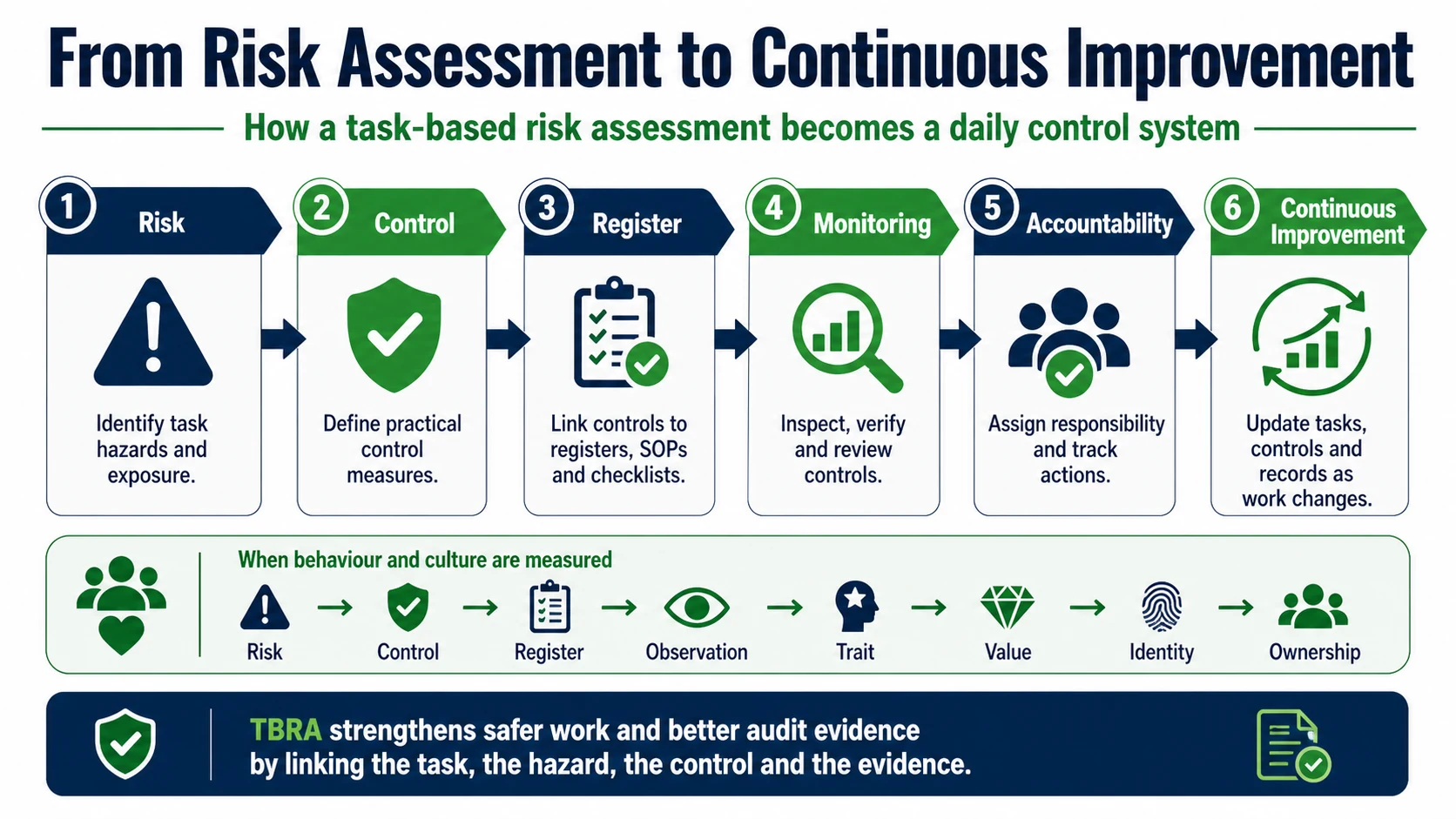
A control measure must move from risk assessment into monitoring and accountability.
The Emotional Truth Behind Every Control Measure
If you are a business owner, manager, supervisor or Health and Safety leader, it is easy to become used to the language of compliance. Risk assessment. Registers. Appointments. Inspections. Corrective actions. Evidence. Audits. These words are necessary, but they can become cold if we forget what they are protecting.
Behind every control measure is a person with a life outside work.
Someone packed lunch for them this morning. Someone expects them home tonight. Someone depends on their income. Someone loves them. Someone would be broken if they did not return.
That is why a control measure should never be treated as just paperwork.
When you check that a machine guard is in place, you are protecting fingers, hands, livelihoods and families. When you make sure a forklift route is followed, you are protecting the pedestrian who has children waiting at home. When you insist that fall protection is used correctly, you are protecting someone's future. When you correct unsafe behaviour, you are not being difficult. You are choosing care.
A control measure is where Health and Safety becomes human.
South African Context: Compliance Is the Minimum, Not the Meaning
In South Africa, employers have a duty under the Occupational Health and Safety Act to provide and maintain, as far as reasonably practicable, a working environment that is safe and without risk to health. That duty matters.
But health and safety compliance in South Africa should never become only about passing an inspection or keeping a file ready. Compliance is the minimum standard. Care is the reason the standard exists.
A company can have documents and still have weak control. A company can have a Task Based Risk Assessment (TBRA) and still fail to implement the control measures. A company can appoint Health and Safety representatives and still not support them properly. A company can schedule inspections and still fail to close out findings.
This is where the real question must be asked: Is the control measure alive in the workplace?
If it is only written down, it is information. If it is implemented, checked, coached and improved, it becomes protection.
The SafetyWallet Logic: Risk Must Become Control
SafetyWallet works from a practical Health and Safety logic:
This means a Task Based Risk Assessment (TBRA) should not end when the document is completed. The risk must lead to a control. The control must link to a register or inspection. The inspection must create monitoring. Monitoring must create accountability. Accountability must lead to improvement.
That is how a control measure becomes part of a living health and safety management system.
For example, if a Task Based Risk Assessment (TBRA) identifies a fire hazard, the control measure may include fire extinguishers, training, emergency exits and inspections. But the system must then ask: Are the extinguishers on a register? Are they inspected? Are employees trained? Are exits clear? Are findings closed out? Is management reviewing the evidence?
Software gives visibility, but visibility is not the same as control. A dashboard can show that an inspection is overdue, but someone still needs to inspect. A register can show that evidence is missing, but someone still needs to upload and verify it. A Task Based Risk Assessment (TBRA) can identify the hazard, but the control must still be implemented. A procedure can exist, but people must still understand and follow it.
This is why the SafetyWallet platform is designed to support more than documentation. It supports visibility, structure, behaviour, follow-through and ownership.
What We See Repeatedly in South African Workplaces
In many workplaces, the intention is good. Management wants people to be safe. Employees do not want to get hurt. Health and Safety representatives want to help.
But the system is often disconnected.
We see risk assessments that are completed but not used. We see control measures that are written down but not checked. We see registers that exist but are not updated. We see inspections that happen but do not always lead to action. We see appointees who are willing but not confident. We see unsafe behaviour being corrected in the moment, but not coached at the belief and value level.
This is not always because people do not care. Often, it is because the business does not yet have a rhythm that connects the task, hazard, control, inspection, behaviour and accountability into one system. That is why a Task Based Risk Assessment (TBRA) must not stand alone. It must feed the system.
The Triple P System: Giving Control Measures Structure
The Triple P System connects Policies, Procedures and Practices. This matters because a control measure needs structure around it.
| Triple P Element | What It Does | How It Supports Control Measures |
|---|---|---|
| Policies | States the company's commitment | Defines what the business expects |
| Procedures | Explains how requirements must be implemented | Turns control measures into repeatable steps |
| Practices | Guides task-level behaviour | Helps employees apply the control measure during real work |
If a Task Based Risk Assessment (TBRA) says employees must wear PPE when handling chemicals, the control measure needs more than a sentence. It needs a policy that supports the requirement. It needs a procedure that explains how chemicals must be handled. It needs a practice or SOP that guides the worker at task level. It needs training. It needs supervision. It needs inspection. It needs correction when it fails.
That is how the control measure moves from paper to practice.
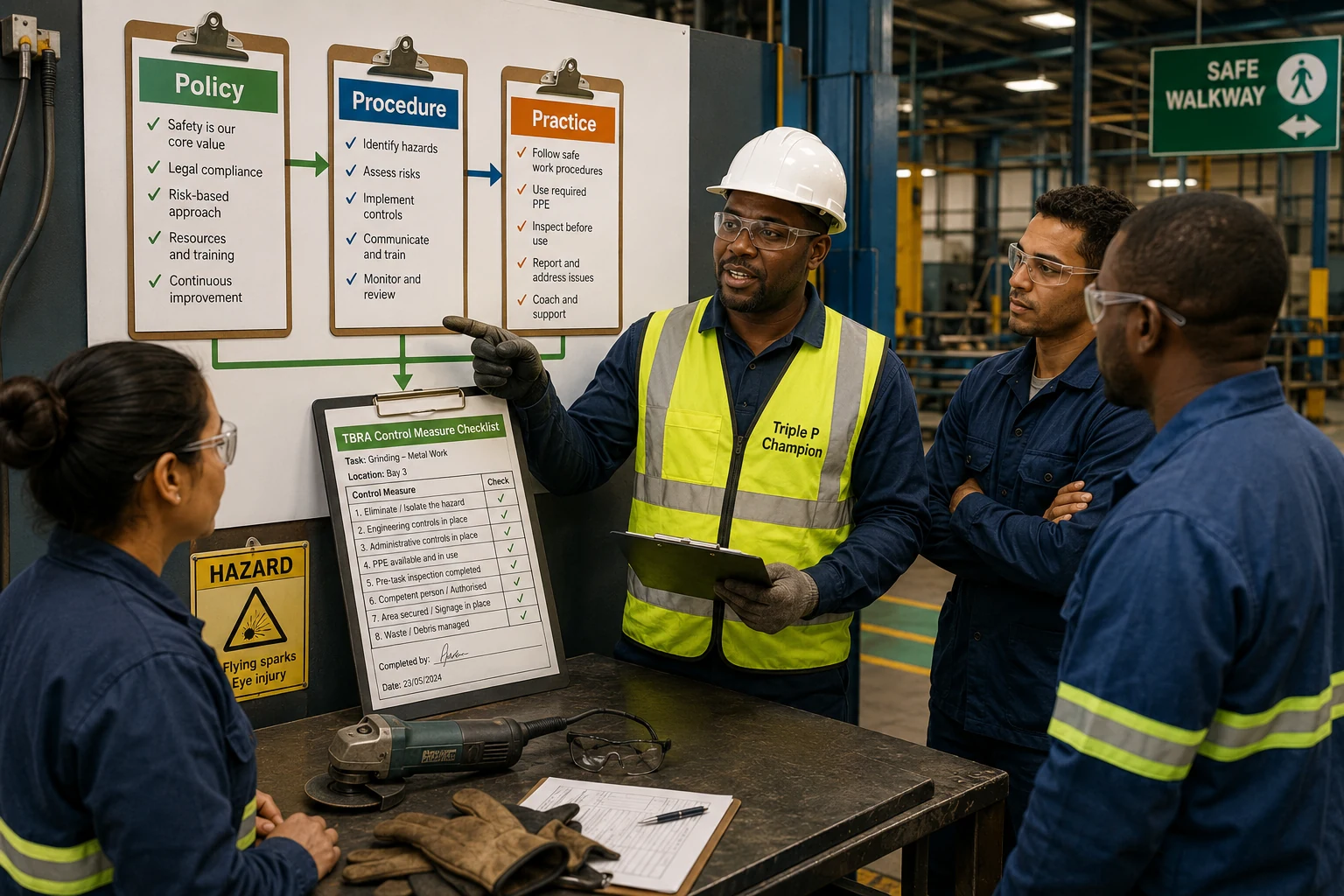
Triple P helps turn TBRA control measures into workplace practice.
OHS Online: Making Control Measures Visible and Manageable
OHS Online helps businesses manage the digital side of Health and Safety through modules, registers, inspections, appointments, corrective actions and evidence. But the power of OHS Online is not only that it stores information. The power is that it helps management see what is happening.
If a control measure requires an inspection, OHS Online helps make that inspection visible. If a control measure requires evidence, the system helps structure the record. If a finding is raised, corrective action can be tracked. If an appointee has responsibilities, the system helps create accountability. If management wants to know whether the workplace is improving, the dashboard helps show the pattern.
A health and safety management system must do more than hold documents. It must help the business manage risk in daily operations.
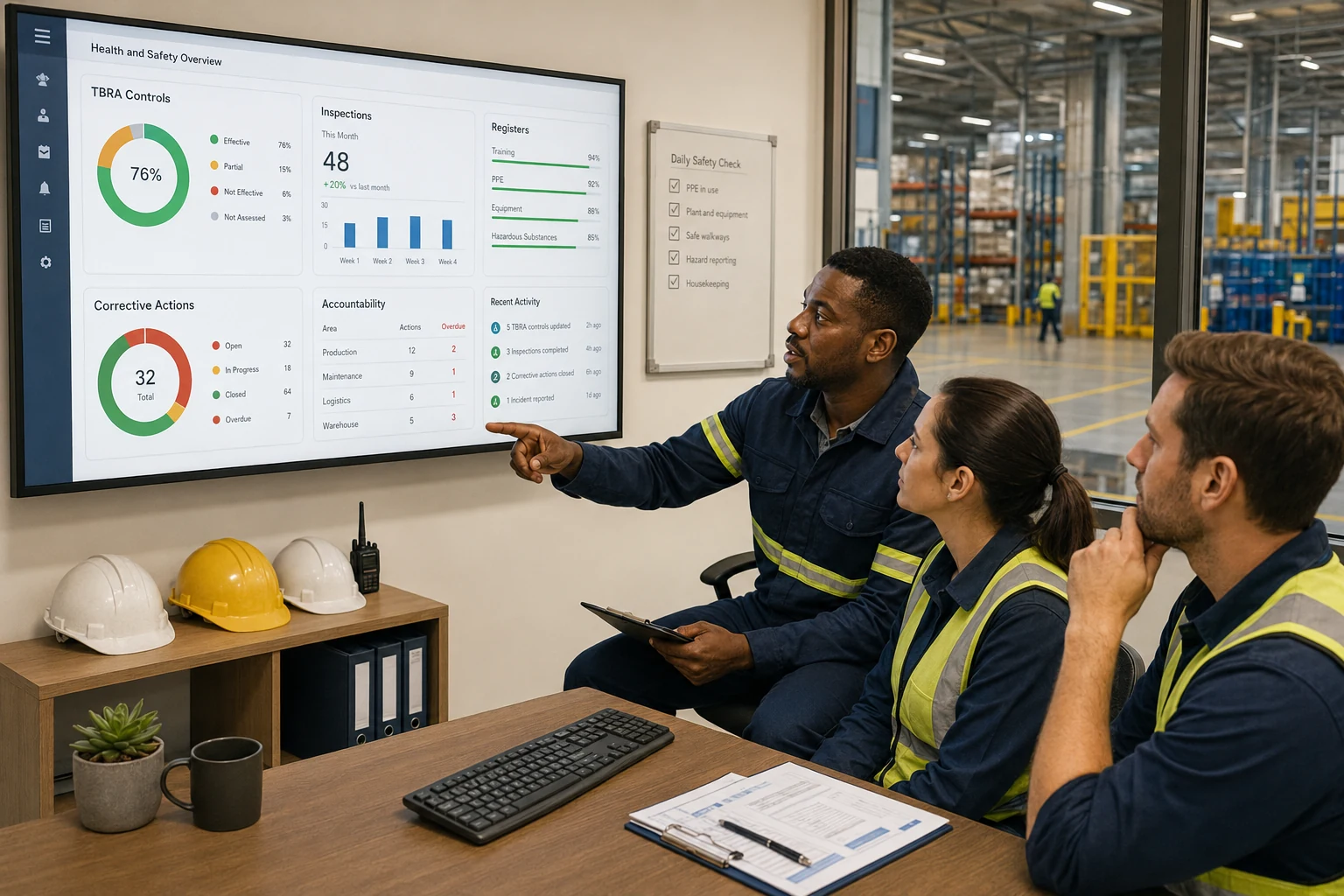
OHS Online helps make TBRA control measure follow-through visible.
MES: Why Behaviour Must Be Linked Back to the Control Measure
A control measure can be perfect on paper and still fail because of behaviour. A worker may remove PPE. A supervisor may rush an inspection. A forklift operator may ignore a speed limit. A team may bypass a procedure because production pressure feels more urgent.
If we only blame the behaviour, we miss the deeper opportunity. This is where MES becomes powerful. MES helps connect behaviour back to the task, control measure, belief, trait, value and ownership behind the action.
SafetyWallet's behaviour based safety logic is:
This means behaviour is not coached in isolation. If someone does not follow a control measure, the question is not only: Why did you break the rule? The better question is: What belief, pressure, misunderstanding, habit or value gap is causing this control measure not to be followed? That is how behaviour based safety becomes practical and fair.
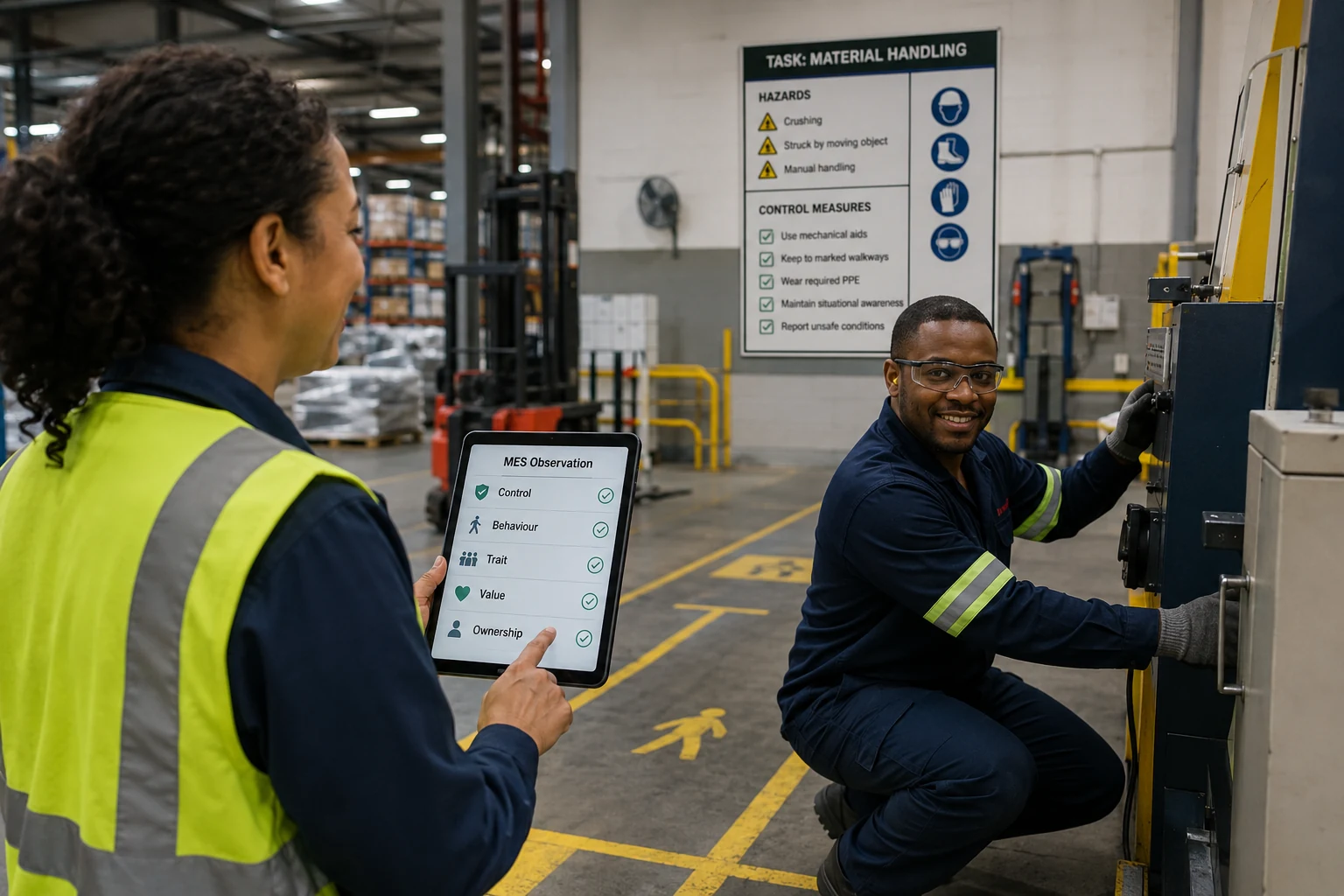
MES helps connect behaviour to control measures, values and ownership.
A Practical Example: Forklift Control Measures in a Warehouse
Imagine a warehouse where forklifts and pedestrians move in the same area.
The Task Based Risk Assessment (TBRA) identifies the hazard: moving forklifts. The risk: a pedestrian could be struck, crushed or killed.
The control measures may include:
- Trained and authorised forklift operators
- Pedestrian walkways
- Speed limits
- Reversing alarms
- Visibility checks
- Pre-use inspections
- Supervisor observations
- Traffic management rules
- Incident and near-miss reporting
Now ask yourself honestly: Are those controls only written down, or are they alive?
Is the walkway still clearly marked? Are operators actually doing pre-use checks? Are pedestrians staying in the safe zones? Are supervisors observing behaviour? Are findings being closed out? Are repeat behaviours being coached through MES?
This is where compliance becomes real. Because if one control fails, the risk starts moving closer to the person. And when the risk reaches the person, the consequence reaches the family.
Software Only vs Consultant Only vs the SafetyWallet Model
| Approach | What It Solves | What It Often Misses | Best Use | Long-Term Result |
|---|---|---|---|---|
| Software only | Gives visibility and records | May not create ownership or behaviour change | Tracking and reporting | Better visibility, but not always better control |
| Consultant only | Brings external expertise | Can create dependence if internal ownership is weak | Specialist support | Compliance may improve, but ownership may stay outside the business |
| Safety file approach | Creates documents and evidence | Documents may not drive daily action | Audit preparation | Paper compliance without living control |
| SafetyWallet model | Connects OHS Online, Triple P, Task Based Risk Assessment (TBRA), control measures, MES and accountability | Requires management commitment | Businesses wanting practical compliance and culture | A living system where risk control becomes visible, owned and improved |
The SafetyWallet Model: One Platform, Multiple Layers of Support
SafetyWallet is not only OHS software. It is a practical Health and Safety compliance and accountability platform that brings together:
- OHS Online as the digital system
- Triple P as the structure
- Task Based Risk Assessment (TBRA) as the risk foundation
- Control measure verification as the execution check
- MES as the behaviour and culture layer
- Expert and partner support as the capacity layer
- SafetyWallet Shop and My Safety Shop as practical support channels
- My Safety Hub as the education layer
The employer remains responsible for Health and Safety. SafetyWallet helps the employer manage that responsibility through structure, visibility, training, monitoring and ownership.
Turn control measures into daily action.
Use SafetyWallet to connect TBRA control measures to real workplace follow-through through OHS Online, Triple P and MES.
Visit the Task Based Risk Assessment page →Why This Matters to You as a Leader
If you are a CEO, business owner, director, manager or supervisor, this article is not asking you to become a technical Health and Safety specialist overnight. It is asking you to look differently at control measures.
Do not only ask: Do we have a risk assessment? Ask:
- Are our Task Based Risk Assessment (TBRA) control measures implemented?
- Are they connected to registers?
- Are they checked through inspections?
- Are findings closed out?
- Are employees trained?
- Are supervisors observing behaviour?
- Are unsafe habits coached?
- Are we building ownership?
- Are we protecting people, or only protecting the file?
Because your Health and Safety system is not measured only by what is written down. It is measured by what happens when the work starts.
Conclusion: TBRA Control Measures Are Where Compliance Becomes Care
A control measure in a Task Based Risk Assessment (TBRA) is so much more than compliance.
It is the point where the business chooses protection over assumption. It is where the hazard is no longer ignored. It is where the worker is no longer left alone with the risk. It is where leadership becomes practical. It is where safety culture begins to show itself.
At SafetyWallet, we believe Health and Safety must always come back to one purpose: helping loved ones return home healthy and safe after work.
That is why TBRA control measures matter. Not because auditors ask for them. Not because the law requires documentation. Not because the safety file needs another page. They matter because people matter.
And when a business truly believes that, control measures stop being words on paper. They become acts of care.
To strengthen your Task Based Risk Assessment (TBRA), control measures and Health and Safety system, talk to the SafetyWallet team.