
Many South African businesses believe they have a health and safety problem because their file is incomplete, their audit result is poor, their risk assessments are outdated, or their employees are not following procedures.
Those problems are real, but they are often not the root problem.
The deeper problem is mindset.
A company can have policies, procedures, risk assessments, legal appointments, inspection registers, training records and Safe Operating Procedures in place, and still fail to build a safe workplace.
Why? Because documents do not create behaviour on their own. People do.
Health and Safety compliance only becomes effective when the people inside the organisation believe in the purpose of the system, understand the reason behind the controls, and take ownership of their daily responsibilities.
Without mindset, compliance becomes a file. With mindset, compliance becomes culture.

Health and safety becomes real when people understand the risk before the task starts.
Short Answer
Health and safety compliance fails when a business focuses only on paperwork, audits and procedures while ignoring the mindset, behaviour, leadership and ownership that make controls work in daily practice. Documents create structure, but people create behaviour. A sustainable programme needs both the system and the mindset to support risk control, monitoring, accountability and continuous improvement.
If your business wants to move beyond audit preparation and build daily safety ownership, explore SafetyWallet's Behaviour-Based Safety programme. It helps organisations connect risk controls, observations, leadership, mindset and accountability in a practical South African workplace context.
Compliance Without Mindset Becomes Box-Ticking
Many organisations approach health and safety as something they need to get through.
They prepare for an audit. They update the file. They collect documents. They create procedures. They appoint the required people. They complete inspection forms. They make sure the paperwork looks acceptable.
But once the audit is over, the energy disappears. This is where many health and safety programmes start to fail.
The organisation may technically have a system, but the system is not alive in the behaviour of the people. Employees may know what the rule says, but they may not believe the rule matters. Supervisors may understand the procedure, but under pressure they may still allow shortcuts. Managers may talk about safety, but only focus on it when there is an incident, client requirement or Department of Employment and Labour inspection.
That is not a mature health and safety culture. That is compliance under pressure.
A business that wants to build sustainable Health and Safety Compliance in South Africa must move beyond paperwork and ask a deeper question: do our people believe in the controls enough to follow them when nobody is watching?
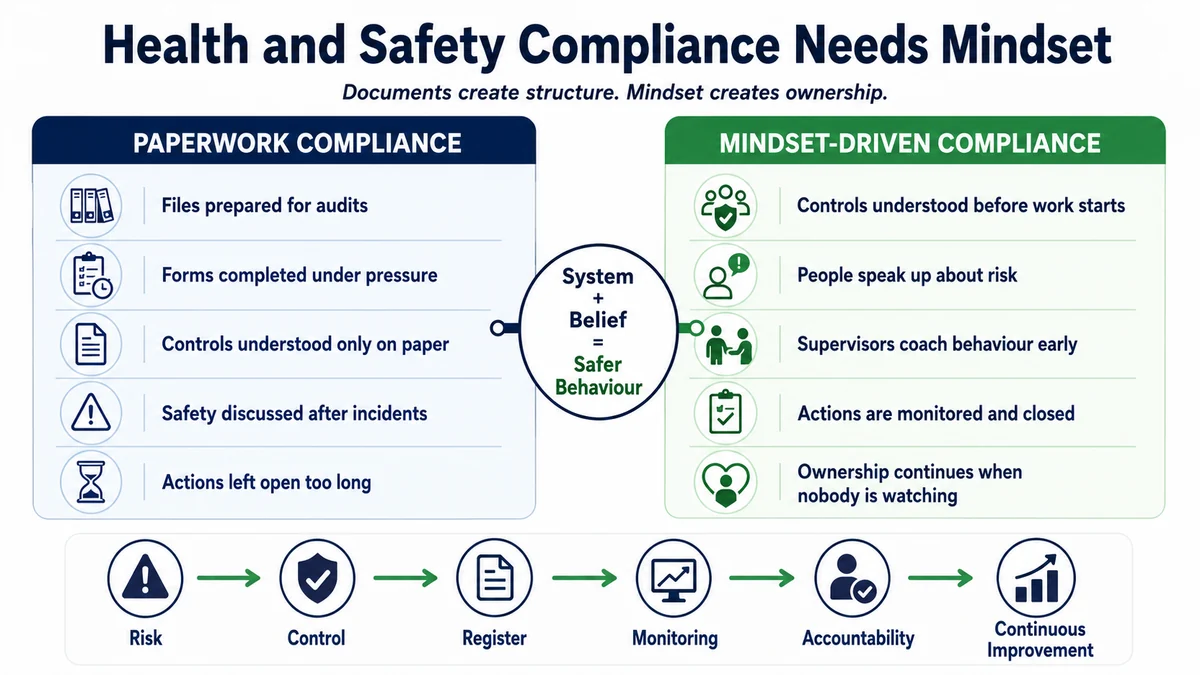
Documents create structure, but mindset creates ownership.
The Real Test Is What People Do When Nobody Is Watching
A strong health and safety culture is not measured only by what is in the file. It is measured by what people do when nobody is watching.
Do employees follow the control measure when the supervisor is not there? Do they report a hazard before someone gets hurt? Do they stop the task when conditions change? Do they use the correct PPE when the job feels simple? Do appointees complete inspections properly, or rush through them? Do supervisors correct unsafe behaviour early? Do managers close action requests, or leave them open until the next audit?
This is where mindset becomes critical. If an employee believes health and safety is only paperwork, their behaviour will reflect that belief. If a supervisor believes production is always more important than safe work, their behaviour will reflect that belief. If a manager believes health and safety belongs only to the safety officer, their behaviour will reflect that belief.
But when people believe health and safety protects lives, families, dignity and the future of the business, behaviour starts to change.
Belief drives attitude. Attitude drives behaviour. Behaviour shapes culture.
Why People Ignore Health and Safety Controls
People do not always ignore health and safety controls because they are careless. Often, they ignore controls because of beliefs they have developed over time.
- This task is not dangerous.
- I have done it this way for years.
- Nothing has happened before.
- The PPE slows me down.
- The procedure is only for audit purposes.
- The supervisor wants the job done quickly.
- Reporting problems will create conflict.
- Health and safety is the safety officer's job.
These beliefs are powerful because they influence behaviour more than a document does. This is why a health and safety system must do more than tell people what to do. It must help them understand why the control exists and why it matters.
A task-based Health and Safety Risk Assessment identifies the task, the hazards and the exposure. Control measures reduce the risk. Safe Operating Procedures explain how the task must be performed. But mindset determines whether the person follows the control when the work gets busy, difficult or uncomfortable.
For example, a restaurant employee cleaning a deep fryer may know the SOP. But if they believe they can do it quickly without waiting for the oil to cool properly, the control may fail. A storeman receiving stock at the back door may know that the pallet jack must be inspected before use, but if they believe it is only a quick job, they may skip the check.
This is why behaviour must be connected to risk.
The Missing Link Between Compliance and Behaviour
Traditional compliance often focuses on the visible part of health and safety: the policy, procedure, appointment letter, risk assessment, training record, inspection form, audit result, legal register and corrective action report.
These are important. They are necessary. They form the structure of the health and safety programme. But they are not enough.
The missing link is the internal part of health and safety: belief, values, attitude, responsibility, risk awareness, willingness to speak up, courage to stop unsafe work and discipline to follow a control consistently.
This is where many companies struggle. They try to fix behaviour only by adding more paperwork. They add another form, another signature, another checklist or another instruction. But if the belief behind the behaviour does not change, the unsafe behaviour often comes back.
You cannot build a strong workplace safety culture through documents alone. You build it by connecting the system to the mindset of the people.
The Roots-to-Fruits View of Health and Safety Mindset
At SafetyWallet, the mindset side of health and safety can be explained through the MES Roots-to-Fruits model.
The roots represent what sits beneath the surface: the internal qualities that influence how people think, respond and make decisions. The trunk represents belief: what people believe about themselves, their work, their responsibilities and the purpose of health and safety. The branches represent values: the principles that guide decision-making, such as Accountability, Purposefulness, Commitment, Excellence, Flexibility, Gratitude and Optimism. The fruits represent visible behaviour: what people actually do in the workplace.
This matters because many companies focus only on the fruit. They see an unsafe act, discipline the employee, update the procedure and add another checklist. But they do not always ask what belief caused the behaviour, what pressure influenced the decision, what value was missing in that moment, what the culture silently allowed or what the employee believes about the control measure.
If we only deal with the behaviour and ignore the belief behind the behaviour, we treat the symptom but not the cause.
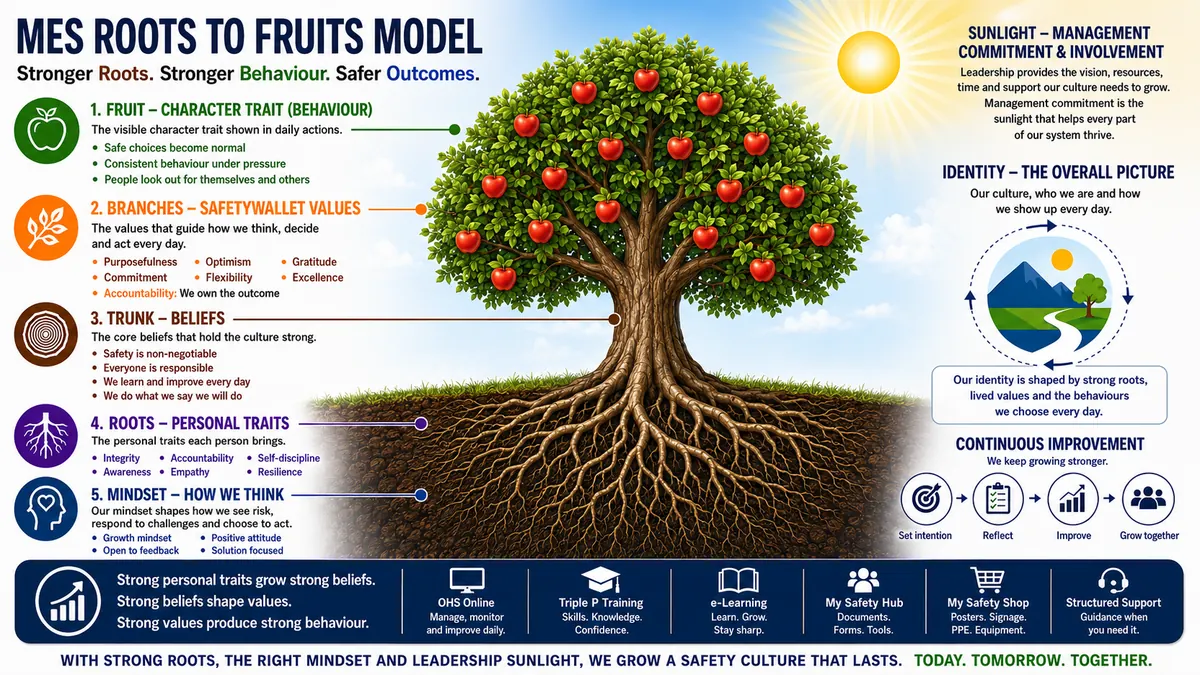
Visible safety behaviour grows from belief, values and ownership.
Health and Safety Needs Both System and Mindset
A strong health and safety programme needs two sides. It needs the system, and it needs the mindset.
The system gives structure. This includes risk assessments, policies, procedures, Safe Operating Procedures, legal appointments, inspection registers, training records, corrective actions, management reviews and audit readiness.
Mindset gives meaning. This includes ownership, accountability, risk awareness, care for people, leadership, discipline and belief in the purpose of health and safety.
When a company has a system without mindset, people may comply only when they are being checked. When a company has mindset without a system, people may care, but they may not have the structure to manage risk properly. The goal is to bring both together.
This is also why a Health and Safety Management System must be practical. It should not only store documents. It should help the organisation manage risk, controls, registers, inspections, appointees, action requests and review activities in a way that creates accountability.
The Triple P System Needs People Who Believe in It
The Triple P System — Policies, Procedures and Practices — is a powerful foundation for health and safety management.
Policies define the organisation's commitment. Procedures explain how responsibilities must be carried out. Practices show how work is actually done in the workplace.
But the success of Triple P depends on people. A policy means very little if leadership does not believe in it. A procedure becomes weak if supervisors do not enforce it. A practice becomes dangerous if employees take shortcuts.
People must understand that a health and safety policy is not just a document. It is a leadership promise. A procedure is not just an instruction. It is a method to create consistency and control. A practice is not just the way work gets done. It is where health and safety becomes real.
Risk Assessments Also Fail When Mindset Is Ignored
Many companies complete risk assessments because they are required to do so. But a task-based risk assessment should not be treated as a once-off document. It should become the foundation for daily health and safety management.
A task-based risk assessment identifies the specific tasks people perform. It identifies the hazards linked to those tasks. It measures the level of risk before controls. It then determines which control measures must be implemented to reduce the risk.
But again, the risk assessment only becomes effective when people believe in the controls. A control measure is not successful because it appears on paper. It is successful when it is implemented, monitored, followed and improved.
Without belief, the risk assessment becomes a document. With belief, the risk assessment becomes a living management tool.
SafetyWallet's behaviour logic connects the flow clearly:
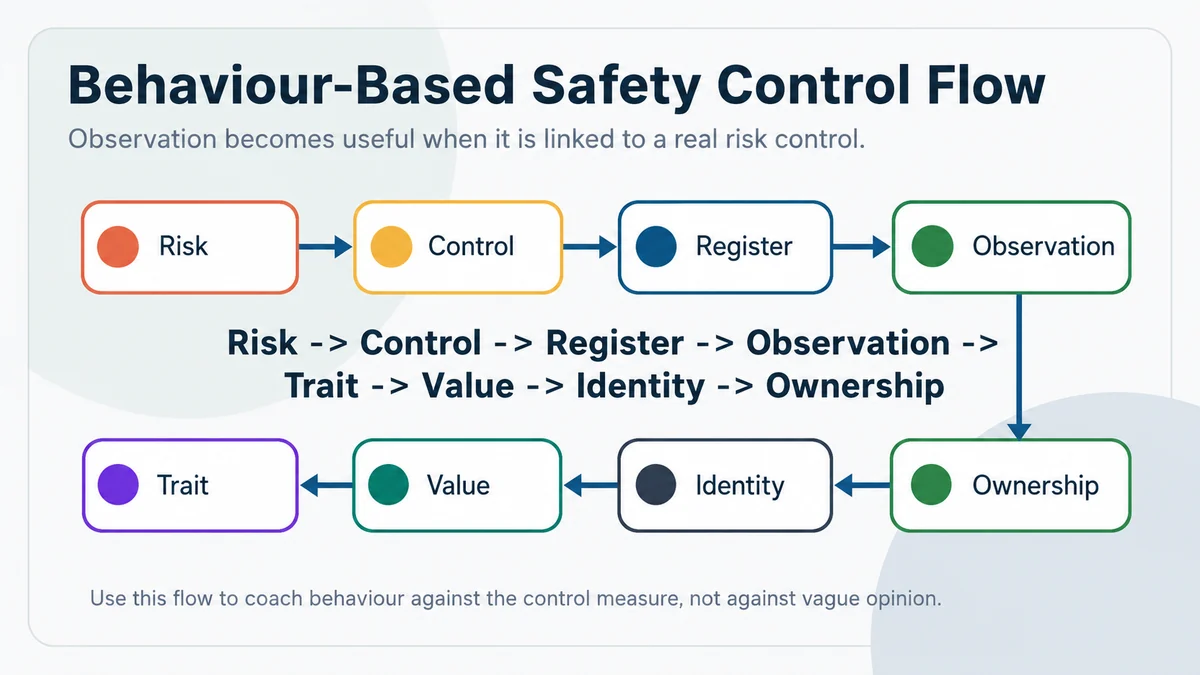
Behaviour-Based Safety becomes practical when observation is linked to risk control.
Leadership Sets the Mindset Standard
Health and safety mindset starts with leadership. Employees watch what leaders tolerate, reward, ignore and prioritise.
If leaders only speak about safety after an incident, employees learn that safety is reactive. If leaders only focus on compliance before an audit, employees learn that safety is about passing audits. If leaders allow shortcuts when production is under pressure, employees learn that safety is optional.
But when leaders consistently connect health and safety to purpose, values, behaviour and accountability, the culture changes.
- Are our people following the controls?
- Do they understand why the controls exist?
- Are supervisors reinforcing safe behaviour?
- Are inspections being completed properly?
- Are action requests being closed out?
- Are risk assessments being reviewed when work changes?
- Are appointees taking ownership of their responsibilities?
- Are we recognising people who live our values through safe behaviour?
Leadership is not only about enforcing compliance. It is about shaping belief. This is central to ISO 45001 support in South Africa, where leadership and worker participation are core requirements of the management system.
Recognition Can Build Health and Safety Mindset
One of the most powerful ways to build mindset is through recognition. When people are recognised for the right behaviour, that behaviour becomes meaningful.
When an employee reports a hazard, the recognition should not only say thank you. It should explain why it matters: You showed Accountability because you did not ignore the risk. You helped protect your team before someone got hurt.
When a supervisor stops unsafe work, the recognition can connect to Purposefulness. When a team consistently completes inspections, recognition can connect to Commitment and Excellence.
This is how recognition builds belief. People begin to see health and safety behaviour as part of who they are, not only something they are forced to do.

Recognition helps people connect safe behaviour to values and ownership.
The Purpose Must Be Bigger Than Compliance
The strongest health and safety cultures are not built on fear. They are built on purpose.
At SafetyWallet, that purpose is clear: We believe in making sure your loved ones return home healthy and safe after work.
This purpose changes how people see compliance. A risk assessment is no longer just a legal document. It becomes a way to identify what could harm someone. A control measure is no longer just an audit requirement. It becomes a way to protect a person. An inspection is no longer just a checklist. It becomes a way to confirm that controls are still working. An SOP is no longer just a procedure. It becomes a guide to help someone complete the task safely.
How SafetyWallet Supports Mindset, Behaviour and Compliance
SafetyWallet is a Health and Safety SaaS platform that helps organisations manage their own health and safety responsibilities through OHS Online, Triple P, e-learning, My Safety Hub, My Safety Shop and structured support.
SafetyWallet does not remove the organisation's responsibility for health and safety. It helps make that responsibility visible, structured and easier to manage.
Through OHS Online, organisations can connect risk assessments, control measures, registers, inspections, appointments, Safe Operating Procedures, action requests and management reviews.
Through Triple P, organisations can connect policies, procedures and practices so that health and safety does not remain stuck in documents.
Through the Behaviour-Based Safety programme, organisations can connect risk controls to observation, traits, values, identity and ownership.
The practical logic is:
Where behaviour and mindset are involved, the logic becomes:
Build behaviour into your health and safety system.
SafetyWallet's Behaviour-Based Safety programme helps your organisation connect risk controls, observations, leadership, values and accountability so that compliance becomes part of daily workplace behaviour.
Explore the Behaviour-Based Safety programme →Conclusion: Mindset Turns Compliance Into Culture
Health and safety compliance fails when mindset is ignored because people do not live inside files. They live inside beliefs, habits, pressures, values and culture.
A company may have the documents, but if people do not believe in the system, the behaviour will not follow. That is why the future of health and safety cannot be built on compliance alone. It must be built on compliance and mindset.
The system creates structure. The mindset creates ownership. The values create direction. The behaviour creates culture.
When all of these work together, health and safety moves from something people have to do, to something they believe in.
And that is when an organisation starts building a workplace where people do not only comply because they are watched. They take ownership because they understand the purpose.
Visit the SafetyWallet Health and Safety SaaS platform or the Behaviour-Based Safety South Africa solution page to see how SafetyWallet helps organisations turn compliance, mindset and behaviour into daily ownership. Talk to the SafetyWallet team to get started.