
Observation Is Important, but It Is Not Enough
Many organisations believe that if supervisors complete enough safety observations, workplace behaviour will improve. Observations are useful because they make behaviour visible. They help supervisors see whether people are following controls, using PPE correctly, isolating equipment, keeping walkways clear, lifting safely, reporting defects and stopping work when controls are missing.
But observation alone does not change safety culture. It only shows what is happening at a point in time. If the observation is not connected to risk, control measures, registers, responsible persons, coaching and management review, it becomes another form on a clipboard or another entry in a system that does not change the work.
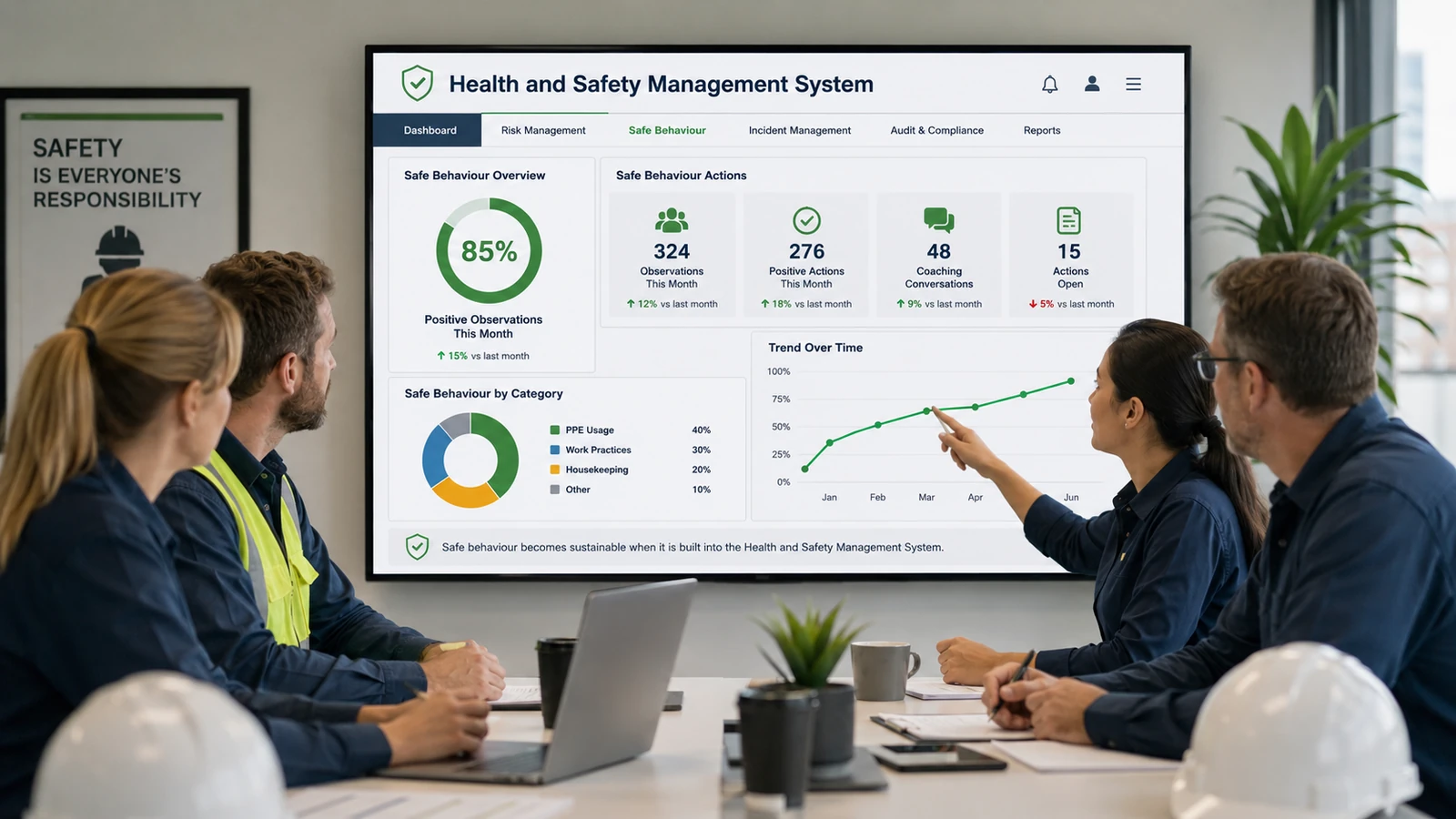
Safe behaviour becomes sustainable when it is built into the Health and Safety Management System.
If your organisation wants safety observations to become practical actions, explore the SafetyWallet Health and Safety Management System. It helps teams connect behaviour, risk controls, registers, inspections, appointees and accountability in one working platform.
Why Safety Observations Often Fail to Change Behaviour
A safety observation can identify an unsafe act, an unsafe condition or a positive behaviour. The weakness is not the observation itself. The weakness appears when the organisation does not have a structured way to respond.
For example, a supervisor may observe that an employee is cleaning a deep fryer without the correct face protection. The observation is recorded, the employee is reminded, and the conversation ends. But the real questions remain: Was the task risk assessment clear? Was the PPE issued and recorded? Was the employee trained on the safe operating procedure? Was the control measure checked in a register? Was the supervisor accountable for follow-up? Was the finding discussed in a Health and Safety Committee meeting? Was the system updated to prevent repeat exposure?
Without that connection, the observation remains isolated.
The Missing Link: Risk to Control to Register to Monitoring
Safe behaviour becomes sustainable when it is built into a system. The correct flow is:
Observation should never float outside this flow. It should test whether the risk controls identified for a task are actually being followed. If a control is missing, weak or ignored, the system must capture the gap, assign responsibility, track correction and review whether the improvement worked.
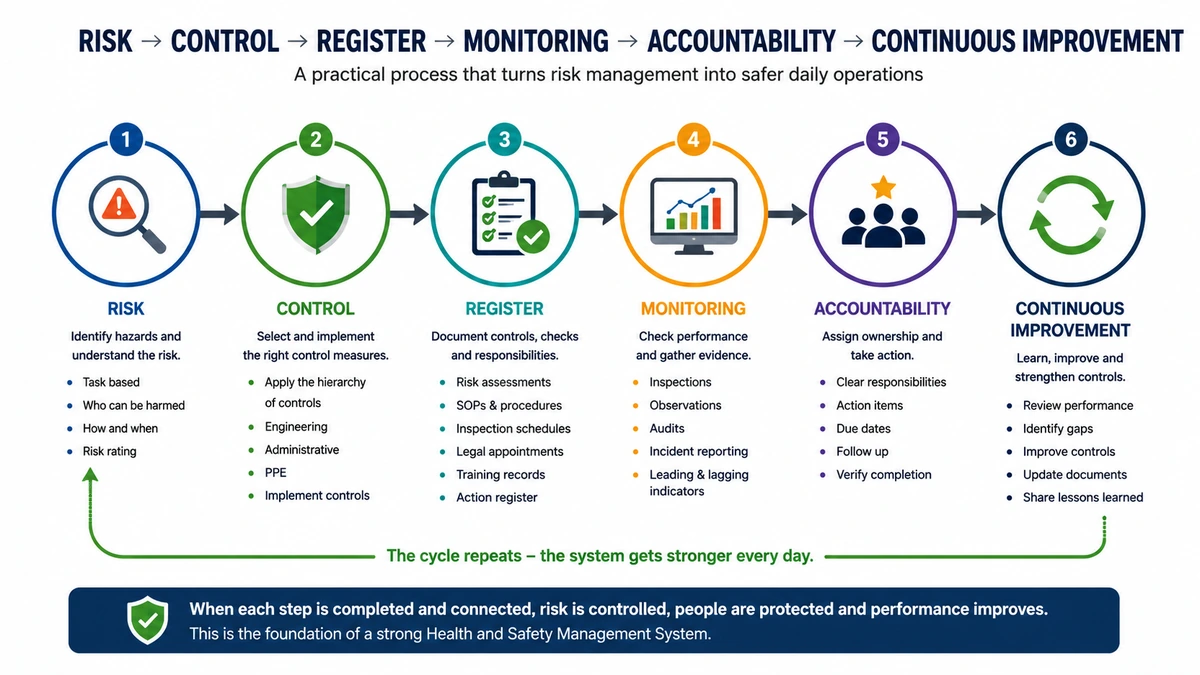
A strong management system connects risk, control, registers, monitoring and accountability.
Observation Must Test Controls, Not Just People
A mature safety culture does not use observation to blame people. It uses observation to test the relationship between the task, the hazard, the control measure and the behaviour expected at the point of work.
If an employee is operating a pallet jack without checking the route first, the organisation should ask whether the task instruction clearly requires a route inspection, whether housekeeping is controlled, whether congestion is normal, whether the supervisor reinforces the behaviour and whether the correct register or inspection process exists.
In other words, the observation must ask: did the person fail the system, or did the system fail the person?
This is where a task-based Health and Safety Risk Assessment becomes essential. When the hazards and controls are clearly linked to the task, observations can test real operational expectations instead of vague general standards.
Why This Belongs Inside a Health and Safety Management System
A Health and Safety Management System gives observations a home. It connects what supervisors see in the workplace to the controls that should already exist.
A system-based approach allows observations to feed action requests, inspection findings, register updates, appointee follow-up, training needs, toolbox talks, contractor induction gaps and management review. The organisation remains responsible for its own Health and Safety, but the system makes ownership visible and manageable.
The Behaviour-Based Safety programme from SafetyWallet connects this logic directly, helping organisations link observation to risk, registers, coaching and ownership rather than treating BBS as a standalone campaign.
South African Context: Health and Safety Must Be Managed Daily
In South Africa, Health and Safety Compliance in South Africa should not be treated as an audit event or a file exercise. Employers need practical systems of work, information, instruction, training, supervision and evidence that controls are being maintained.
Department of Employment and Labour inspections, incident investigations, Health and Safety Committee meetings and internal reviews all test whether the business is managing risk in practice. Observation can support this, but only when observations become part of daily management and not only part of a behaviour programme.
MES Roots to Fruits: Behaviour Is the Fruit, Not the Root
The MES Roots to Fruits model helps explain why observation alone is too shallow. Behaviour is visible, but it is the fruit of deeper factors. Personal traits form the roots. Beliefs form the trunk. SafetyWallet values form the branches. Character behaviour is the fruit. Identity is the overall picture that grows over time through repeated behaviour and continuous improvement.
Management commitment and involvement act like sunlight. Without leadership providing vision, resources, time and support, the culture cannot grow.
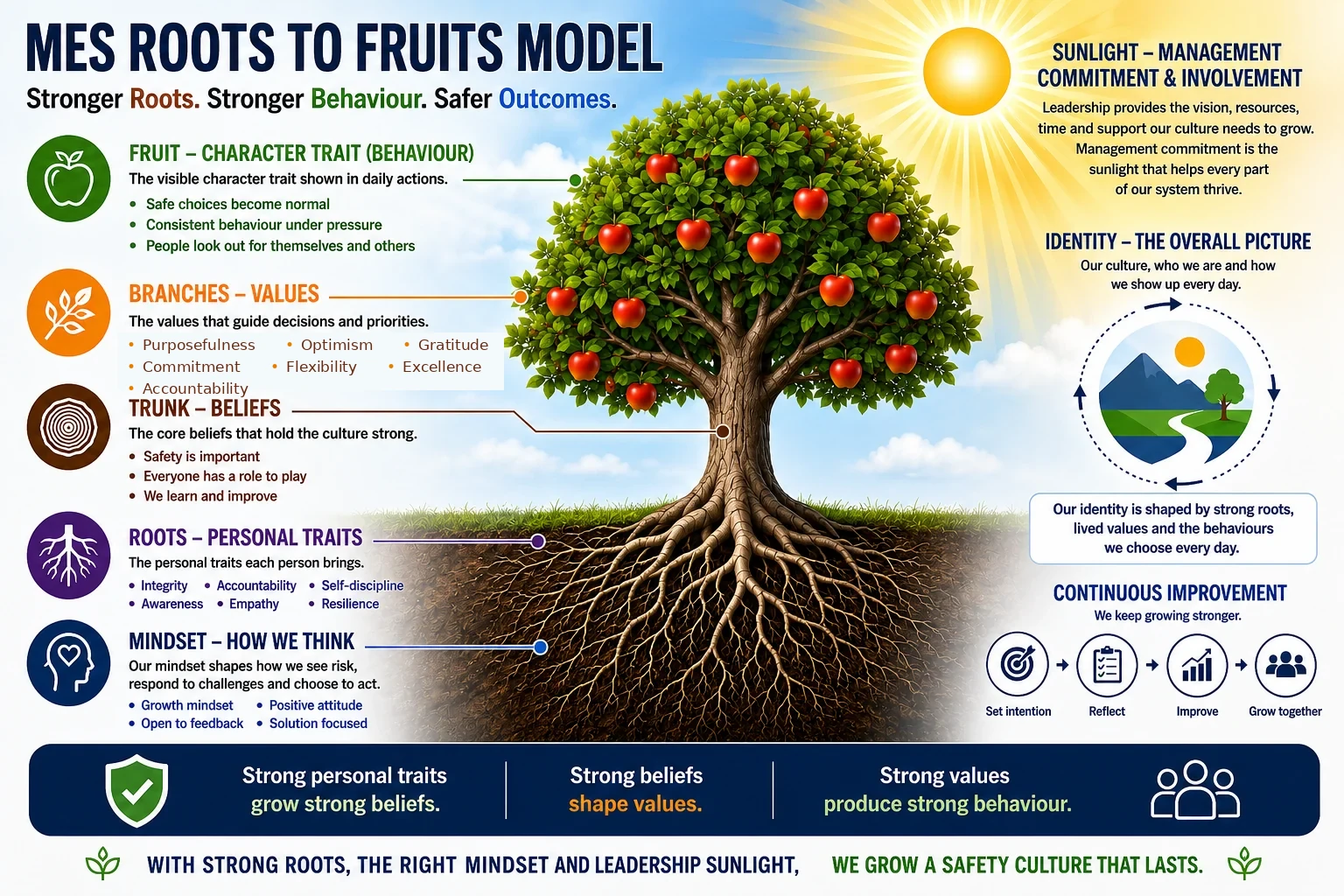
Behaviour is the fruit. MES helps strengthen the roots that shape ownership.
From Observation to Trait, Value, Identity and Ownership
Where behaviour and culture are discussed, the flow becomes:
An observation should identify more than whether a person complied. It should help the organisation understand what behaviour needs to be strengthened. Did the employee show accountability by stopping when a control was missing? Did the supervisor show commitment by following up on an action request? Did the team show excellence by improving the way a task is performed?
When observations are linked to values and identity, people begin to see Health and Safety as part of who they are, not only what they are told to do.
The Role of the Triple P Champion
The Triple P Champion helps turn policies, procedures and practices into daily ownership. The Champion is not there to take responsibility away from management or employees. The Champion helps the organisation coordinate the system, follow up on actions, support supervisors, guide appointees, strengthen SOP discipline and ensure that observations are connected to the correct control measures.
This is where Triple P training and the Triple P Champion role become important for a sustainable Health and Safety Management System.
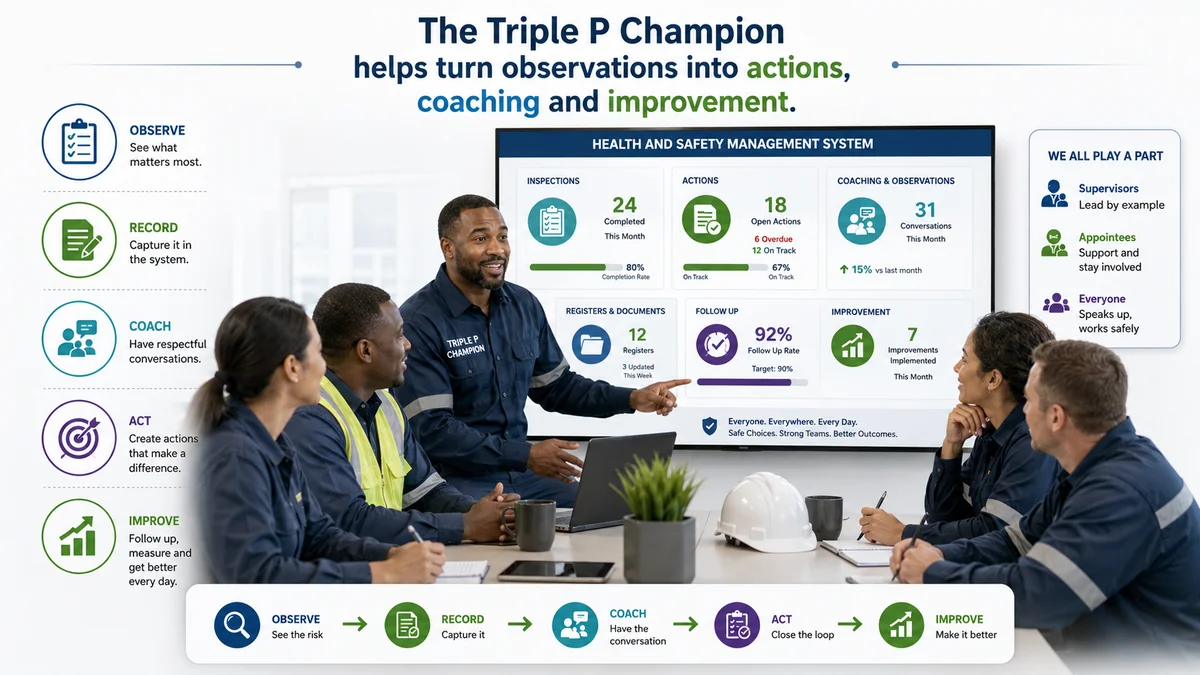
The Triple P Champion helps turn observations into actions, coaching and improvement.
Task-Based Examples: How Observation Becomes System Action
Cleaning a deep fryer
Observation: employee begins cleaning before confirming the oil has cooled and PPE is available. System response: review the task-based risk assessment, verify PPE issue, update the SOP if needed, confirm training, check the chemical/PPE register and assign action follow-up.
Inspecting fire extinguishers
Observation: monthly inspection is missed. System response: check the appointee register, inspection schedule, reminder process, action request and management review.
Receiving stock at the back door
Observation: employee pulls heavy stock from a truck without assistance. System response: review manual handling controls, trolley availability, receiving procedure, supervision and toolbox talk content.
Contractor induction
Observation: contractor starts work without proof of induction. System response: check contractor control, Section 37(2) acceptance, induction register, access control and supervisor accountability.
How SafetyWallet Supports This System
The SafetyWallet Health and Safety SaaS platform helps organisations manage their own Health and Safety responsibilities through OHS Online, Triple P training, e-learning, My Safety Hub, My Safety Shop and structured support. It helps businesses connect risk assessments, control measures, registers, inspections, appointees, action requests, training and management review.
SafetyWallet does not remove the client's responsibility. It supports the client with structure, visibility, guidance and accountability so that the organisation can manage its own system more effectively. This also supports ISO 45001 support in South Africa, where leadership, worker participation, operational control and continual improvement must be demonstrated in practice.
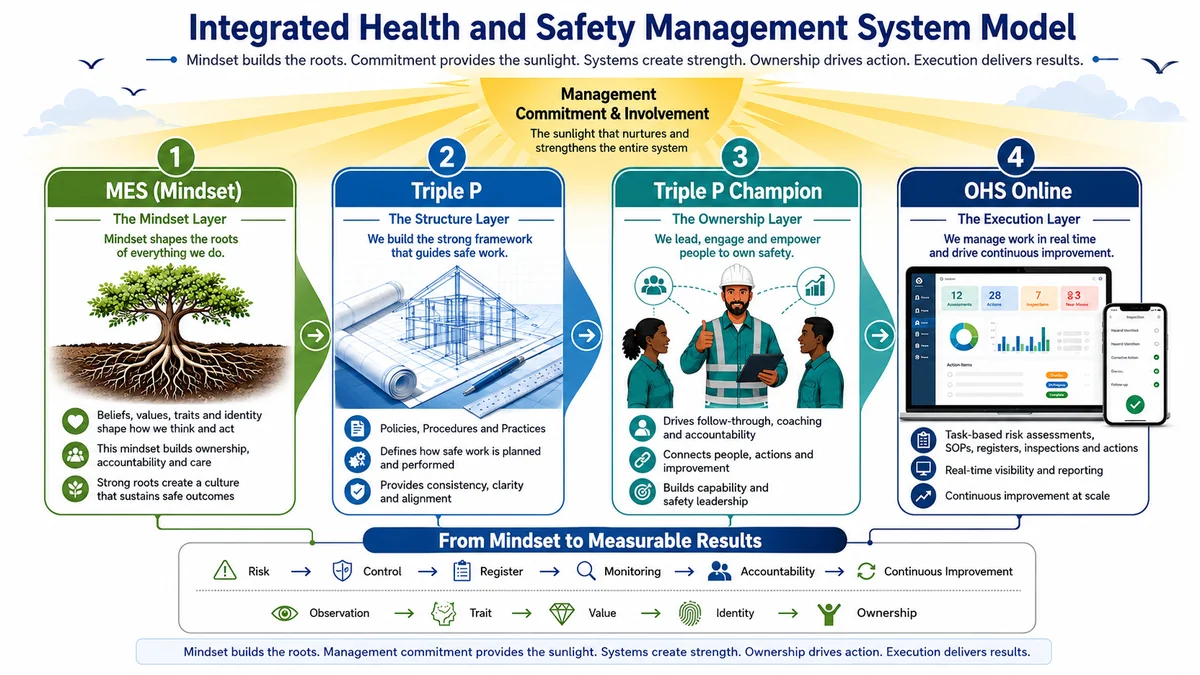
MES builds the roots, Triple P builds the structure, the Champion drives ownership and OHS Online manages execution.
Package Positioning
Enterprise Secure provides platform access and internal support for stable organisations that are ready to manage their own system.
Expert Guidance provides structured guidance for companies that need help maturing their Health and Safety system.
Apex AI provides advanced support and AI-enabled assistance for more complex environments.
These are compliance enablement options, not promises that SafetyWallet does the client's Health and Safety for them.
Turn observations into action, ownership and improvement.
SafetyWallet's Health and Safety Management System helps your team connect safe behaviour, control measures, registers, appointees, inspections and accountability in one practical platform.
Visit the Health and Safety Management System page →Conclusion: Observation Must Become Ownership
Observation alone does not change safety culture because it only shows what happened. Culture changes when observations are connected to risk controls, registers, coaching, values, management commitment and continuous improvement.
A business that wants sustainable safe behaviour must stop treating observation as the end of the process. Observation should be the start of action, learning and ownership. When risk, control, register discipline, monitoring and accountability work together, safe behaviour becomes part of the organisation's identity.
Visit the SafetyWallet homepage or the Health and Safety Management System solution page to see how SafetyWallet helps organisations manage Health and Safety through structure, visibility, ownership and continuous improvement.