
Safe Behaviour Is Not a Side Project
Many organisations try to improve workplace safety by focusing on behaviour. They introduce observation cards, toolbox talks, safety campaigns, supervisor walkabouts and reminders to "work safely". These activities can help create awareness, but awareness alone does not create a strong safety culture.
Safe behaviour must be managed as part of the organisation's Health and Safety Management System. If behaviour sits outside the system, it becomes a campaign. If it is built into the system, it becomes part of how the business manages risk every day.
A business may have policies, risk assessments, PPE, signs, training records, registers and procedures in place. But if employees, supervisors, managers and contractors do not live those controls during daily work, the system is not working in practice. Safe behaviour turns the system into reality.
That means behaviour must be connected to task-based risk assessment, control measures, SOPs, inspections, registers, appointee duties, contractor induction, supervision, corrective actions, management review, leadership decisions, culture and ownership.
In South Africa, Health and Safety Compliance in South Africa cannot only be prepared for audits or inspections. It must be managed daily through safe systems of work, clear responsibilities, suitable controls, competent supervision and practical follow-through.
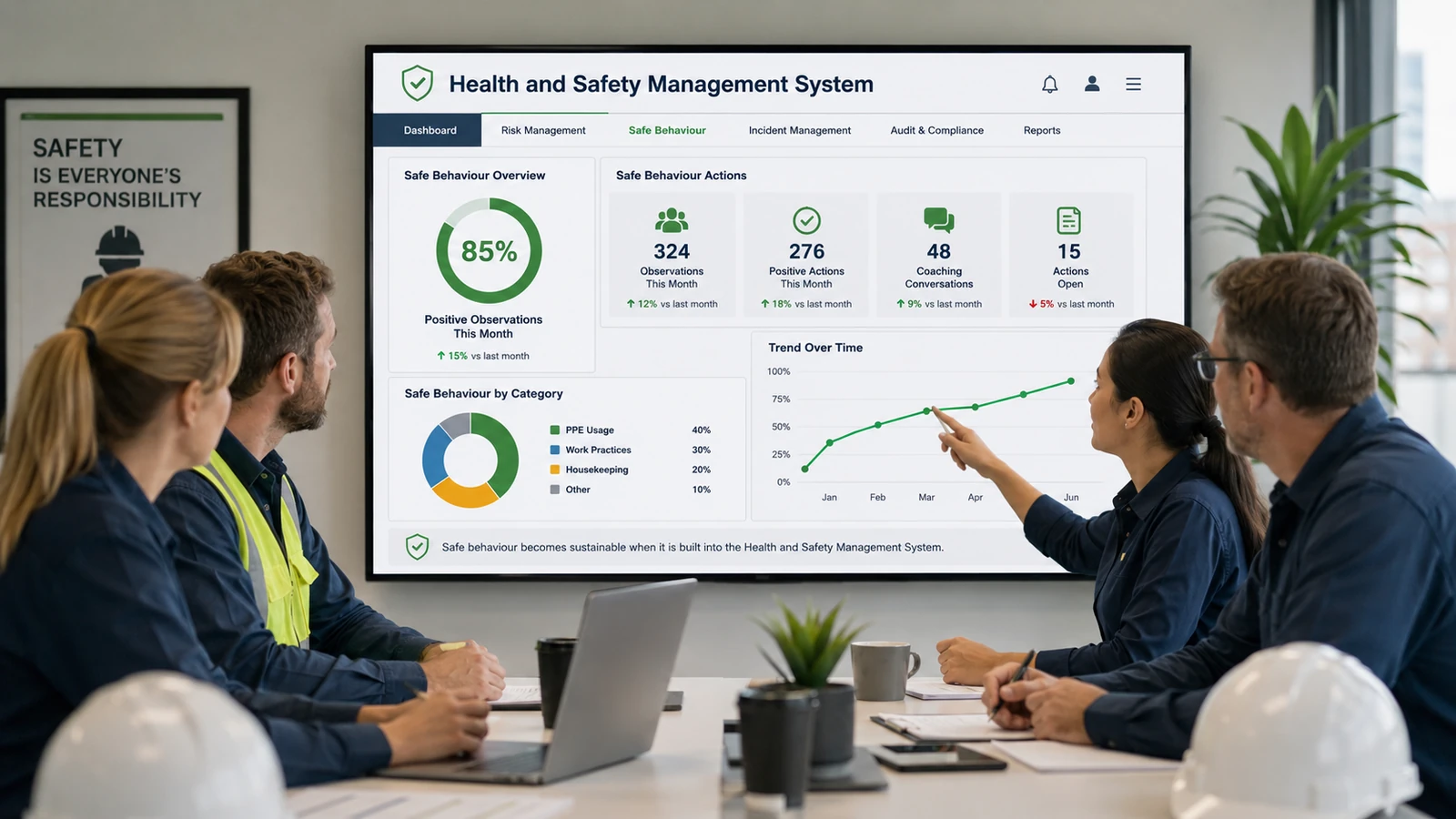
Safe behaviour becomes sustainable when it is built into the Health and Safety Management System.
If your organisation wants safe behaviour to become part of daily Health and Safety management, explore SafetyWallet's Health and Safety Management System. SafetyWallet helps businesses connect risk, controls, registers, observations, actions and accountability through OHS Online and structured support.
Why Observation Alone Does Not Change Safety Culture
Observation has value. It helps supervisors and managers see what is happening in the workplace. An observation may show that someone followed a procedure, skipped a safety step, wore the correct PPE, used the wrong tool, stopped work when a control was missing, reported a hazard, completed an inspection or took a shortcut under pressure.
But observation only shows visible behaviour. It does not automatically explain why the behaviour happened.
A mature Health and Safety Management System must ask deeper questions: Was the correct control measure available? Was the person trained? Was the SOP clear? Was the equipment suitable? Was there production pressure? Was the supervisor reinforcing the right behaviour? Was the register up to date? Was an action request raised? Was the risk assessment reviewed? Was management responding to previous issues? Was there a belief, value or ownership issue behind the behaviour?
Without these questions, observation becomes another form. It may create short-term awareness, but it does not create lasting safety ownership.
Safe behaviour must therefore be managed through this system flow:
When behaviour and culture are included, the flow becomes:
Safe Behaviour Starts With Risk
A safe behaviour strategy should never start with random observations. It must start with risk. If the organisation does not understand the task, the hazard, the exposure and the control measure, it cannot properly define the safe behaviour required.
This is why a task-based Health and Safety Risk Assessment is so important. It identifies the work being done, the hazards linked to that work, the control measures required and the practical behaviours that must be visible during the task.
| Task | Risk Control Requirement | Safe Behaviour to Manage |
|---|---|---|
| Cleaning a deep fryer | Prevent burns, chemical exposure and slips | Switch off fryer, allow cooling, wear PPE, control spills |
| Operating a pallet jack | Prevent pedestrian impact and unstable loads | Check route, control speed, keep load stable |
| Inspecting fire extinguishers | Maintain fire readiness | Check access, pressure, signage, tag and defects |
| Handling cleaning chemicals | Prevent exposure and incorrect mixing | Follow SDS, use correct dilution and PPE |
| Working at height to replace signage | Prevent falls | Check access equipment, surface and positioning |
| Conducting a toolbox talk | Communicate task-specific controls | Discuss task hazards before work starts |
| Issuing PPE | Ensure correct PPE for the task | Record issue and explain correct use |
| First aid box inspection | Maintain emergency readiness | Check contents and raise actions for missing items |
| Contractor induction | Control contractor risk | Complete induction before work starts |
This turns behaviour into risk control verification. The question is not only, "Did the person behave safely?" The better question is: Did the person follow the behaviour required by the risk control, and did the system support that behaviour?
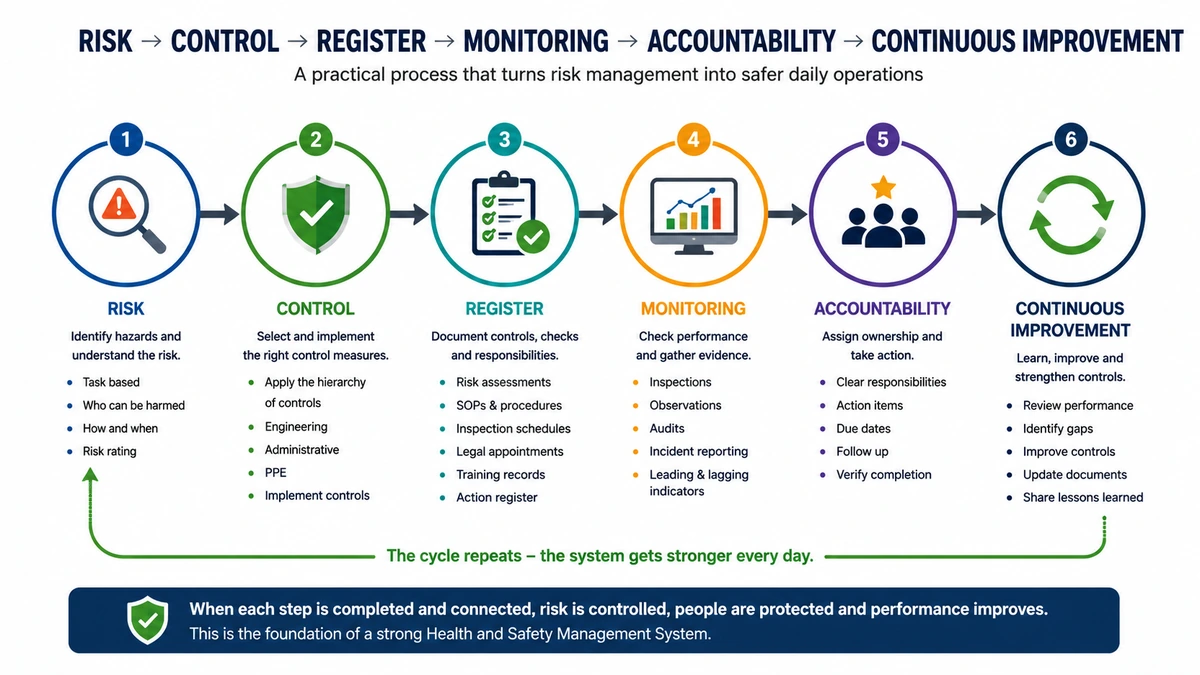
A strong management system connects risk, control, registers, monitoring and accountability.
Why Safe Behaviour Must Be Linked to Registers
A control measure that is not monitored can easily fail. That is why registers are so important inside a Health and Safety Management System. Registers help convert controls into recurring responsibilities.
For example, fire extinguishers require inspection registers, first aid boxes require inspection registers, PPE issue requires a PPE register, legal appointments require appointment records, lifting equipment requires inspection records, contractor induction requires induction records, training requires training records, incidents require investigation and action tracking, and corrective actions require action registers.
If a Behaviour-Based Safety South Africa observation shows that something is not being done, the organisation must be able to connect that behaviour back to the register.
Behaviour-Based Safety Belongs Inside the Management System
Behaviour-Based Safety South Africa should not be a standalone campaign. It should be one of the ways the organisation checks whether its Health and Safety Management System is being lived in practice.
BBS helps the organisation observe whether critical behaviours are happening at the point of work. But BBS becomes much stronger when it is connected to risk assessments, SOPs, registers, inspection findings, appointee responsibilities, supervisor coaching, action requests, management review, MES coaching, Triple P implementation and continuous improvement.
That is the difference between watching behaviour and managing behaviour.
MES Roots to Fruits: Behaviour Is the Fruit, Not the Root
Safe behaviour is visible. But visible behaviour is not always the root cause. Behaviour is the fruit. The deeper question is: What is growing that fruit?
This is where SafetyWallet's MES Roots to Fruits model becomes important. In a workplace, unsafe behaviour may be the visible result of deeper beliefs, values, habits and identity. An employee may take a shortcut because they believe production is more important than safety. A supervisor may ignore a weak control because they believe raising the issue will slow the team down. A manager may delay closing an action because they believe Health and Safety can wait until the audit is close.
MES helps the organisation ask: What belief is driving this behaviour? What value needs to be strengthened? What trait must be coached? What identity do we want to build? How do we help people take ownership of safe work?
When safe behaviour is recognised consistently, it strengthens identity: "I am the kind of person who takes responsibility for safety, even when no one is watching."
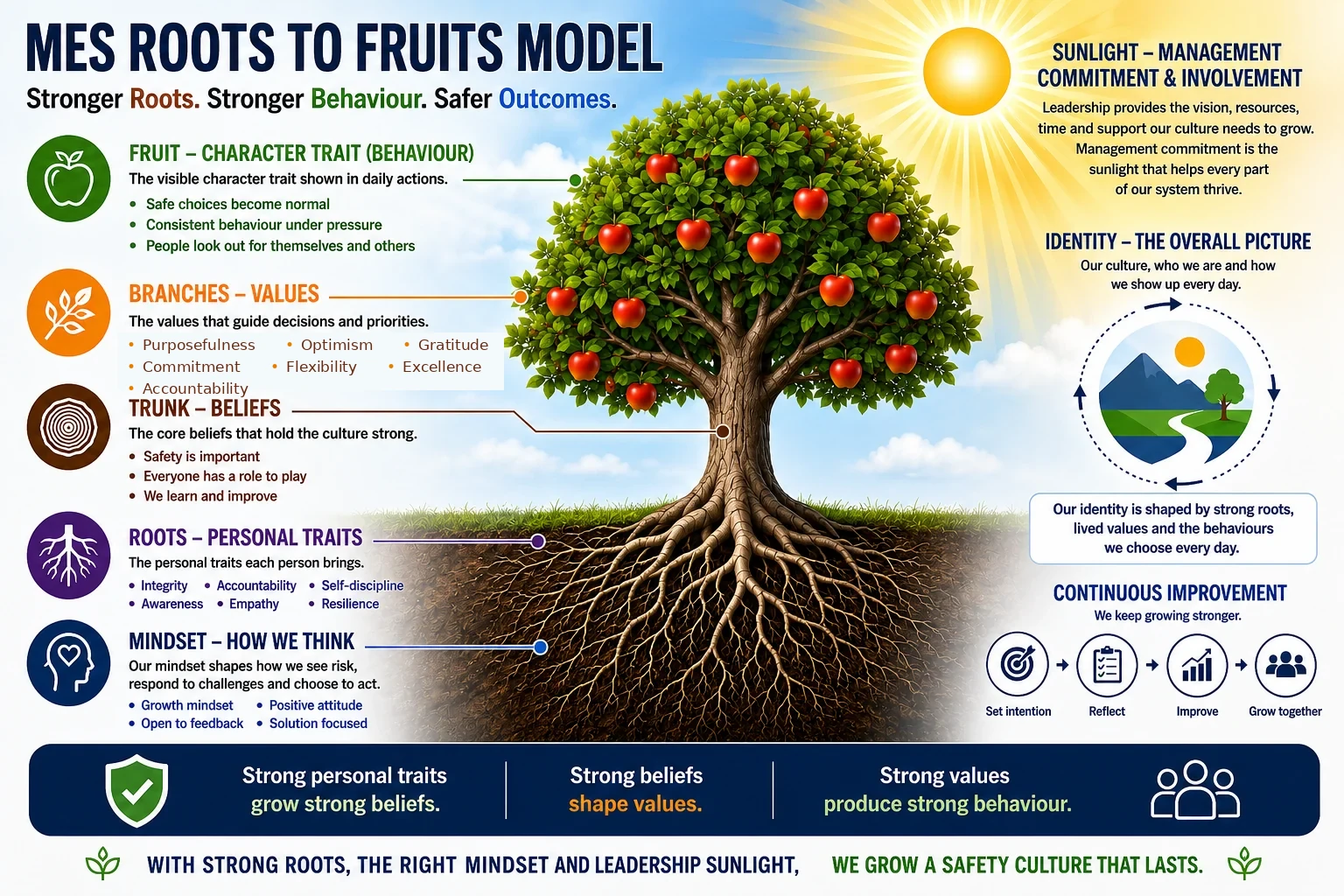
Behaviour is the fruit. MES helps strengthen the roots that shape ownership.
Triple P: The Structure That Turns Behaviour Into Practice
MES strengthens the roots of behaviour, but behaviour also needs structure. That structure is built through the Triple P Health and Safety Programme.
Triple P stands for Policies, Procedures and Practices. Policies define what the organisation expects and why it matters. Procedures explain how those expectations must be carried out. Practices turn safe work into daily operations.
A safe behaviour strategy without Triple P can become too informal. People may talk about safety, but the organisation may not have a clear structure to define, support and monitor the expected behaviour.
MES builds the mindset. Triple P builds the structure. OHS Online drives the execution.
The Triple P Champion: The Internal Driver of Ownership
Every Health and Safety Management System needs internal ownership. Without an internal driver, safe behaviour can fade. Inspections become late. Registers are ignored. Actions stay open. Toolbox talks become routine. Observations become forms. Employees stop believing that anything will change.
The Triple P Champion training helps prevent this. The Champion is not there to take responsibility away from management, supervisors or employees. The organisation remains responsible for its own Health and Safety. The Champion helps guide the system, support appointees, encourage supervisors, monitor follow-through and keep the Health and Safety Management System alive.
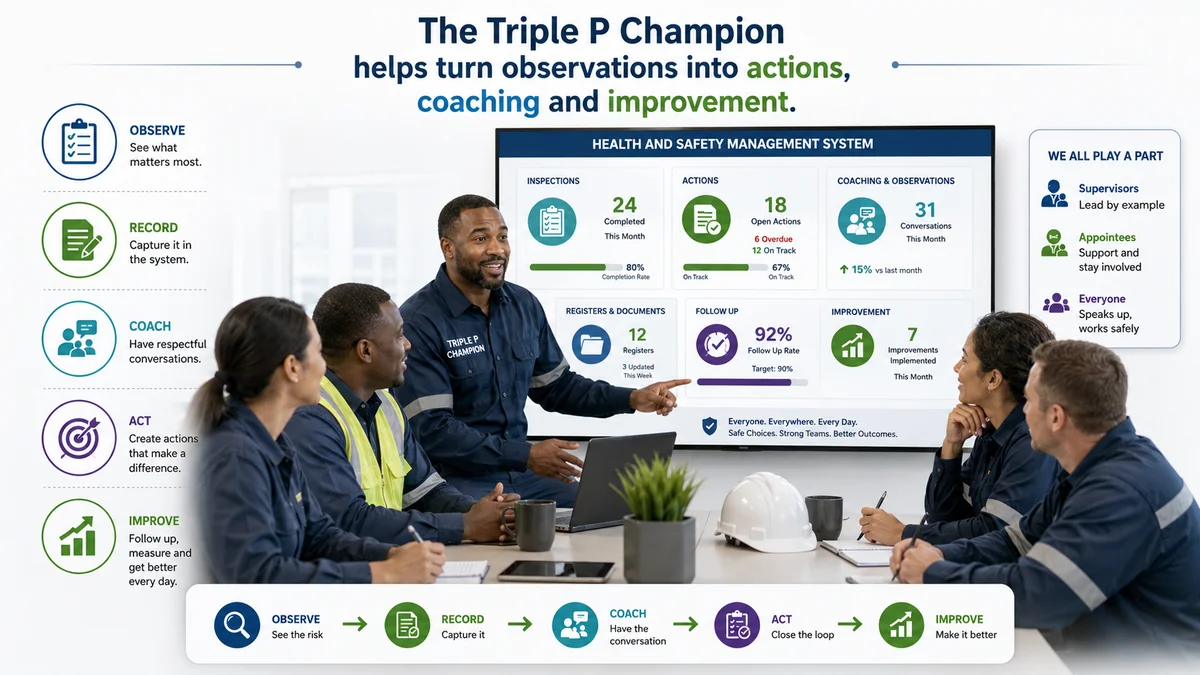
The Triple P Champion helps turn observations into actions, coaching and improvement.
Management Behaviour Is Part of the System
Safe behaviour is not only a frontline employee issue. Management behaviour has a major influence on workplace safety.
If supervisors do not plan work properly, employees experience pressure. If managers do not respond to reported hazards, employees stop reporting. If leadership rewards speed but ignores control discipline, people learn that production matters more than safety. If corrective actions stay open for months, trust weakens.
A proper Health and Safety Management System must therefore include management behaviours such as:
- Supervisors conducting task-specific toolbox talks
- Managers responding to safety suggestions
- Supervisors giving feedback after observing work
- Leaders attending Health and Safety committee meetings
- Managers closing corrective actions on time
- Departments reviewing inspection results
- Supervisors involving employees in planning high-risk tasks
- Management removing barriers that make safe behaviour difficult
Safe Behaviour Must Not Replace Better Controls
A safe behaviour strategy must never become an excuse for weak risk control. If a machine guard is poor, the answer is not to tell employees to "be more careful." If a chemical splash risk exists, the answer is not only to observe PPE use when a better dispensing system may be reasonably practicable.
Safe behaviour supports controls. It must not replace controls.
The correct order is: Understand the task → assess the risk → select suitable controls → activate registers → monitor behaviour → raise actions → improve the system.
Feedback Must Reinforce the System
Feedback is one of the most important parts of managing safe behaviour. But poor feedback can damage trust. General feedback such as "be careful" does not help much. Public correction can feel like punishment. Blaming feedback creates defensiveness. Feedback from someone who does not understand the task may not be trusted.
Good feedback should be:
- Specific and linked to the task and control measure
- Respectful and given as soon as practical
- Focused on improvement rather than blame
- Supported by action where a barrier exists
Safe Behaviour and ISO 45001 Thinking
A safe behaviour strategy also supports ISO 45001 support in South Africa, because ISO 45001 is built around leadership, worker participation, hazard identification, risk assessment, operational control, performance evaluation and continual improvement.
A Health and Safety Management System that includes safe behaviour can help the organisation demonstrate:
- Leadership involvement and worker participation
- Practical operational control and competence
- Monitoring of safe work practices
- Corrective action follow-up and continual improvement
- Stronger safety culture across all levels
How SafetyWallet Supports Safe Behaviour Inside a Health and Safety Management System
The SafetyWallet Health and Safety SaaS platform helps organisations manage their own Health and Safety responsibilities through OHS Online, MES, Triple P, e-learning, My Safety Hub, My Safety Shop and structured support.
SafetyWallet does not take responsibility away from the employer. The employer, managers, supervisors, appointees and employees remain responsible for living the Health and Safety system every day. SafetyWallet helps make that responsibility visible, structured, measurable and easier to manage.
SafetyWallet supports safe behaviour through four connected layers:
| Layer | Component | What It Does |
|---|---|---|
| Root layer | MES Roots to Fruits | Builds the beliefs, values, traits and identity behind safe behaviour |
| Structure layer | Triple P Health and Safety Programme | Defines Policies, Procedures and Practices that shape daily safe work |
| Ownership layer | Triple P Champion | Drives internal ownership, guides appointees and keeps the system alive |
| Execution layer | OHS Online | Manages daily risk assessments, inspections, actions, training and reporting |
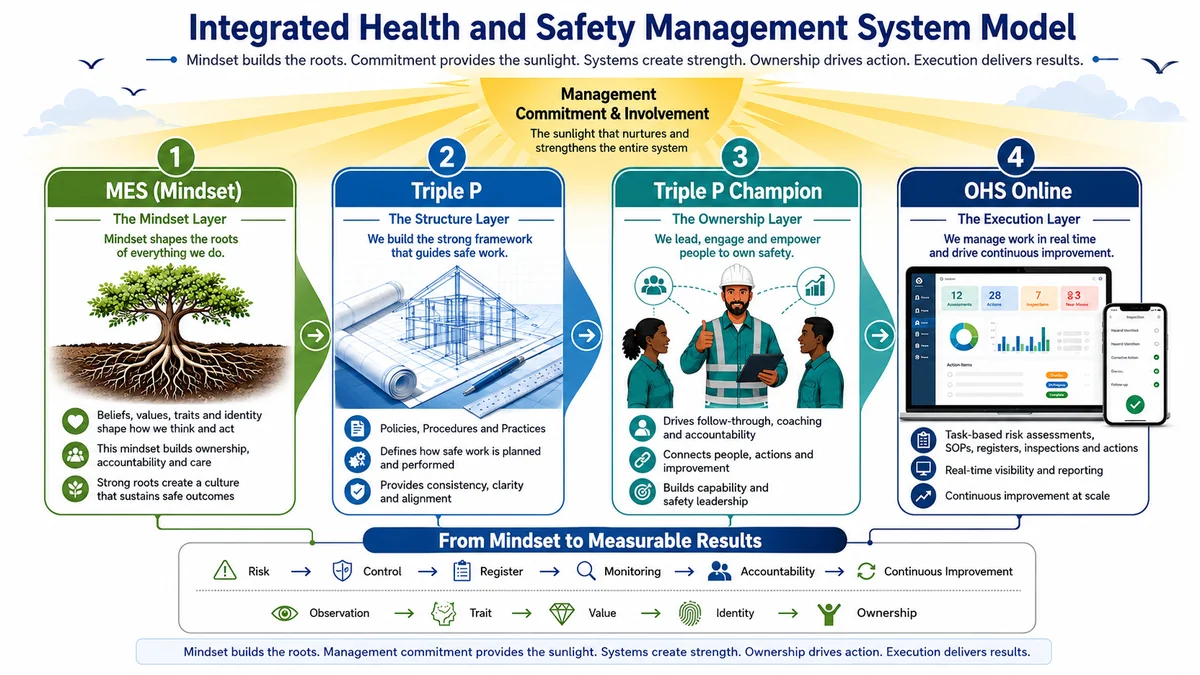
MES builds the roots, Triple P builds the structure, the Champion drives ownership and OHS Online manages execution.
Why Safe Behaviour Strategies Fail When They Are Not Integrated
Safe behaviour strategies often fail when they are treated as campaigns instead of systems. Common failure points include:
- Observations completed for numbers instead of learning
- Employees feeling watched instead of supported
- Supervisors being excluded from the process
- Management not responding to reported issues
- Actions not being tracked or closed
- Critical behaviours not linked to risk assessment
- Vague or blaming feedback that damages trust
- Production pressure contradicting safety messaging
- Disconnected registers and weak Triple P structure
- An unsupported Triple P Champion and missing MES coaching
Employees quickly see whether the system is real. If they raise concerns and nothing changes, they stop reporting. If safe behaviour is praised but unsafe production pressure is rewarded, they follow the pressure. If observations lead to blame, they hide. If observations lead to support, they engage.
Build safe behaviour into your Health and Safety Management System.
SafetyWallet helps your organisation connect MES, Triple P, Triple P Champion support and OHS Online so that risk controls, registers, observations, actions and ownership work together every day.
Visit the Health and Safety Management System page →Conclusion: Safe Behaviour Must Become Part of Daily Management
Safe behaviour is powerful when it is managed correctly. It should not be a blame system. It should not be limited to frontline workers. It should not rely only on observation cards. It should not replace proper risk controls. It should not sit outside the Health and Safety Management System.
For South African businesses, this is where Health and Safety becomes practical. SafetyWallet's approach brings together the roots, structure, ownership and execution: MES builds the roots. Triple P builds the structure. The Triple P Champion drives ownership. OHS Online manages daily execution.
The real purpose of a safe behaviour strategy is not to observe people. It is to help employees, supervisors, managers and leaders live the Health and Safety Management System every day.
Start with the risk, strengthen the controls, activate the registers and build ownership through daily behaviour. Visit the SafetyWallet homepage, the Health and Safety Management System page, or the Triple P Champion training page to see how SafetyWallet helps organisations move from paperwork to practical Health and Safety ownership.