A signed contractor agreement can be neatly filed while two supervisors hold opposite views about who will isolate a machine. The signature records an arrangement. Whether that arrangement actually controls the work depends on what the parties agreed, understood and implemented.
For South African employers, section 37(2) of the Occupational Health and Safety Act deserves more attention than a standard clause at the back of a purchase order. It concerns arrangements and procedures between an employer or user and a mandatary. The SafetyWallet platform helps organisations connect those arrangements to people, evidence and ongoing follow-up.
A section 37(2) agreement records written arrangements and procedures intended to ensure a mandatary’s compliance with the OHS Act. Its legal significance depends on the statutory wording and the actual relationship. It does not erase duties imposed directly on the parties. A useful agreement identifies the work, responsibilities, controls, information, supervision and change process, then connects them to workplace verification.

Agree responsibilities before the work begins.
Read section 37 as a whole
Section 37(1) addresses specified acts or omissions by employees and the circumstances in which an employer or user may be treated as responsible. Its stated exception contains three cumulative elements concerning permission, the employee’s authority, and reasonable preventive steps. Instructions prohibiting the conduct are not, by themselves, sufficient proof of those preventive steps.
Section 37(2) extends subsection (1) to a mandatary, subject to the written-arrangement exception it describes. The Act’s definition of mandatary includes an agent, contractor or subcontractor for work. Section 41 also matters: statutory requirements generally cannot be removed by agreement, subject to its stated exceptions, including section 37(2). These provisions require careful reading together. Source: OHS Act, sections 1, 37 and 41.
This is not a basis for declaring that every incident automatically makes the client guilty, or that a signed form guarantees a defence. Applying a criminal provision to a particular case requires legal advice, evidence and the relevant legal principles. The practical management lesson is clearer: understand the relationship and make the preventive arrangements work.
The duties that still need owners
Section 8 addresses an employer’s duties to its employees, including safe systems and appropriate information, training and supervision. Section 9 concerns people other than employees who may be directly affected by the undertaking. Both use the reasonably practicable standard within their scope. A client and a contractor can each have duties arising from their own activities. Source: OHS Act, sections 8 and 9.
Calling the contractor an independent business does not answer who controls the client’s production line, delivery routes or emergency arrangements. Equally, the client reviewing a method statement does not make it the contractor’s employer. Define each role from the actual work and control available to it.
For practical health and safety compliance in South Africa, ask who has the information, competence, authority and resources to implement each requirement. An agreement becomes useful when those answers are consistent with the scope, risk assessment and site arrangements.
What we see repeatedly in South African workplaces
The gaps to test include agreements copied from another job, subcontractors introduced without discussion, undefined shutdown responsibilities and paperwork signed by someone who cannot commit the resources needed. Another warning sign is an agreement that says everything belongs to the contractor while the client still controls the decisive operating conditions.
A constructive review starts with one live job. Ask the client supervisor and contractor supervisor separately who controls access, isolation, changes and restart. Different answers identify a coordination problem worth resolving before mobilisation.
Discuss your contractor-management arrangements with SafetyWallet if your documents and daily decisions are difficult to connect.
Build the agreement around the actual interface
Define the work and its boundaries
Record the parties, site, scope, intended period and relevant activities. Identify supplied goods, installation, maintenance, delivery and subcontracted work where applicable. The term “general maintenance” is rarely enough to explain a shutdown involving electrical work, lifting and cleaning.
Use task-based risk assessments to identify hazards and controls for the actual work. The agreement should explain how the parties will exchange relevant information and coordinate those controls. It should not be expected to replace the task assessment itself.
Allocate decisions and evidence
| Arrangement | Client contribution | Contractor contribution |
|---|---|---|
| Site information | Explain relevant hazards, restrictions and interfaces | Ask for missing information and adapt the method |
| People and equipment | Define access and site requirements | Supply competent people and suitable equipment |
| Coordination | Manage client operations affecting the work | Explain sequencing, resources and subcontractors |
| Changes | Identify authorised client decisions | Report proposed changes before implementation |
| Handover | Confirm acceptance and operating conditions | Provide completion evidence and outstanding defects |
Use named roles and escalation routes rather than assuming that “management” will decide. Record how absences and shift changes are covered. Requirements must remain workable when the person who signed the agreement is off site.
Provide for monitoring and change
Agree how supervision, inspections, incidents, non-conformances and corrective actions will be managed. Define the response when information expires, a critical control fails or the scope changes. Identify who can authorise resumption after the conditions have been reassessed.
These are practical arrangements to develop according to the work, not a universal statutory template. Specialist activities may carry additional legal requirements. Obtain competent legal input where the agreement’s interpretation or liability consequences need resolution.
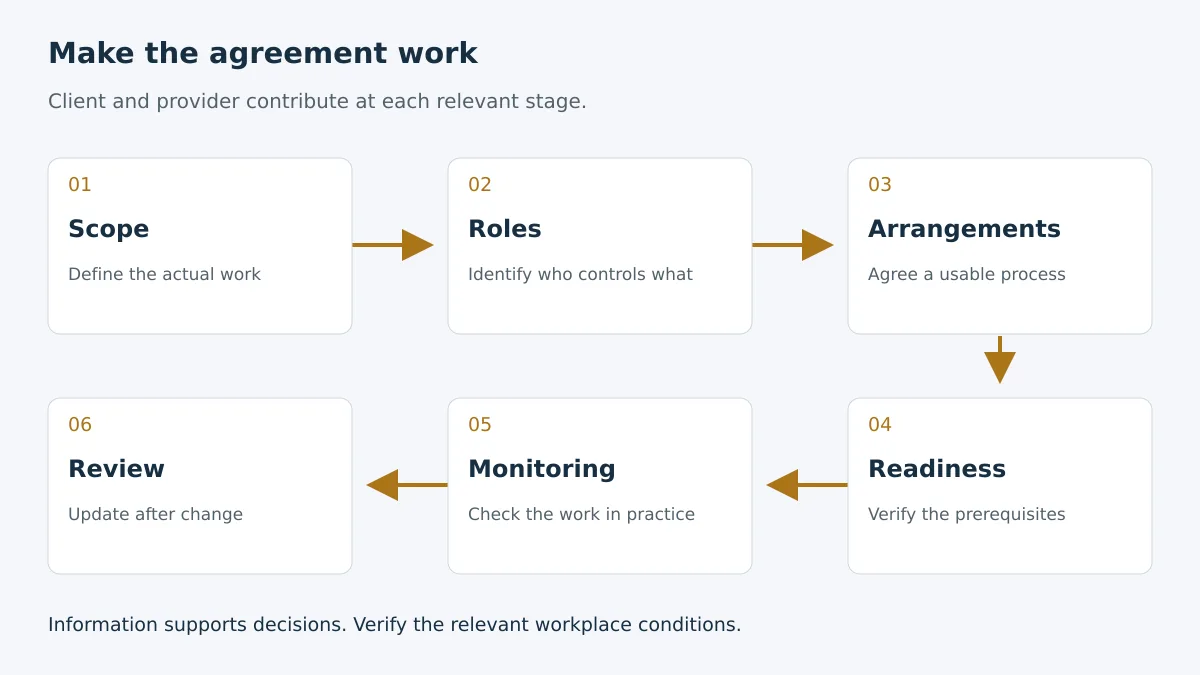
Follow the sequence and verify the evidence supporting each decision.
A roof repair example
Consider a fictional office appointing a contractor to repair a roof above an occupied entrance. The agreement says that the contractor manages safety. The contractor assumes the client will close the entrance; the client assumes the contractor will provide an alternative pedestrian route.
A useful pre-start meeting identifies the overlap. The client controls building access and occupant communication. The contractor explains its access method, work area and falling-object precautions. Together they determine the separation arrangements, timing, supervision and conditions for reopening the entrance.
If rain changes the method or a different access system is proposed, the original signature does not settle the new risk. The parties review the change and confirm the relevant controls before proceeding. Both benefit: the client can plan building operations, and the contractor can price and resource a realistic method.

Check that the people doing the work understand the agreed arrangements.
How OHS Online makes the arrangements easier to manage
A relationship record is useful when it connects agreed requirements to the information people actually review. Through OHS Online, a subscriber can invite a contractor, request relevant evidence, establish authorised sharing and follow up missing or overdue requirements.
For a connected SafetyWallet contractor, applicable shared information updates in the client’s view as the contractor maintains its own programme. An external contractor can use the upload portal, but must manually replace changed or expired documents. Neither route makes an uploaded agreement proof that workplace controls have been implemented.
Software gives visibility, but visibility is not the same as control. A visible overdue item needs a responsible person to evaluate its significance. A completed induction record needs to relate to the people doing the job. The authorised employer representatives still make the operational decisions.
The Contractor and Supplier Directory helps logged-in subscribers discover consenting organisations by relevant services and keywords. It supports the beginning of the relationship; evaluation and suitable arrangements still follow. Contractors gain visibility without a promise of appointment or a claim that SafetyWallet has certified them for every job.

Relevant authorised information supports decisions and follow-up by both organisations.
The SafetyWallet model: one platform, multiple layers of support
The SafetyWallet model combines a SaaS subscription, OHS Online, structured methods, learning and support. Triple P-Policies, Procedures and Practices connects the commitment in an agreement to a repeatable management process and actual workplace practice.
Task assessments establish the control requirements. Registers allocate recurring work. Job Safety Observations check implementation. MES, the Mindset Evolution Schema, supports respectful recognition and development after immediate risks are controlled. This links behaviour based safety to observable work rather than assumptions about someone’s attitude.
Expert health and safety support and approved Partners help within agreed scope. OHS Connect supports self-management; Expert Guidance adds allocated professional guidance. My Safety Hub and eLearning support understanding. The SafetyWallet Shop, also known as My Safety Shop, offers relevant products and services.
Together these support a practical health and safety management system. ISO 45001 support in South Africa can assist organisations developing their management approach; certification remains a separate assessment outcome.
Benefits for the client and the contractor
The client gains clearer responsibilities, fewer conflicting assumptions and a retrievable record of important decisions. The contractor gains earlier access to site information, a clearer scope and an agreed route for raising obstacles or changes. Good arrangements also make performance reviews fairer because both parties can test what they actually undertook to do.
Qualifying subscribers can receive contractor and supplier management reward discounts for active ongoing management through OHS Online. The reward applies to eligible ecosystem purchases under the programme rules. Signing agreements or collecting records alone does not qualify, and the benefit is not automatically a reduction on an external contractor’s invoice.
Book a SafetyWallet demo to see how requirements, shared evidence and follow-up can support your contractor arrangements.
Software only vs consultant only vs the SafetyWallet model
| Approach | What it solves | What it often misses | Best use | Long-term result |
|---|---|---|---|---|
| Software only | Stores agreements | Workplace implementation | Accessible records | Depends on action |
| Consultant only | Adds expertise | Daily coordination | Defined specialist input | Depends on follow-through |
| Safety file/document approach | Records arrangements | Changing conditions | Evidence for decisions | Needs continual review |
| SafetyWallet model | Connects software, training, support, risk, controls, behaviour and accountability | Still needs employer action | Building internal ownership | Supports sustained improvement |
Frequently Asked Questions
Questions about section 37(2) agreements
Make the agreement usable before work starts
Choose one current agreement and compare it with the next planned job. Confirm scope, decision-makers, critical interfaces, monitoring and change arrangements. Ask the people doing the work to explain those arrangements in their own words.
SafetyWallet helps connect the record to the management process. Our purpose remains: “We believe in making sure your loved ones return home healthy and safe after work.”
Talk to the SafetyWallet team about turning contractor arrangements into visible, accountable workplace practice.
Continue the series
Previous article: Contractors and Suppliers on Your Premises.
By SafetyWallet. Based on its Contractor and Supplier Health and Safety Management learning material and Ownership with Support approach. General educational guidance; obtain advice appropriate to the facts for specific legal arrangements.