The risk assessment says the equipment will be isolated. The method statement describes diagnostic testing while energised. The permit request simply says “maintenance”. Three documents exist, but they do not describe one agreed task.
That contradiction should be resolved before authorisation. Contractor work needs a consistent account of what will happen, which hazards matter, which controls apply and who verifies them. The SafetyWallet platform supports the connection through OHS Online and a structured management process, while competent authorised people remain responsible for decisions at the workplace.
A task-based risk assessment identifies hazards, risks and controls. A method statement explains how the work will be done. A permit-to-work authorises defined work under specified conditions where required by applicable rules. These documents must agree and reflect the actual site. A permit does not replace risk assessment, supervision or verification, and changed conditions may require suspension, review and reauthorisation.

Authorisation must reflect the task and actual workplace conditions.
Begin with the legal duty to understand and control the work
Section 8 of the OHS Act addresses safe systems, hazard identification, precautions, information and supervision within its scope. Section 9 concerns people other than employees affected by the undertaking. These duties apply to real activities and conditions, not merely the existence of a completed form. Source: OHS Act, sections 8 and 9.
Specific activities may require additional assessments, competence, authorisations or controls under applicable regulations. Determine those requirements from the work and legal context. A site can also establish its own approved permit matrix to manage defined activities and interfaces.
Avoid a universal rule that every contractor visit, or every activity labelled “high risk”, requires the same permit. Equally, do not omit a required authorisation because the company has an approved safety file. The correct question is which legal and site requirements apply to this task, at this place and time.
What we see repeatedly in South African workplaces
The gaps to test include copied assessments with unrelated hazards, method statements written before the site was understood, permits issued without checking the area and changed work continuing under the original description. Another problem is assuming that a contractor’s assessment accounts for client-controlled hazards that were never disclosed.
A useful pre-start review asks both parties to describe the task in plain language. If their explanations differ about energy, access, sequencing, simultaneous work or emergency arrangements, the documents need more than signatures. The underlying decision still needs to be made.
Discuss your task-control process with SafetyWallet if risk assessments and permits are currently managed as separate paperwork exercises.
Give each document a clear purpose
| Record | Main question | What it cannot establish alone |
|---|---|---|
| Task-based risk assessment | What can cause harm and which controls are needed? | That every control is in place today |
| Method statement | How will the contractor carry out the agreed work? | That the site has been prepared |
| Site procedure or SOP | What approved sequence and rules apply? | That the team understands and follows them |
| Permit-to-work | Is this defined work authorised under stated conditions? | That conditions will remain unchanged |
| Inspection or JSO record | What was verified or observed? | That unobserved activities were also satisfactory |
Keep the documents linked to the same scope, work location and revision. When a method changes, identify the affected assessment, instructions, permit conditions and people. Updating only one record can leave the work team relying on conflicting information.
Build the assessment from actual task steps
Establish what the work includes
“Service the conveyor” can involve access, cleaning, isolation, dismantling, lifting, replacement, testing and restart. Break the scope into meaningful activities and consider who can be affected at each stage. Include contractor employees, client employees, delivery drivers and other people within the relevant interface.
Use task-based risk assessments as a structured starting point. Customise hazards and controls for actual equipment, environment, people and operations. Library content helps people begin; it does not remove the need for competent workplace input.
Check the controls as a connected set
A control can depend on another organisation’s action. The contractor may require access to an isolated area, while the client controls the shutdown. A lifting activity may depend on clearing an access route used by deliveries. Record these dependencies so an unanswered assumption does not become a dangerous instruction.
Consider elimination or reduction of hazards and suitable physical or organisational controls before relying only on personal protective equipment. The Act’s section 8 duty structure expressly addresses eliminating or mitigating hazards before resorting to PPE. The exact controls still depend on the task and competent assessment.
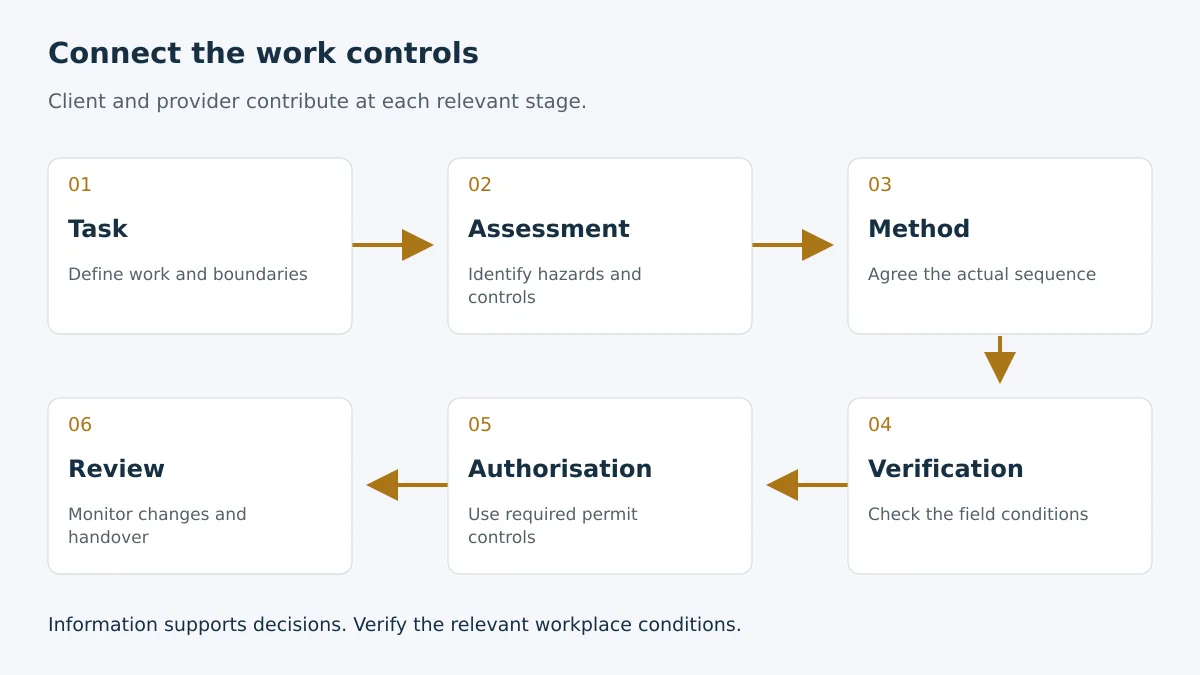
Follow the sequence and verify the evidence supporting each decision.
Use the permit as a defined decision point
Where a permit is required, the request should identify the work, location, period, person in charge and linked assessment or method. The authorised reviewer needs sufficient information to determine the applicable conditions and prerequisites.
Before issue, verify the relevant area preparation, isolation, testing, boundaries, conflicting activities and emergency arrangements through the approved process. A software check that a document exists is different from competent confirmation that a physical condition is satisfactory.
The work team needs to understand and accept the conditions. Confirm who monitors them, what changes require a pause, and how handover is managed. A permit should be specific enough that a worker can recognise when the task has moved outside its authorised limits.
Suspend when the facts change
Changed scope, people, method, isolation, weather or nearby work can alter the risk. Follow the approved stop and escalation process when conditions fail or material uncertainty arises. Make the situation safe within competence and authority, record the facts and obtain the appropriate review before restart.
Revalidation should confirm the changed facts and controls, not simply extend a time field. At closeout, check completion, remaining defects, removal of equipment, restoration and handover through the approved process. Ending a permit record does not itself prove safe recommissioning.
A weekend maintenance conflict
In a fictional distribution centre, an electrical contractor and a cleaning team are booked into the same plant area. The electrical method assumes restricted access. The cleaning schedule assumes the area is available throughout the morning. Each team has a valid purchase order and its own paperwork.
A joint review identifies the conflict before work. The client sequences the activities, confirms the relevant boundaries and arranges communication between the people in charge. The contractor and cleaner revise their plans accordingly. If a delay changes the sequence, the affected arrangements are reviewed again.
The client gains a workable programme rather than competing instructions. The providers gain a clear basis for staffing and supervision. The records capture why the sequence was chosen, who agreed it and what must remain true during execution.

Resolve conflicting activities and explain the agreed sequence before work.
How OHS Online supports the work-control process
OHS Online connects tasks, risk information, controls, documents, responsibilities and evidence. Where the approved client permit matrix requires a permit, use the enabled permit workflow and authorised roles appropriate to the relationship, site and work. Confirm the actual configuration rather than assuming every deployment has identical automatic checks.
Keep the contractor relationship and its information current. Connected SafetyWallet providers can share authorised programme information, while external providers maintain requested records through manual portal uploads. Neither route removes the need to reconcile the task assessment, method and field conditions.
Software gives visibility, but visibility is not the same as control. A dashboard can show an overdue requirement or a permit record. It cannot physically establish an isolation, remove an obstruction or decide whether an unanticipated condition is acceptable. Those actions need competent people with clear authority.

Relevant authorised information supports decisions and follow-up by both organisations.
The SafetyWallet model: one platform, multiple layers of support
SafetyWallet combines a SaaS subscription, OHS Online, structured methods, learning and support. Triple P—Policies, Procedures and Practices connects the organisation’s work-control commitments to procedures and daily implementation.
Registers assign recurring checks. Job Safety Observations compare the approved task controls with actual practice. MES, the Mindset Evolution Schema, supports recognition and development after immediate risks are controlled. This makes behaviour based safety relevant to real decisions, such as stopping when permit conditions no longer match the work.
Expert health and safety support and approved Partners assist within agreed competence and scope. My Safety Hub and eLearning support understanding. The SafetyWallet Shop, also known as My Safety Shop, offers relevant products and services.
These elements support a practical health and safety management system and health and safety compliance in South Africa. ISO 45001 support in South Africa can assist system development without guaranteeing certification.
Why both parties benefit
The client gains clearer coordination, authorisation and handover evidence. Contractors gain better information about site dependencies and a defined route for raising conflicts before being expected to proceed. Suppliers involved in installation also gain clarity about when product acceptance becomes on-site work control.
Directory visibility can help consenting providers become discoverable to subscribers. Qualifying active management through OHS Online can earn reward discounts on eligible ecosystem purchases. A permit count or uploaded assessment alone does not establish reward eligibility, and commercial benefits must never displace a required control.
Book a SafetyWallet demo to discuss how task information, contractor records and work-control evidence can connect in your programme.
Software only vs consultant only vs the SafetyWallet model
| Approach | What it solves | What it often misses | Best use | Long-term result |
|---|---|---|---|---|
| Software only | Organises work records | Physical verification | Supporting authorised roles | Depends on competent action |
| Consultant only | Adds technical input | Every changing work condition | Defined specialist support | Depends on implementation |
| Safety file/document approach | Records planned controls | Contradictions during execution | Supporting authorisation | Needs active revision |
| SafetyWallet model | Connects software, training, support, risk, controls, behaviour and accountability | Still needs field control | Building internal ownership | Supports coordinated work |