The contractor’s folder is complete. At the gate, however, the team includes a new worker, a different supervisor and a chemical that was not part of the original review. The document check may have been completed correctly, but the facts on which it relied have changed.
A safety file supports readiness decisions. It cannot make those decisions permanently true. The SafetyWallet platform helps clients and providers keep relevant information connected while maintaining the essential distinction between organisation approval, site readiness and authorisation for a particular task.
Before work begins, verify the actual people, equipment, substances, task, site conditions and required controls. Check relevant evidence for validity and scope, complete site-specific induction and confirm understanding. Resolve critical gaps before authorisation. A complete file, a signed attendance sheet or a current company profile does not by itself establish that this team is ready for this work today.

Induction should establish understanding of the actual site and work.
The legal purpose behind the readiness check
Section 8 of the OHS Act includes duties concerning hazards, precautionary measures, information, instruction, training and supervision within its applicable scope. Section 9 addresses hazards affecting people other than employees. These duties help explain why a readiness decision must consider actual conditions and affected people. Source: OHS Act, sections 8 and 9.
A safety file is a way of organising evidence; it is not a universal substitute for every requirement under the Act or applicable regulations. Specific activities may prescribe documents, competence, medical fitness, appointments or authorisations. Determine what applies to the actual work rather than copying every item from another project.
Section 37(2) arrangements may also form part of the relationship where applicable. They should explain practical responsibilities and coordination. A signed agreement does not make an incomplete induction, unsuitable item of equipment or unresolved critical control acceptable.
What we see repeatedly in South African workplaces
Readiness gaps often arise when the organisation approved in the office is treated as identical to the crew arriving at site. Other problems worth testing include expired documents left in a folder, induction records that do not identify the site, and evidence reviewed by someone unfamiliar with its technical limits.
The remedy is not necessarily a larger checklist. It is a clearer decision: what must be true before this activity begins, who verifies it and what evidence supports that conclusion? The answer should be understandable to the client representative and the contractor’s person in charge.
Discuss your readiness and induction process with SafetyWallet if a completed file currently functions as automatic permission to work.
Keep three decisions separate
| Decision | Question | Example of a remaining gap |
|---|---|---|
| Organisation suitability | Can this provider undertake the defined scope? | The proposed subcontractor has not been evaluated |
| Site readiness | Are the actual people and resources prepared for this site? | A replacement worker has not completed induction |
| Task authorisation | Are the conditions for this particular activity in place? | An isolation or required permit is unresolved |
A positive answer at one level does not settle the next. This separation protects contractors as well as clients: it makes clear why a delay occurs and who must resolve it. A provider should not be blamed for an access route or shutdown condition controlled by the client.
Build the file from the task and risk
Start with the scope and task-based risk assessments. Identify the people, equipment, substances and interfaces involved. Request information because it supports a control or decision, and record why it matters.
For a maintenance activity, relevant evidence could concern competence, equipment inspection, method, emergency arrangements and site coordination. For a routine delivery, the important checks may be receiving instructions and vehicle-pedestrian separation. The same document list is unlikely to serve both well.
When reviewing a record, check identity, scope, currency, issuing source and limitations. A certificate relating to another person or item does not answer the question. Where technical interpretation is needed, involve a competent reviewer rather than allowing a file administrator to infer suitability.
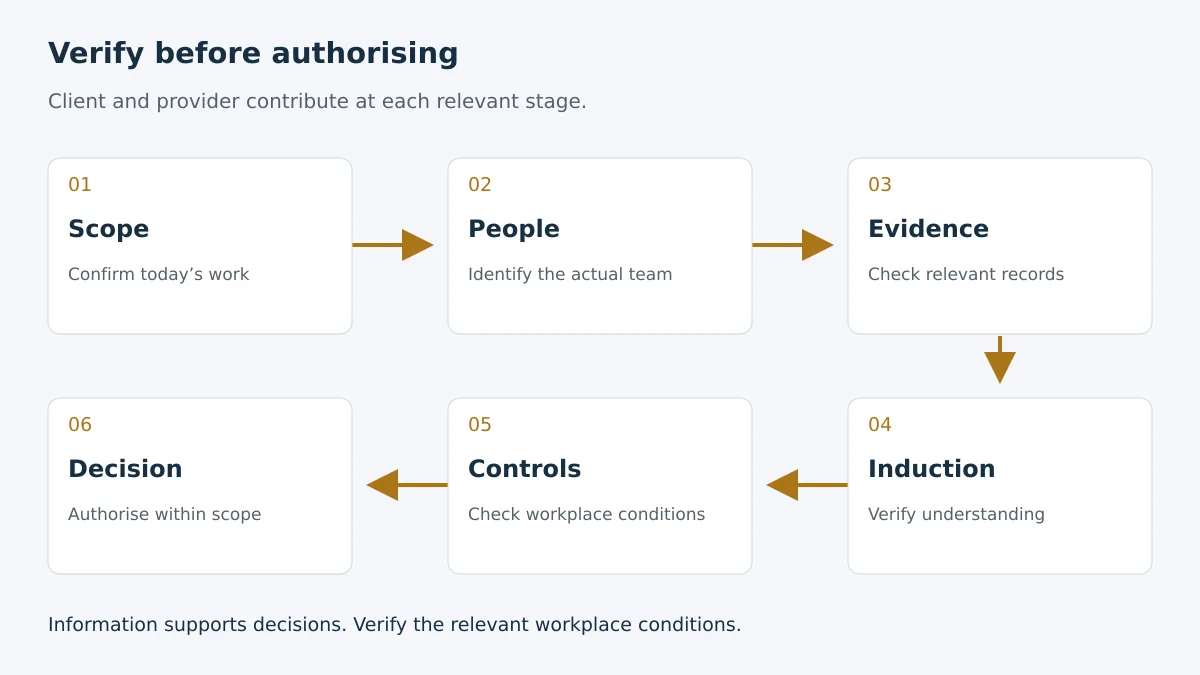
Follow the sequence and verify the evidence supporting each decision.
Induction should change what people understand
Explain the actual site and work interface
Useful induction covers relevant access routes, restricted areas, emergencies, reporting, local hazards and work boundaries. Explain how the contractor’s activities interact with employees, visitors and other providers. Information should be understandable to the intended people and appropriate to their roles.
A delivery driver, cleaning worker and electrical supervisor may share some site information while needing different task-related instruction. A generic video can support the process, but it should not be expected to explain every local condition or replace practical verification where required.
Test understanding without turning it into an exam exercise
Ask the worker to show the permitted route, explain whom to contact when conditions change or describe what would make the work stop. A short practical conversation can reveal a misunderstanding that an attendance signature would miss.
If the person cannot explain a critical instruction, clarify it and check again before the affected work proceeds. Record what was covered, who participated and how the relevant understanding was checked. Do not equate attendance, online course completion or a signature with demonstrated competence.
Refresh when relevant conditions change
A changed site layout, emergency arrangement, scope or work team may require updated induction or instruction. Review the change rather than assuming an annual renewal date answers every question. The appropriate trigger should follow the risk and applicable requirements.
A replacement worker on a planned shutdown
In a fictional food warehouse, a contractor replaces an absent team member on the morning of planned equipment maintenance. The company has been evaluated and its records are current. The new worker has relevant experience but has not been shown the site’s access restrictions or emergency arrangements.
The client and contractor do not need to repeat every part of company prequalification. They need to address the specific gap: confirm identity and relevant evidence, complete appropriate induction, check understanding and update the team record. The task authorisation still requires its own field checks.
This is a more useful response than either admitting everyone because the company is approved or restarting the entire supplier onboarding process. It protects the client while giving the contractor a clear and proportionate route to readiness.

A change in the team or work needs a focused readiness review.
What a connected Health-and-Safety File changes
A participating SafetyWallet contractor or supplier can maintain its own programme and authorise relevant information sharing with connected clients. When applicable shared information changes, the connected client’s view updates automatically. Overdue shared managed requirements are flagged for review and follow-up.
That can reduce repeated document requests and reliance on old email attachments. It also gives the provider a reason to maintain one programme for its own operations rather than assembling unrelated files for each client. The client must still review what is shared and determine whether it answers the site-specific question.
External contractors can use the upload portal without an existing SafetyWallet subscription. They manually upload and replace required documents as information changes or expires. This is a useful participation route, but it is different from information connected to an actively maintained OHS Online programme.
Software gives visibility, but visibility is not the same as control. A current record cannot inspect a damaged ladder, identify an unreported chemical substitution or judge whether the team understands an instruction. The readiness process needs both information review and workplace verification.

Relevant authorised information supports decisions and follow-up by both organisations.
Protect information while making it useful
Share what the authorised reviewer needs for the relevant decision. Avoid circulating unrelated client records, unnecessary identity details or private medical information simply because it appears in a provider’s file. Apply the organisation’s approved access, privacy and retention arrangements.
For example, a person assessing a fitness requirement may need an appropriate confirmation for the task, rather than a broad medical history. Establish the applicable requirement and authorised disclosure route with competent advice. More information is not automatically better evidence.
The SafetyWallet model: one platform, multiple layers of support
SafetyWallet combines its SaaS subscription with OHS Online, structured methods, learning and support. Triple P-Policies, Procedures and Practices connects the readiness policy to the review procedure and what happens at the gate and workface.
Registers allocate control-related activities. Inspections and Job Safety Observations check implementation. MES, the Mindset Evolution Schema, supports respectful recognition and development after immediate risks are addressed, linking behaviour based safety to observed practice.
My Safety Hub and eLearning support understanding. Expert health and safety support and approved Partners assist within scope. The SafetyWallet Shop, also known as My Safety Shop, provides relevant products and services.
This supports a practical health and safety management system, health and safety compliance in South Africa and continuing improvement. ISO 45001 support in South Africa is available as support for the management approach, without a promise of certification.
Benefits for both sides of the gate
The client gains clearer readiness decisions and a better view of missing or overdue information. The contractor gains advance notice of requirements and less avoidable repetition. Both gain a documented route to resolve gaps before schedule pressure dominates the discussion.
Directory participation helps consenting providers become discoverable to logged-in subscribers. Qualifying subscribers can also earn active-management reward discounts on eligible ecosystem purchases. Neither a listing nor a complete file alone qualifies as active management, and neither proves permission to start work.
Book a SafetyWallet demo to explore how connected information and clear requirements can support your readiness process.
Software only vs consultant only vs the SafetyWallet model
| Approach | What it solves | What it often misses | Best use | Long-term result |
|---|---|---|---|---|
| Software only | Makes records accessible | Conditions at the gate | Supporting reviewers | Depends on verification |
| Consultant only | Adds specialist review | Every crew change | Defined technical input | Depends on local ownership |
| Safety file/document approach | Collects evidence | Whether the actual team is ready | Readiness support | Needs current checks |
| SafetyWallet model | Connects software, training, support, risk, controls, behaviour and accountability | Still needs field decisions | Consistent readiness management | Supports sustained improvement |