By the time three quotations reach Procurement, an important safety decision may already have been made: what the bidders were asked to include. If the scope omits isolation, pedestrian separation or a competent supervisor, the cheapest price may simply be the price of an incomplete job.
Choosing a contractor or supplier should begin with the work and its risks. The SafetyWallet platform supports that process through structured requirements, directory discovery and connected information. The appointment remains the client’s decision, based on evidence relevant to the proposed relationship.
Select contractors and suppliers by defining the scope, identifying applicable risks and setting proportionate capability requirements before comparing offers. Verify evidence, resolve critical gaps and record the reasons for appointment or restriction. Directory visibility helps clients find providers; it does not establish suitability. Both parties benefit when the client communicates clear requirements and the provider can price the resources and controls needed to meet them.

Compare capability and a complete scope before comparing price.
Why selection belongs in the health and safety system
The OHS Act does not reduce workplace protection to a purchasing decision. Section 8 requires employers, within its reasonably practicable standard, to provide safe systems and address hazards affecting employees. Section 9 concerns affected non-employees. Section 10 addresses specified duties relating to articles and substances for use at work. Selection influences whether these duties can be implemented effectively. Source: OHS Act, sections 8–10.
A client cannot use a low quotation to make an absent critical control acceptable. A contractor also needs to understand the site sufficiently to propose a suitable method. This is why Procurement, Operations and OHS should contribute before an order is placed, rather than asking the safety team to repair the scope afterwards.
Where work falls under specific regulations, establish the applicable selection and appointment requirements. Do not assume that every service is construction work, or that a generic supplier questionnaire satisfies every regulated activity. Competent advice should resolve uncertainty about the actual task and legal roles.
What we see repeatedly in South African workplaces
Common gaps worth checking are vague purchase descriptions, last-minute safety requirements, expired evidence accepted because the company is familiar, and a single approval reused for work outside its original scope. A supplier may also be judged on an impressive certificate without anyone checking whether it covers the exact product offered.
The useful question is not simply whether a provider has a file. Ask whether its evidence supports the proposed work, with the people, equipment, timing and site conditions actually involved. Long-standing relationships still need that test when circumstances change.
Discuss your contractor-selection process with SafetyWallet if procurement approval and work readiness currently mean the same thing in your organisation.
Start with a scope that a competent bidder can price
Describe the outcome and interfaces
A useful brief identifies the asset or service, location, intended outcome, work period and acceptance criteria. Explain known site hazards, nearby operations, access restrictions and the information the client will supply. Ask bidders to identify assumptions and exclusions, including subcontracted activities.
For a motor replacement, distinguish supply, removal, lifting, electrical connection, alignment, testing and recommissioning. Those activities may involve different people and control requirements. If a contractor assumes the client provides lifting equipment while the client assumes it is included, the comparison is already unreliable.
Use task-based risk assessments to establish the relevant work and controls. A library task is a starting point; the assessment must reflect the actual workplace. Convert the important controls into selection questions that can be answered with evidence.
Match requirements to the relationship
| Relationship | Useful selection evidence | Question it helps answer |
|---|---|---|
| Routine goods delivery | Delivery method and receiving arrangements | Can the delivery interface be controlled? |
| Maintenance contractor | Relevant competence, equipment and proposed method | Can this organisation perform the defined task? |
| Equipment supplier | Exact specification and applicable technical information | Is the proposed item suitable for its intended use? |
| Chemical supplier | Product identity and relevant safety information | Can use, storage and exposure be assessed? |
Proportionality improves both safety and participation. A small supplier should not be excluded because it lacks documents unrelated to its work. Equally, a short visit can involve serious hazards and may justify detailed checks. Duration and company size are poor substitutes for understanding risk.
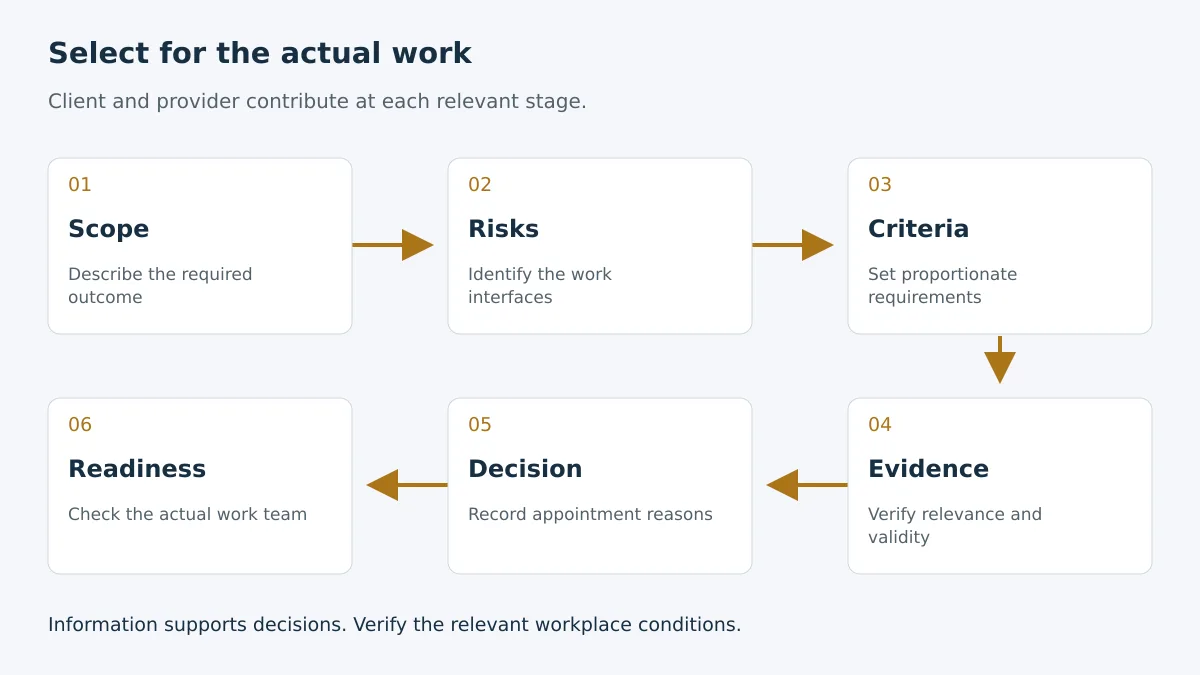
Follow the sequence and verify the evidence supporting each decision.
Verify the evidence behind the offer
Read a submitted record as evidence for a particular decision. Check the organisation or person named, issuing source, scope, date, limitations and applicability. Where verification requires a regulator, issuing body or competent technical person, use that route rather than accepting an unsupported assurance.
A training certificate does not establish that the person can safely perform every related task. A product certificate does not establish that a different model is equivalent. A previous client’s approval does not establish that the provider understands your site. Ask focused follow-up questions and record what remains uncertain.
Keep the process fair. Apply the same relevant criteria to comparable bidders, record conflicts of interest and distinguish missing information from demonstrated failure. An organisation new to the platform should have a reasonable route to submit evidence. A platform history is helpful context, not a substitute for evaluation.
Separate critical conditions from preferences
Identify what must be resolved before appointment, what must be verified before mobilisation and what requires checking at the workface. A conditional selection should name the condition, owner, deadline and gate it controls. It must not quietly authorise work that still lacks a critical prerequisite.
For example, a contractor may be selected subject to confirming named personnel before a future shutdown. That is different from allowing it to start electrical work while competence remains unresolved. The decision record should make the distinction understandable to Procurement and the site supervisor.
A three-bid comparison that reveals the real choice
In a fictional warehouse, three companies quote to replace damaged loading-bay barriers. Bid A excludes temporary pedestrian separation. Bid B includes the agreed separation and a supervisor. Bid C proposes working during peak deliveries without explaining how vehicle movements will be controlled.
The client first clarifies the common scope and minimum controls. It asks Bid A to price the missing arrangement and Bid C to explain a workable method. Only then can cost, timing and capability be compared fairly. The safety discussion improves the commercial decision instead of being added as a vague score afterwards.
The client gains a more reliable comparison. Providers gain equal visibility of the requirements and avoid being penalised for pricing precautions that others omitted. The recorded decision also gives the eventual supervisor a useful starting point for readiness checks.

Selection requirements should also define what will be checked at delivery.
Find suitable candidates through the SafetyWallet Directory
The Contractor and Supplier Directory allows logged-in subscribers to search consenting participating organisations by products, services and keywords. This helps a facilities team discover relevant providers beyond an old spreadsheet of company names.
For contractors and suppliers, clear categories and accurate descriptions support visibility among subscribers looking for their services. Describe actual capability and service scope. A listing is a discovery opportunity, not a SafetyWallet endorsement, guaranteed enquiry or automatic approval for the work.
Once a candidate has been evaluated, the subscriber can invite it into the OHS Online management process. Existing providers can also be invited directly, including unlisted organisations and those that do not already subscribe. Selection should remain based on relevant evidence rather than a forced subscription requirement.
Connect the selection decision to ongoing management
OHS Online helps organise requirements and maintain the relationship after selection. Connected SafetyWallet providers can share authorised information from their own programmes; applicable updates become visible to connected clients. External providers maintain requested information manually through the upload portal.
The original selection reasons should influence later checks. If the appointment depends on a particular competence, equipment condition or method, verify that condition remains true when work starts. Review material changes rather than treating the approved vendor list as permanent authorisation.
Software gives visibility, but visibility is not the same as control. A current document can support a decision, but someone must assess relevance and inspect what arrives. Digital records are most useful when the responsible person knows which question each record answers.

Relevant authorised information supports decisions and follow-up by both organisations.
The SafetyWallet model: one platform, multiple layers of support
SafetyWallet combines a SaaS subscription, OHS Online, structured methods, learning and support. Triple P—Policies, Procedures and Practices gives procurement requirements management backing and a repeatable operating process.
Task assessments connect selection to risk. Registers allocate follow-up, while inspections and Job Safety Observations check actual practice. MES, the Mindset Evolution Schema, connects evidence to respectful recognition and development. This approach to behaviour based safety helps reinforce honest disclosure of limitations and changed conditions.
Expert health and safety support and approved Partners add assistance within agreed scope. My Safety Hub and eLearning help people understand their roles. The SafetyWallet Shop, also known as My Safety Shop, provides relevant products and services.
These elements support a health and safety management system and practical health and safety compliance in South Africa. Organisations developing their system can explore ISO 45001 support in South Africa; support does not itself confer certification.
Value that continues after the purchase order
The client gains clearer purchasing criteria and a traceable basis for appointment. The contractor gains a scope it can resource and a fair opportunity to explain its capability. The supplier gains explicit acceptance requirements that reduce disputes over what was actually ordered.
OHS Connect supports self-management with internal support. Expert Guidance adds professional guidance within its agreed allocation. Qualifying active contractor and supplier management can also earn reward discounts on eligible ecosystem purchases. A search result, invitation or appointment alone does not qualify, and the reward is not automatically a discount on an external supplier invoice.
Book a SafetyWallet demo to explore discovery, evaluation, evidence sharing and ongoing management as one connected process.
Software only vs consultant only vs the SafetyWallet model
| Approach | What it solves | What it often misses | Best use | Long-term result |
|---|---|---|---|---|
| Software only | Organises bidder information | Judgement about suitability | Supporting capable reviewers | Depends on evaluation |
| Consultant only | Adds specialist input | Daily purchasing decisions | Complex scopes | Depends on implementation |
| Safety file/document approach | Collects evidence | Relevance to the exact work | Supporting checks | Needs review after change |
| SafetyWallet model | Connects software, training, support, risk, controls, behaviour and accountability | Still needs employer decisions | Building internal ownership | Supports consistent selection |