A contractor can pass prequalification, complete induction and begin with a sound method, yet encounter a different situation two hours later. A delivery blocks the agreed route. A temporary barrier moves. Another team enters the area. The approval remains in the system, but the work now needs a fresh decision.
Supervision connects the original plan to changing conditions. The SafetyWallet platform helps organisations connect observations, actions and evidence, while the client and contractor retain the responsibilities that apply to their own people and activities.
Contractor supervision should check whether agreed controls remain suitable and are used in practice. Plan monitoring according to task risk, work phases and change. Record facts, address immediate danger, assign corrective actions and verify effectiveness. Job Safety Observations and MES support learning and recognition, but they do not replace physical controls, competent supervision or statutory incident processes.

Observe the control and the supervisory arrangements that keep it working.
What the OHS Act says about supervision
Section 8(2)(e) includes necessary information, instruction, training and supervision within the employer’s duty. Section 8(2)(i) addresses work and plant or machinery being under the general supervision of someone trained to understand the hazards and authorised to ensure precautions are implemented. The requirement concerns real capability and authority, not simply a name on a letter. Source: OHS Act, section 8.
Section 9 also matters where an undertaking affects non-employees. The client’s monitoring of site interfaces does not remove the contractor employer’s obligations to its workers. Likewise, a contractor supervisor cannot control information or operating decisions that remain with the client unless the necessary arrangements are made.
Section 14 sets out employee duties, including reasonable care, cooperation and specified reporting obligations. These duties sit alongside employer responsibilities; they do not justify treating every control failure as an employee attitude problem. Source: OHS Act, sections 9 and 14.
What we see repeatedly in South African workplaces
The gaps worth testing include supervisors covering too many work fronts, inspections scheduled without reference to critical work phases, and findings closed after a briefing without checking whether the condition improved. Another concern is a contractor being criticised for a barrier or resource the client never provided.
A practical observation should identify the task, expected control, actual condition and response. That evidence is more useful than a broad statement that the contractor is “unsafe” or “has a bad attitude”. It also gives the provider a fair opportunity to explain the circumstances.
Discuss contractor monitoring with SafetyWallet if inspections produce records but recurring problems remain unresolved.
Plan supervision before work begins
Identify the important control points
Use the scope and task-based risk assessments to identify controls whose failure could have serious consequences. Consider mobilisation, preparation, execution, testing and handover. A single morning visit may miss the stage when conditions change most significantly.
Decide what requires direct field observation, competent inspection, document review or a conversation with the team. Match the method to the question. A checklist can confirm that a record exists; it cannot by itself show how a worker responds when a delivery route becomes obstructed.
Give supervisors authority and time
Identify the client and contractor people responsible for coordination. Explain how they communicate, what they can stop or escalate and who covers an absence. Their authority needs to be consistent with the agreed arrangements and applicable law.
Monitoring should reflect risk, complexity, workforce changes, simultaneous activities and recent findings. Define change-triggered checks as well as planned ones. Frequency should follow the work; copying a daily or weekly schedule without considering the task can create either gaps or unnecessary administration.
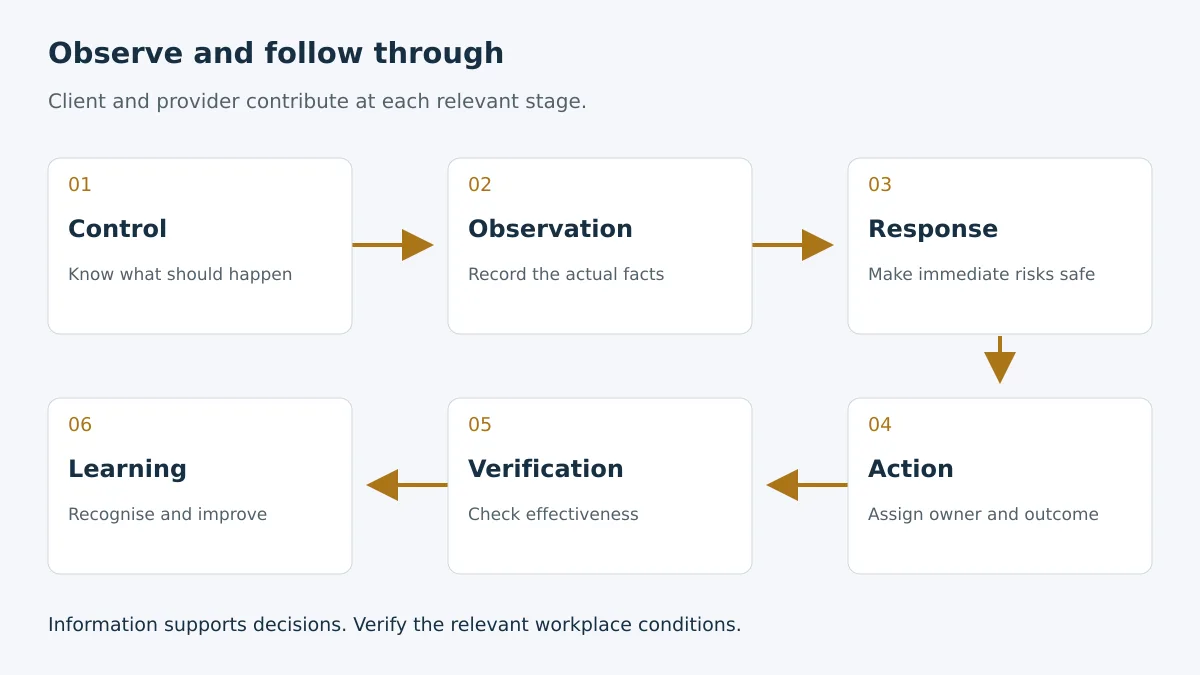
Follow the sequence and verify the evidence supporting each decision.
Observe both the supervisor and the work team
A useful programme asks two connected questions. First, is the supervisor managing the conditions needed for safe work? Second, is the work team applying the relevant controls? Looking only at the worker can miss a planning or resource failure upstream.
For the supervisor, evidence may concern access, coordination, communication, readiness, permit conditions and response to change. For the team, evidence may concern the actual task sequence, use of available controls and reporting of unexpected conditions. Keep observations specific to the work and within the observer’s competence.
This approach can support the client’s own employee programme as well as contractor management. The same discipline applies: understand the task, verify controls, record facts and follow through. Contractors are part of the workplace interface, not a separate reason to abandon consistent management principles.
Separate safe acts, unsafe acts and unsafe conditions
| Observation | Immediate management question | Useful response |
|---|---|---|
| Safe act | Which relevant control was correctly applied? | Record the fact and recognise its practical value |
| Unsafe act | Was the control available, understood and workable? | Restore safety and examine the evidenced reasons |
| Unsafe condition | What control is missing, unsuitable or ineffective? | Correct the condition and its management cause |
| Uncertain evidence | What could not be verified? | Record the limitation and arrange the necessary check |
These distinctions help avoid premature blame. If safe access is unavailable, coaching someone to “take ownership” does not create the access. If a worker reports a change and waits for direction, that action may deserve recognition even when it delays the job.
Where both behaviour and conditions contributed, record both. A fair explanation can acknowledge a poor decision while also identifying inadequate instructions, production pressure or an impractical method. The objective is an effective correction supported by evidence.
A barrier that keeps moving
Consider a fictional loading area where temporary pedestrian barriers are repeatedly displaced. The first action is a driver briefing. It is marked complete, but the next delivery produces the same problem.
The review asks whether the briefing happened and whether the control worked. Those are different questions. Observation shows that the unloading method leaves insufficient turning space and the temporary barrier is easily moved. The client and contractor review the layout, delivery sequence and physical separation, then verify the revised arrangement during comparable deliveries.
The provider gains a workable route instead of repeated criticism for an unresolved interface. The client gains evidence that a control remains effective in use. A completed action becomes meaningful because the intended condition has actually been checked.

Changes at the workface need communication between both organisations.
Use MES after immediate risk is controlled
MES means Mindset Evolution Schema. It supports respectful recognition, coaching and development grounded in observed facts. Begin with the task, required control and what happened. Then explore what information, resources, understanding or assumptions influenced the decision.
Ask questions that allow a real answer: what changed, what did the person understand and what made the agreed method difficult? Do not infer personality, diagnose someone or convert a single observation into a permanent character judgement. Evidence not observed is a limitation, not a negative score.
A development action needs an owner, a practical next step and follow-up. Recognition should name the observed action and its effect, such as a team leader pausing when a boundary changed. Keep private coaching information appropriately controlled and separate from public appreciation.
This makes behaviour based safety part of risk management rather than an alternative to it. The working connection is:
Apply that connection with care and evidence.
Turn a finding into an effective action
Record the relevant fact, location, time, task and control. State the immediate response and the condition that must be achieved. Assign a responsible person, due date, resources and verification method. “Be more careful” rarely defines a usable corrective action.
OHS Online supports observations, inspections, action tracking and evidence. Software gives visibility, but visibility is not the same as control. An overdue action requires follow-up; a completed action requires evidence appropriate to the problem. A field recheck may be needed to establish effectiveness.
Incident reporting, emergency response and contractual performance management are separate routes that may all apply. Entering an event in the system does not itself fulfil every legal reporting requirement. Use the applicable law and approved procedures to determine what must happen and who is responsible.

Relevant authorised information supports decisions and follow-up by both organisations.
The SafetyWallet model: one platform, multiple layers of support
SafetyWallet combines a SaaS subscription, OHS Online, methods, learning and support. Triple P—Policies, Procedures and Practices connects management expectations to procedures and the work being observed.
Task assessments define the control baseline; registers allocate recurring activities; JSO checks implementation; MES supports evidence-based development. Expert health and safety support and approved Partners assist within agreed scope. My Safety Hub and eLearning support role understanding. The SafetyWallet Shop, also known as My Safety Shop, provides relevant products and services.
Together they support a practical health and safety management system and health and safety compliance in South Africa. ISO 45001 support in South Africa can assist system development, with certification determined separately.
The shared value of ongoing management
Clients gain earlier visibility of changing conditions and clearer action ownership. Contractors gain useful feedback, recognition for sound decisions and a fairer distinction between their performance and client-controlled obstacles. Suppliers attending site gain the same clarity when delivery or installation conditions change.
Consenting providers can become discoverable through the subscriber Directory. Qualifying subscribers can earn active-management reward discounts on eligible ecosystem purchases. Observations support genuine ongoing management, but a count of inspections or uploaded documents alone does not prove reward eligibility.
Book a SafetyWallet demo to discuss how supervision evidence, JSO and corrective actions can support both parties.
Software only vs consultant only vs the SafetyWallet model
| Approach | What it solves | What it often misses | Best use | Long-term result |
|---|---|---|---|---|
| Software only | Makes findings visible | Corrective field action | Supporting owners | Depends on follow-up |
| Consultant only | Adds expert observation | Every work phase | Defined assistance | Depends on local supervision |
| Safety file/document approach | Records expected practice | What actually happens | Reference for checks | Needs live observation |
| SafetyWallet model | Connects software, training, support, risk, controls, behaviour and accountability | Still needs employer action | Building supervisory ownership | Supports sustained improvement |