The job finished on time and nobody was injured. That sounds reassuring until the review finds an unresolved isolation question, a late change to the scope and a near miss that was never followed up. Completion tells only part of the performance story.
A useful review examines how the work was planned, controlled and improved. It includes the client’s contribution as well as the provider’s. The SafetyWallet platform helps bring relationship records, observations and actions together so the next appointment can be informed by evidence.
Review contractor and supplier performance against the agreed scope, relevant controls, actual work and verified outcomes. Consider severity, recurrence, response quality and client-controlled obstacles. Record the reasons for continuing, conditioning or restricting a relationship, using the authorised contractual process. OHS Online supports evidence and follow-up; the responsible people make the decision and verify improvement.

Review evidence and both parties’ contributions before deciding what changes.
Why the review has legal significance
The OHS Act’s section 8 duty includes maintaining safe systems and relevant precautions, while section 9 addresses affected non-employees. Those are ongoing responsibilities. Information showing that a control repeatedly fails is relevant to what the organisations need to address next. Source: OHS Act, sections 8 and 9.
The Act does not make one universal quarterly supplier scorecard the answer for every business. Review timing and evidence should reflect the work, risk, applicable regulations and contractual arrangements. Serious findings may require immediate action rather than waiting for a scheduled meeting.
Section 37 arrangements may help define how the parties coordinate and respond, but an agreement must not be treated as a reason to ignore known failures. Likewise, a commercial review does not replace statutory incident reporting or investigation where applicable. Keep the relevant legal and management processes connected without assuming they are interchangeable.
What we see repeatedly in South African workplaces
Review weaknesses worth testing include counting documents instead of checking controls, treating every finding as equally serious, and assessing contractors without considering late client instructions. Another trap is assuming that no reported incident means the arrangements worked reliably.
A fair review asks what work occurred, which controls were tested, what was found and how the parties responded. It should also state the limits of the evidence. If a critical activity was never observed, record that gap instead of turning it into a positive score.
Discuss contractor performance reviews with SafetyWallet if your current reports show activity but do not help management decide what to change.
Define the review before comparing performance
Identify the relationship, sites, scope and period. Note changes in work volume, task risk, personnel, products or subcontracting. A provider completing a few routine deliveries should not be compared mechanically with one performing a complex shutdown.
Choose evidence that answers the important questions. Readiness reviews, inspections, JSO records, permits where applicable, product discrepancies, incidents, corrective actions and handovers may all contribute. Assess their reliability and relevance rather than treating every uploaded item as equally useful.
Use task-based risk assessments to establish which controls matter most. The review should reveal whether those controls were implemented and maintained, and whether the assessment itself needs revision after workplace learning.
Follow the relationship through its lifecycle
| Stage | Review question | Evidence to consider |
|---|---|---|
| Planning and selection | Was the scope clear and capability evaluated? | Scope, requirements and selection reasons |
| Onboarding and readiness | Were the actual team and resources prepared? | Relevant information, induction and readiness decisions |
| Execution and change | Did the work remain within agreed conditions? | Observations, change decisions and applicable permits |
| Corrective action | Were failures resolved effectively? | Completion evidence and follow-up verification |
| Handover and learning | Was the outcome safely accepted and learning applied? | Defects, acceptance records and revised arrangements |
This approach helps the provider understand how the conclusion was reached. It also exposes missing client decisions. An overdue contractor action may depend on a drawing, access approval or shutdown date that only the client can provide.
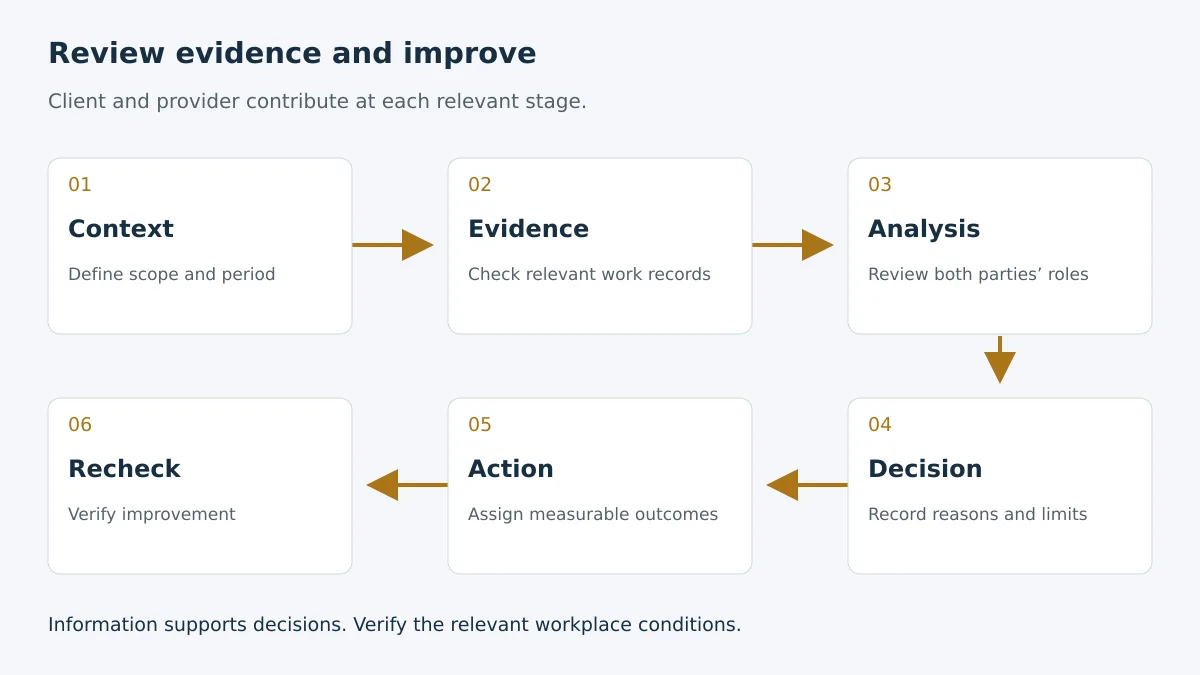
Follow the sequence and verify the evidence supporting each decision.
Use measures that explain decisions
Add context to counts
A count of findings is difficult to interpret without work volume, risk and observation coverage. More reported findings may reflect more effective detection rather than worsening behaviour. Less reporting may mean fewer problems, less work or less willingness to speak up.
Choose measures with a clear purpose. For example, examine whether critical actions were verified effective, whether material changes were reviewed before implementation, or whether repeated product discrepancies were resolved. State the denominator or scope where a percentage is used.
Separate completion from effectiveness
An action can be completed as written and still fail to solve the problem. A toolbox talk may occur while the unsafe access arrangement remains unchanged. A replacement document may be current while the equipment it concerns is no longer the item on site.
Ask what condition the action was intended to achieve and what evidence demonstrates that condition. Where the result depends on actual work, use an appropriate recheck. This distinction protects both parties from repeatedly completing low-value actions that do not improve the interface.
Avoid rewarding silence
Treat honest reporting and timely escalation as useful management behaviours. Do not make the absence of reported events the sole basis for rewards or approval. A contractor that identifies and stops a material change may be helping the client avoid harm, even when the report creates additional work.
Review the client’s contribution fairly
Ask whether the client provided accurate site information, a realistic programme, timely decisions and the resources it agreed to supply. Check whether procurement or operational changes undermined the planned method. These questions do not excuse contractor failures; they help identify what must change to prevent recurrence.
Give the provider an opportunity to clarify material facts through the applicable process. Distinguish disagreement about evidence from refusal to act. Record unresolved technical or contractual issues for the authorised decision-maker rather than allowing a dashboard score to settle them implicitly.
Where a relationship may be restricted, suspended or terminated, follow the contract, delegated authority and applicable legal process. Safety concerns can require immediate protective action, but a platform status is not a substitute for the relevant operational and contractual decisions.
A shutdown that succeeded on the clock
In a fictional factory, a contractor completes the shutdown before Monday. The review finds that the client issued a vague scope, the contractor introduced a subcontractor without timely disclosure, and a supplier substitution was stopped before use. No injury occurred.
A useful conclusion acknowledges the completed work and the positive decision to stop the substitution. It also assigns corrections to the weak scope, subcontractor communication and change process. The next appointment depends on clear evidence that the relevant conditions have improved.
The contractor gains recognition for a sound intervention without having the other gaps overlooked. The client receives a realistic account of its own role. Both can focus on the next controlled outcome rather than defending a simplistic success or failure label.

Use review findings to improve the next briefing and work arrangement.
Turn findings into a management decision
Decide whether the relationship can continue, needs measurable conditions, requires a restriction or should be referred for another authorised outcome. Explain the scope of the decision. A problem affecting one activity does not automatically establish that every service the organisation provides is unsuitable.
For each material improvement, specify the condition to achieve, owner, due date, resources and verification. Agree the next review trigger. A practical report should make the outstanding management decision visible rather than burying it in a large attachment.
A one-page executive summary can cover the work reviewed, critical risks, significant exceptions, both parties’ contributions, the recommended decision and the follow-up plan. Detailed records remain available for verification. Management needs enough evidence to understand the decision and its limitations.
Use MES for learning and recognition
MES, the Mindset Evolution Schema, supports evidence-based recognition, coaching and development after immediate risks are controlled. Begin with the observed task and control. Explore what understanding, assumptions, resources or system conditions influenced the action.
Recognise specific useful behaviour, such as a supervisor reporting an unexpected energy source and waiting for review. Avoid using one observation as a permanent character label or turning private coaching information into a supplier ranking. This approach to behaviour based safety supports learning while protecting fair treatment.
How OHS Online supports the review
OHS Online helps maintain relationship requirements, shared information, observations, actions and evidence. Connected SafetyWallet providers can keep applicable authorised programme information current in the client’s view. External providers maintain requested documents manually through the upload portal.
Software gives visibility, but visibility is not the same as control. A visible trend needs interpretation. An overdue action needs follow-up. A relationship decision needs an authorised owner who understands the scope and evidence. The system supports accountability rather than replacing judgement.

Relevant authorised information supports decisions and follow-up by both organisations.
The SafetyWallet model: one platform, multiple layers of support
SafetyWallet combines a SaaS subscription, OHS Online, methods, learning and support. Triple P—Policies, Procedures and Practices connects review findings to revised commitments, procedures and actual work.
Task assessments identify controls, registers allocate responsibilities, and JSO provides feedback from practice. MES supports development. Expert health and safety support and approved Partners assist within scope. My Safety Hub and eLearning support understanding. The SafetyWallet Shop, also known as My Safety Shop, offers relevant products and services.
Together these support a health and safety management system, health and safety compliance in South Africa and continued improvement. ISO 45001 support in South Africa supports system development, with certification assessed separately.
Benefits that grow with a well-managed relationship
Clients gain better evidence for repeat appointments and clearer priorities for improvement. Contractors and suppliers gain predictable criteria, an opportunity to explain constraints and recognition for reliable responses. Reviews can reduce repeated disputes by clarifying what good performance looks like.
Directory participation helps consenting providers become discoverable to logged-in subscribers. Qualifying active management may earn reward discounts on eligible ecosystem purchases. A positive review score alone does not qualify, and the reward must never encourage overlooking a critical gap.
Book a SafetyWallet demo to explore how relationship evidence can support useful performance decisions.
Software only vs consultant only vs the SafetyWallet model
| Approach | What it solves | What it often misses | Best use | Long-term result |
|---|---|---|---|---|
| Software only | Organises trends | Interpretation and action | Supporting reviewers | Depends on decisions |
| Consultant only | Adds review expertise | Daily implementation | Defined independent input | Depends on follow-through |
| Safety file/document approach | Preserves records | Effectiveness and change | Evidence for review | Needs context |
| SafetyWallet model | Connects software, training, support, risk, controls, behaviour and accountability | Still needs employer decisions | Building internal ownership | Supports lasting improvement |