The replacement hose fits the connection, so it is accepted into stores. Later, someone notices that its temperature rating differs from the approved specification. The supplier called it equivalent. No one recorded who was competent to approve that substitution.
Supplier management begins before delivery and continues into use, maintenance and change. The SafetyWallet platform helps organisations connect product and service requirements to evidence and follow-up, while the supplier and client retain the duties relevant to their roles.
Supplier assurance means defining the intended use, selecting an appropriate source, checking the exact item and its information, controlling introduction into the workplace and responding to defects or changes. Section 10 of the OHS Act addresses specified duties for articles and substances used at work. Requirements should follow the product, activity and risk; a routine delivery and an equipment installation need different controls.

An equivalent replacement still needs approval against the intended service.
Section 10 makes the product itself important
Section 10(1) addresses people who design, manufacture, import, sell or supply an article for use at work. Within its reasonably practicable standard, it concerns safety when properly used and compliance with prescribed requirements. Section 10(2) addresses erection or installation that could make an article unsafe or create health risks when properly used. Source: OHS Act, section 10.
Section 10(3) deals with substances for use at work, including safety when properly used and relevant information about use, risks, safe conditions and accident procedures. This is why identifying the exact chemical and obtaining usable safety information matters before workplace exposure occurs.
Section 10(4) provides a specific mechanism concerning written undertakings to take sufficient specified steps, with a limited effect determined by its terms. Do not treat it as a general permission for suppliers to disclaim all duties. Section 41 and the actual facts also need consideration. Obtain competent advice for a particular undertaking or dispute.
The client employer still needs to manage its own use, handling, storage and work systems under applicable duties. A supplier’s certificate does not decide whether the client’s installation, training or maintenance arrangements are suitable. Supplier assurance and employer risk management must connect.
What we see repeatedly in South African workplaces
The gaps to test include vague purchase specifications, different products delivered under a familiar description, certificates without a model or batch reference, and safety information stored where the people using the product cannot find it.
Another common management trap is treating the invoice as the final control point. A delivered item may still need inspection, technical acceptance, installation, commissioning, instruction or controlled storage. Commercial receipt and permission to use should be distinguished where the risk requires it.
Discuss supplier assurance with SafetyWallet if your receiving team is expected to accept safety-critical items without usable acceptance criteria.
Classify the supply before choosing the checks
| Supply or activity | Main questions | Typical management focus |
|---|---|---|
| Routine delivery | Can the vehicle and people move safely? | Access, parking, unloading and receipt |
| Replacement equipment | Is the exact item suitable for its intended service? | Specification, compatibility and technical acceptance |
| Hazardous substance | Is identity and safety information sufficient for the intended use? | Exposure, storage, handling and emergency planning |
| Supply with installation | How will the product and on-site work be controlled? | Supplier assurance plus contractor work control |
A company may occupy more than one role. A refrigeration supplier delivering a compressor, removing equipment and recommissioning a system creates product and work interfaces. Describing it as “a supplier” does not settle the controls for all those activities.
Use task-based risk assessments for the relevant receiving, handling, storage, installation and operating tasks. Include the actual environment and affected people. The assessment should inform what Procurement specifies and what the receiver verifies.
Write an acceptance specification before ordering
Identify the intended use, service conditions, users, connected equipment and safety-critical performance. Specify the relevant information, traceability, installation and maintenance needs. Where a prescribed standard, approval or specialist assessment applies, identify it accurately with competent input.
For a replacement component, appearance and dimensions may not establish compatibility. Consider the requirements relevant to the service, such as material, pressure, temperature, chemical compatibility, fittings and manufacturer instructions. This is not a universal engineering checklist; the responsible competent person determines the actual acceptance criteria.
Ask the supplier to disclose proposed alternatives before dispatch. Record who can approve a substitution and what evidence is needed. A clear specification helps the supplier quote accurately and avoids disputes when a lower-cost alternative does not meet the intended requirement.
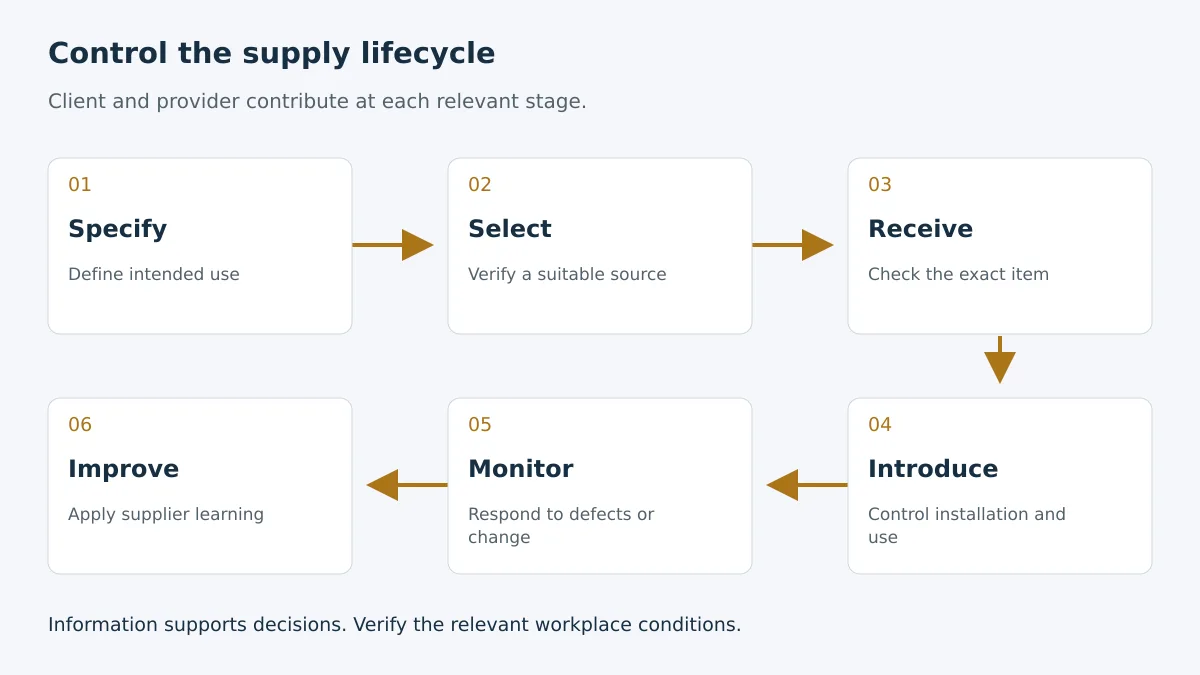
Follow the sequence and verify the evidence supporting each decision.
Make receiving an informed control point
The receiving person needs a practical way to identify the approved item and recognise a discrepancy. Depending on the supply, check model, batch or serial details, condition, packaging, quantity, accompanying information and any specified acceptance evidence.
When something does not match, follow the approved segregation or quarantine process so it cannot be used inadvertently. Record the discrepancy and notify the responsible buyer or technical reviewer. A delivery signature should not be allowed to imply technical acceptance that the receiver was not authorised or competent to give.
Preserve traceability where necessary. If an affected batch has already been issued, the organisation needs to identify where it went and who must be informed. Records should support the actual response, not just demonstrate that a document was uploaded.

Receiving is a control point when the team has clear acceptance criteria.
Chemicals require usable information and workplace assessment
Obtain the relevant current safety information for the exact product, including a safety data sheet where applicable. Check that the identity matches the delivered container and that the information is available to those who need it. Review the specific legal requirements applying to the substance and activity.
The supplier’s information informs the employer’s assessment; it does not complete it. Actual quantities, application methods, ventilation, storage, incompatible materials, exposure routes and emergency arrangements can change the risk. Competent assessment may be required before use.
A substitution should trigger review before introduction. “Same purpose” does not establish the same hazard profile or control requirements. Explain the approval route to suppliers so they can propose alternatives constructively rather than leaving the receiving team to discover the change.
An equivalent hose that needs a decision
In a fictional maintenance store, a supplier delivers a hose with the correct diameter but different temperature rating and end fitting. The buyer is under pressure to complete a repair, and the supplier describes the item as an equivalent replacement.
The receiving team separates the item from approved stock and refers it for competent review against the intended service. The reviewer compares the relevant technical requirements and connected equipment. If the alternative is acceptable, the approval and affected maintenance information are updated. If it is not, the item is returned through the agreed process.
The supplier benefits from knowing why the item cannot simply be accepted. The client avoids allowing urgency to substitute for technical judgement. Both gain a traceable decision that can improve the next order and reduce repeated disagreement.
Manage defects and changes after delivery
Agree how the supplier will communicate material changes and known defects. Define the client’s route for stopping use, identifying affected items, notifying relevant people and arranging correction or replacement. Where a recall or regulatory process applies, follow that process with competent advice.
A corrective action should address the cause as well as the individual item. If the purchase description allowed several incompatible products, the client may need to improve its specification. If the supplier repeatedly substitutes without approval, the relationship needs a performance response.
Review what happened and whether the correction worked. A replacement delivery may resolve the immediate shortage while leaving the same communication failure in place. Supplier assurance is stronger when both organisations examine their contribution to the outcome.
How OHS Online supports supplier assurance
OHS Online structures the relationship, risk-based information requirements, records, reminders and follow-up. A connected SafetyWallet supplier can authorise relevant programme information sharing with clients. Applicable updates become visible through that connection. External suppliers maintain requested information manually through the upload portal.
Keep the exact product or activity context with the evidence. A company-level file does not automatically validate every batch or component it supplies. Preserve the original issuer or regulator record as authoritative where applicable, and use competent technical verification when the decision requires it.
Software gives visibility, but visibility is not the same as control. Someone must inspect the delivery, assess the discrepancy and prevent an unapproved item from entering use. The system supports the responsible person’s work rather than making the technical decision.

Relevant authorised information supports decisions and follow-up by both organisations.
The SafetyWallet model: one platform, multiple layers of support
SafetyWallet combines a SaaS subscription, OHS Online, methods, learning and support. Triple P—Policies, Procedures and Practices connects purchasing commitments to receiving procedures and actual workplace practice.
Task assessments establish controls, registers assign recurring checks, and inspections or JSO test implementation. MES, the Mindset Evolution Schema, supports recognition and development after risks are controlled. This approach to behaviour based safety can recognise a receiver who reports a discrepancy instead of accepting an unsupported assurance.
Expert health and safety support and approved Partners assist within scope and competence. My Safety Hub and eLearning support role understanding. The SafetyWallet Shop, also known as My Safety Shop, offers relevant products and services.
These elements support a health and safety management system and health and safety compliance in South Africa. ISO 45001 support in South Africa supports system development without promising certification.
A clearer relationship benefits both organisations
Clients gain better acceptance decisions, traceability and change control. Suppliers gain clearer specifications, proportionate information requests and a fair basis for resolving discrepancies. Consenting suppliers can also become discoverable to logged-in subscribers through relevant Directory categories and keywords.
Qualifying subscribers can earn active contractor and supplier management reward discounts on eligible ecosystem purchases. The reward is for genuine ongoing management, not simply listing a supplier or storing a certificate. It does not automatically reduce the supplier’s external invoice.
Book a SafetyWallet demo to explore how supplier requirements and follow-up can connect to your wider programme.
Software only vs consultant only vs the SafetyWallet model
| Approach | What it solves | What it often misses | Best use | Long-term result |
|---|---|---|---|---|
| Software only | Stores product information | Exact item verification | Supporting traceability | Depends on acceptance checks |
| Consultant only | Adds specialist assessment | Routine receipt and change | Defined technical input | Depends on implementation |
| Safety file/document approach | Collects certificates | Product identity and use | Supporting assurance | Needs contextual review |
| SafetyWallet model | Connects software, training, support, risk, controls, behaviour and accountability | Still needs competent decisions | Building supplier assurance | Supports continuous improvement |